


They are wriggly, they are gross and they are worth more than US$2,000 a pound. Soon, fishers might be able to catch thousands of pounds of them for years to come.
Baby eels, also called elvers, are likely the most valuable fish in the US on a per-pound basis — worth orders of magnitude more money at the docks than lobsters, scallops or salmon. That is because they are vitally important to the worldwide supply chain for Japanese food.
The tiny fish, which weigh only a few grams, are harvested by fishers using nets in rivers and streams. The only state in the country with a significant elver catch is Maine, where fishers have voiced concerns in the past few months about the possibility of a cut to the fishery’s strict quota system.
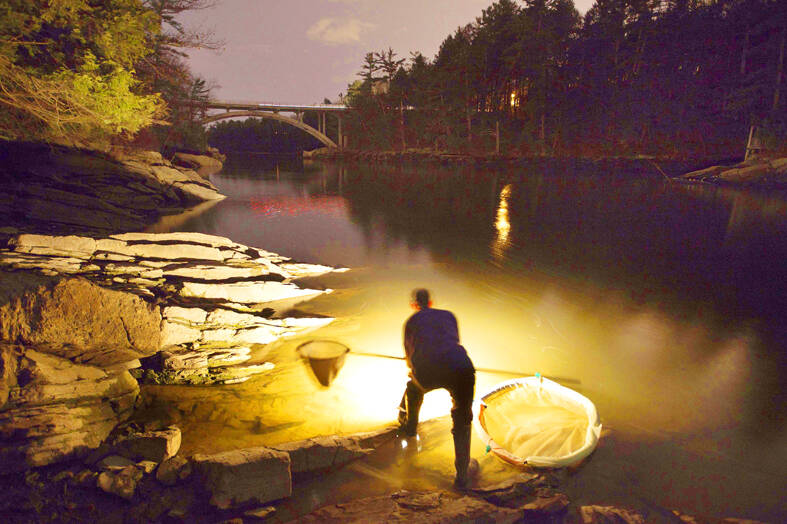
Photo: AP
An interstate regulatory board that controls the fishery has released a plan to potentially keep the elver quota at its current level of a little less than 10,000 pounds (4,536kg) a year with no sunset date.
Fishers who have spent years touting the sustainability of the fishery are pulling for approval, Maine Elver Fishermen Association director Darrell Young said.
“Just let ‘er go and let us fish,” Young said. “They should do that because we’ve done everything they’ve asked, above and beyond.”
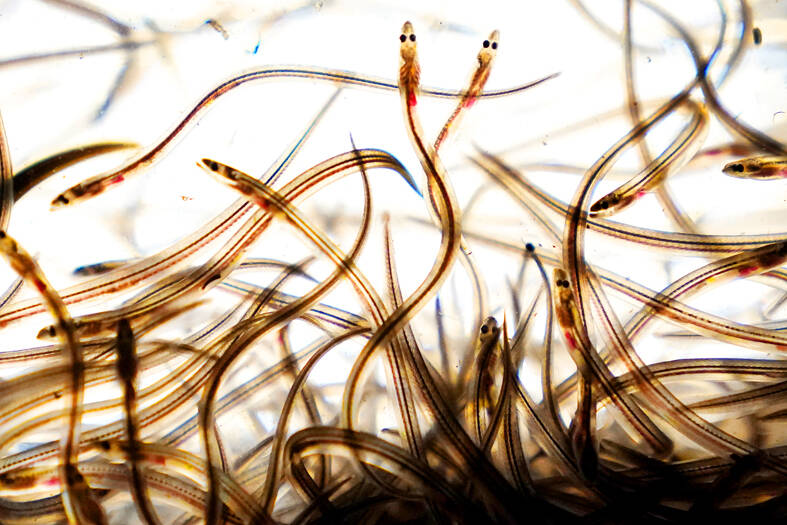
Photo: AP
A board of the Atlantic States Marine Fisheries Commission is scheduled to vote on a new quota system for the eel fishery on May 1. The board could also extend the current quota for three years.
The eels are sold as seed stock to Asian aquaculture companies that raise them to maturity so they can be used as food, such as kabayaki, a dish of marinated, grilled eel. Some of the fish eventually return to the US where they are sold at sushi restaurants.
The eels were worth US$2,009 a pound last year — more than 400 times more than lobster, Maine’s signature seafood. The state has had an elver fishery for decades, but its eels became more valuable in the early 2010s, in part, because foreign sources dried up.
The International Union for Conservation of Nature lists the European eel as more critically endangered than the US eel, although some environmental groups have pushed for greater conservation in the US.
Since booming in value, elvers have become the second-most valuable fish species in Maine in terms of total value. The state has instituted numerous new controls to try to thwart poaching, which has emerged as a major concern as the eels have increased in value.
The elver quota remaining at current levels reflects “strong management measures we’ve instituted here in Maine,” Maine Department of Marine Resources Commissioner Patrick Keliher said.
A quota cut “could have been a loss of millions of dollars in income for Maine’s elver industry,” he said.
This year’s elver season starts next week. Catching the elvers is difficult and involves setting up large nets in Maine’s cold rivers and streams at predawn hours.
That has not stopped new fishers from trying their hand in the lucrative business. The state awards to right to apply for an elver license through a lottery, and this year more than 4,500 applicants applied for just 16 available licenses.
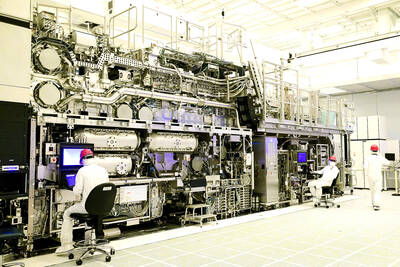
ASML Holding NV’s new advanced chip machines have a daunting price tag, said Taiwan Semiconductor Manufacturing Co (TSMC, 台積電), one of the Dutch company’s biggest clients. “The cost is very high,” TSMC senior vice president Kevin Zhang (張曉強) said at a technology symposium in Amsterdam on Tuesday, referring to ASML’s latest system known as high-NA extreme ultraviolet (EUV). “I like the high-NA EUV’s capability, but I don’t like the sticker price,” Zhang said. ASML’s new chip machine can imprint semiconductors with lines that are just 8 nanometers thick — 1.7 times smaller than the previous generation. The machines cost 350 million euros (US$378 million)

Apple Inc has closed in on an agreement with OpenAI to use the start-up’s technology on the iPhone, part of a broader push to bring artificial intelligence (AI) features to its devices, people familiar with the matter said. The two sides have been finalizing terms for a pact to use ChatGPT features in Apple’s iOS 18, the next iPhone operating system, said the people, who asked not to be identified because the situation is private. Apple also has held talks with Alphabet Inc’s Google about licensing its Gemini chatbot. Those discussions have not led to an agreement, but are ongoing. An OpenAI

INSATIABLE: Almost all AI innovators are working with the chipmaker to address the rapidly growing AI-related demand for energy-efficient computing power, the CEO said Taiwan Semiconductor Manufacturing Co (TSMC, 台積電) yesterday reported about 60 percent annual growth in revenue for last month, benefiting from rapidly growing demand for artificial intelligence (AI) and high-performance computing applications. Revenue last month expanded to NT$236.02 billion (US$7.28 billion), compared with NT$147.9 billion in April last year, the second-highest level in company history, TSMC said in a statement. On a monthly basis, revenue surged 20.9 percent, from NT$195.21 billion in March. As AI-related applications continue to show strong growth, TSMC expects revenue to expand about 27.6 percent year-on-year during the current quarter to between US$19.6 billion and US$20.4 billion. That would

‘FULL SUPPORT’: Kumamoto Governor Takashi Kimura said he hopes more companies would settle in the prefecture to create an area similar to Taiwan’s Hsinchu Science Park The newly elected governor of Japan’s Kumamoto Prefecture said he is ready to ensure wide-ranging support to woo Taiwan Semiconductor Manufacturing Co (TSMC, 台積電) to build its third Japanese chip factory there. Concerns of groundwater shortages when TSMC’s two plants begin operations in the prefecture’s Kikuyo have spurred discussions about the possibility of tapping unused dam water, Kumamoto Governor Takashi Kimura said in an interview on Saturday. While Kimura said talks about a third plant have yet to occur, Bloomberg had reported TSMC is already considering its third Japanese fab — also in Kumamoto — which would make more advanced chips. “We are


 RSS
RSS