


Hon Hai Precision Industry Co (鴻海精密) yesterday revised its revenue outlook for this year to “significant” growth from a “neutral” view forecast five months ago, due to strong demand for artificial intelligence (AI) servers from cloud service providers.
Hon Hai, a major assembler of iPhones that is also known as Foxconn, expects AI server revenues to soar more than 40 percent annually this year, chairman Young Liu (劉揚偉) told investors.
The robust growth would uplift revenue contribution from AI servers to 40 percent of the company’s overall server revenue this year, from 30 percent last year, Liu said.
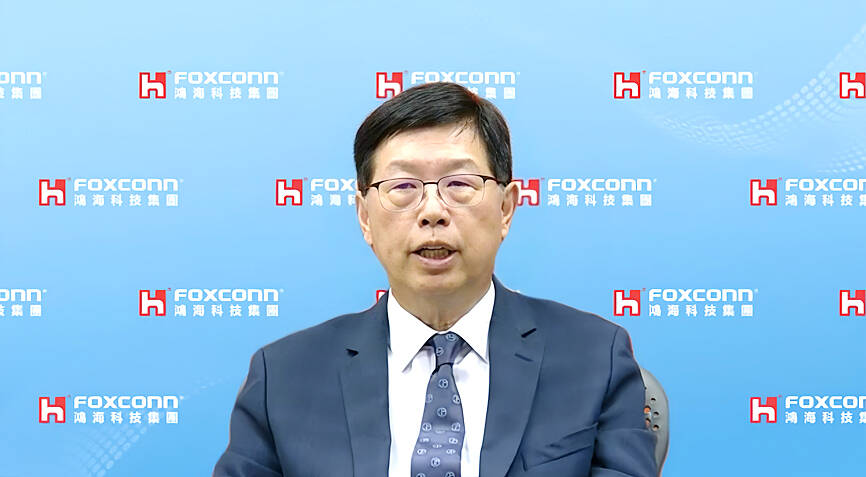
Photo: screen grab from the Internet
In the three-year period from last year to next year, Hon Hai’s AI server revenue growth is to match, or even outpace, the world market’s annual growth rate of 30 percent, he said.
“Since we feel the exceptionally strong AI server demand, we forecast AI servers would be the major growth drivers this year,” Liu said. “In addition to CSP [cloud server provider] customers, electronics brands also aggressively embarked on new efforts to develop AI servers.”
Hon Hai is primed to vie for a 40 percent share in the global AI server market, Liu said.
The company has strong capabilities of providing key components including high-speed switches and liquid cooling technology to address the high amount of heat generated by servers, he said.
Liquid cooling is considered a more efficient technology for heat transfer than traditional air-cooled systems.
As a major supplier of graphics processing unit (GPU) modules used in AI servers, Hon Hai aims to triple its GPU module shipments this year from last year, Liu said.
Given the company’s deep partnerships with Nvidia Corp, he is set to attend Nvidia’s annual technology conference, GTC 2024, next week, Liu said.
Hon Hai is to unveil several new AI servers during the conference, he added.
The smartphone business should see a flat revenue growth this year as market demand gradually recovers from a slump last year, Liu said.
Computer business would also show little change in revenue this year, as new AI-enabled models and the introduction of new operating systems would stimulate replacement demand, he said.
However, the components business, benefiting from robust demand for components used in electric vehicles and market share gains for its components used in electronic gadgets, would see strong year-on-year growth this year, the firm said.
In the short term, Hon Hai expects a mild revenue decline this quarter on an annual basis, as the smartphone business is to see a decline due to seasonal weakness and a high base last year, it said.
Hon Hai yesterday reported a net profit for last year of NT$142.1 billion (US$4.51 billion), compared with NT$141.48 billion the previous year.
Earnings per share edged up to NT$10.25 last year from NT$10.21 in 2022, marking the firm’s best performance in about 16 years.
Gross margin improved to 6.3 percent last year from 6.04 percent the previous year, the company said.
The company’s board of directors has approved a cash dividend distribution of NT$5.4 per share, which represents a payout ratio of 53 percent — the highest since 1991, it said.
Hon Hai said it also made progress in the electric vehicle business. At home, the company has received more than 9,000 orders for Luxgen N7 electric vehicles, which is based on the Model C prototype developed by Foxtron, it said.
It aims to ship more than 10,000 N7s this year, it added.
The Model C would become available in the US and Southeast Asia at the end of next year at the earliest, Hon Hai said, adding that it plans to start accepting orders for its new Model B by the end of this year.

Cairo’s new monorail slices across the city skyline, running above the familiar chaos of blaring horns and aging buses’ exhaust fumes that mark rush hour below. The US$4.5 billion monorail, opened this month, is among Egypt’s most prominent new transport projects, part of a debt-funded infrastructure drive criticized for sapping state finances while bringing limited benefits to most of the country’s 109 million people. “It feels like you’re in a different country,” said Ramy Sayed, a restaurant manager, aboard a driverless Innovia 300 train. “No noise, no traffic, we’re not used to this.” The eastern line runs 56km from the bustling middle-class
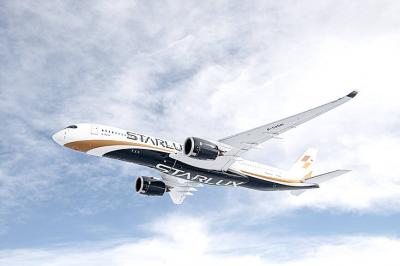
Starlux Airlines Co (星宇航空) today unveiled a long-haul network expansion plan at a shareholders’ meeting in Taipei, including direct flights to Barcelona, Spain, and Zurich, Switzerland, as well as a service connecting Taipei, Sydney and New Zealand. Starlux is to become the first Taiwanese carrier to offer non-stop services to the two European cities, while the inaugural oceanic route is expected to expand transit opportunities within the Australia-New Zealand market, Starlux said. Flight services to Chicago, Dallas, Washington and New York are under evaluation, the airline added. Prior to the shareholders’ meeting, the airline earlier this year announced that it would be

Taiwanese firms have increased investment in the Philippines in recent years as Manila’s ties with Washington deepen and global supply chains continue to shift away from China, an expert at the Chung-Hua Institution for Economic Research (CIER, 中華經濟研究院) said yesterday. The Philippines had not been among Taiwanese investors’ top choices in Southeast Asia, CIER Taiwan ASEAN Studies Center director Kristy Hsu (徐遵慈) said at a seminar in Taipei. However, Taiwan’s investment in the country has grown significantly since the COVID-19 pandemic, reaching US $257 million last year, a high in recent years, she said. Although Taiwan’s total investment in the Philippines still lags

Taiwanese prosecutors suspect that three people successfully smuggled at least one shipment of Nvidia Corp artificial intelligence (AI) chips to China after first exporting them to Japan, people familiar with the matter said. The trio was detained last week by the Keelung District Prosecutors’ Office for allegedly falsifying documents related to exports of Super Micro Computer Inc servers containing advanced Nvidia chips, which the US has barred from sale to China without a license from Washington. The move marked Taiwan’s first public crackdown on AI chip diversion after years of pressure from the US to take a more active role in curtailing


 RSS
RSS