


On a corner by the entrance to Tunis zoo, Leila waits for a hot meal from the Tunisian capital’s “Restaurant of Love” in a cardboard shelter where she and her dogs sleep.
The 50-year-old said she has been living on the streets for more than 27 years.
“I don’t want to go to the shelter centers,” and feels safer in her makeshift abode, despite the dangers of robbery and violence on the street, she said as she fixed a plastic cover over her bed for the cold winter night.
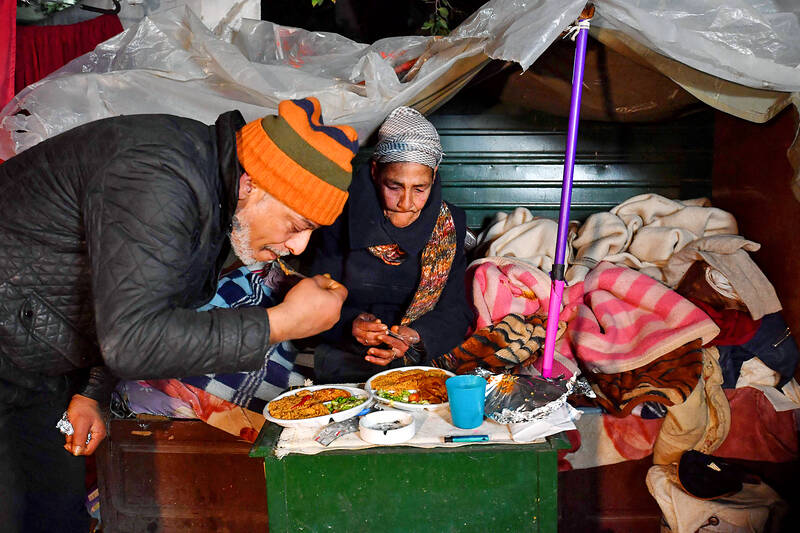
Photo: AFP
Leila is always happy to see the volunteers from the NGOs Universelle and Samu Social when they bring her food and clothing every Friday night.
For the rest of the week, she often has to make do with no more than a tin of sardines.
The Friday night meal is from the kitchen of the “Restaurant of Love,” a charitable initiative launched by Universelle three years ago to help feed the growing number of Tunis’ homeless.

Photo: AFP
There is no official data on the exact number of people living on the streets in the capital, but it is estimated to be in the hundreds.
The “Restaurant of Love” is the “first of its kind” in Tunisia, said Nizar Khadhari, the 39-year-old head of Universelle.
The idea is simple — a regular eatery affordable for everyone, with a plate of pasta costing just 4.5 dinars or US$1.40. Homeless people can eat there for free — accounting for around 30 percent of the 400 to 450 meals served there every day. But paying customers can also make donations in a tin by the cash register to help cover the costs.

Photo: AFP
“All profits go to the homeless, and we also employ some of them... We try to motivate them to return and integrate into society,” Khadhari said.
“The economic situation is hitting this vulnerable group of people particularly hard,” said Khadhari, who predicts that the number of rough sleepers in the capital will continue to grow “due to rising prices and a lack of job opportunities.”
According to World Bank data, growth of the North African country’s highly indebted economy stood at just 1.2 percent last year, while inflation stood at 8.3 percent in 2022. And with the economic woes exacerbated by the COVID-19 pandemic and soaring food prices in the wake of the war in Ukraine, poverty rates are on the rise in the population of 12 million.
According to official statistics, the poverty rate in Tunisia stood at 16.6 percent nationwide in 2021 but was nearer 25 percent in rural areas.
Many Tunisians flee the poorer regions in the interior of the country to coastal cities in the hope of finding work, but with no luck when they get there, they often find themselves with nowhere to live. Some are kicked out by their families or suffer from mental health problems and can often only find shelter in a metro or bus station.
Sabri, a man in his thirties who makes a living selling paper handkerchiefs on the street, said he has repeatedly tried to kill himself.
“I’m tired of being on the street for 20 years,” he said, having “no solution” in sight.
Last year, Tunisia’s Ministry of Social Affairs said it helped 223 homeless people in the greater Tunis area, but in other areas of the country, such help is non-existent.
“The economic impact on vulnerable people cannot be ignored, and there are programs to help them,” said Rafik Bouktif, a ministry official who heads a shelter center in Tunis.
The center is home to about 50 people and has a budget of 400,000 dinars (US$128,000) to work with Universelle and Samu Social in the greater Tunis region.
“Combining state resources with those of NGOs is a sure way of reaching more people,” Bouktif said. Nevertheless, “while ambitions are great, the means remain limited.”
The “Restaurant of Love” recently moved from the outskirts of the city to downtown Tunis. And the paying customers — from all walks of life — think it is a great idea.
“We eat while we feed others,” said Asmaa, a government worker who eats there every day after finding out about it on social media.

The domestic unit of the Chinese-owned, Dutch-headquartered chipmaker Nexperia BV will soon be able to produce semiconductors locally within China, according to two company sources. Nexperia is at the center of a global tug-of-war over critical semiconductor technology, with a Dutch court in February ordering a probe into alleged mismanagement at the company. The geopolitical tussle has disrupted supply chains, with some carmakers reportedly forced to cut production due to chip shortages. Local production would allow Nexperia’s domestic arm, Nexperia Semiconductors (China) Ltd (安世半導體中國), to bypass restrictions in place since October on the supply of silicon wafers — etched with tiny components to

Singapore-based ride-hailing and delivery giant Grab Holdings Ltd has applied for regulatory approval to acquire the Taiwan operations of Germany-based Delivery Hero SE's Foodpanda in a deal valued at about US$600 million. Grab submitted the filing to the Fair Trade Commission on Friday last week, with the transaction subject to regulatory review and approval, the company said in a statement yesterday. Its independent governance structure would help foster a healthy and competitive market in Taiwan if the deal is approved, Grab said. Grab, which is listed on the NASDAQ, said in the filing that US-based Uber Technologies Inc holds about 13 percent of

Taiwan Semiconductor Manufacturing Co (TSMC, 台積電) yesterday received government approval to deploy its advanced 3-nanometer (3nm) process at its second fab currently under construction in Japan, the Ministry of Economic Affairs said in a news release. The ministry green-lit the plan for the facility in Kumamoto, which is scheduled to start installing equipment and come online in 2028 with a monthly production capacity of 15,000 12-inch wafers, the ministry said. The Department of Investment Review in June 2024 authorized a US$5.26 billion investment for the facility, slated to manufacture 6- to 12nm chips, significantly less advanced than 3nm process. At a meeting with

Taiwan is open to joining a global liquefied natural gas (LNG) program if one is created, but on the condition that countries provide delivery even in a scenario where there is a conflict with China, an energy department official said yesterday. While Taiwan’s priority is to have enough LNG at home, the nation is open to exploring potential strategic reserves in other countries such as Japan or South Korea, Energy Administration Deputy Director-General Chen Chung-hsien (陳崇憲) said. While the LNG market does not have a global reserve for emergencies like that of oil, the concept has been raised a few times —


 RSS
RSS