


Taiwan’s financial system undergirds a US$760 billion high-tech economy, but its vulnerability to advanced hacks has raised fears of a worst-case scenario: a cyberattack from China that sends its currency and markets into a tailspin.
To bolster its online defenses, government officials and financial institutions in Taipei are consulting security experts from the US Department of the Treasury and working with US cybersecurity company SimSpace Corp to run simulated cyberattacks, cramming a hypothetical three weeks of digital assaults into an eight-hour drill.
Tabletop cyberexercises are hardly new, but the urgency to beef up digital defenses in Taiwan is acute, as it sits at the center of US-China tensions and has a presidential election next month.
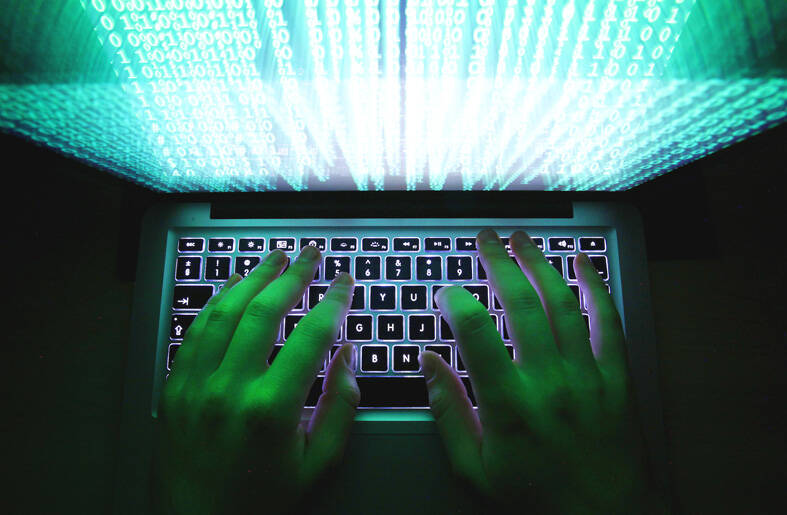
Photo: Reuters
A victory by the Democratic Progressive Party could prompt Beijing to take a more aggressive approach toward Taipei.
“Taiwan has near-zero capability to defend itself from these advanced cyberattacks,” said Charles Li (李庭閣), chief analyst at Taiwanese cybersecurity firm TeamT5 (杜浦數位安全).
Li said that his firm’s work tracking state-sponsored hackers in Taiwan showed that most of the country’s companies and government agencies attacked last year “did not even notice that they were being hacked.”
The number of state-sponsored attacks has been soaring, more than doubling in three years, according to TeamT5, which has clients from Singapore to the US.
Moreover, researchers at cybersecurity firm Fortinet Inc said that Taiwan accounted for about 55 percent of the billions of malicious cyberthreats detected in the Asia-Pacific region this year.
The Ministry of Digital Affairs said that the most common attack is focused on stealing sensitive information, and that the frequency and number of threats surge depending upon geopolitical events.
For instance, during former US House of Representatives speaker Nancy Pelosi’s visit to Taipei in August last year, Taiwan “experienced foreign cyberattacks reaching levels 23 times higher than previous peaks” and some government Web sites temporarily went offline due to the large volume of distributed denial-of-service attacks, the ministry said.
That period, which coincided with unprecedented Chinese military drills around Taiwan, highlighted the nation’s vulnerabilities.
“The majority of cases we’re dealing with are espionage attacks, they’re stealing data, and they’re attempting to maintain a persistent presence inside these networks for as long as they possibly can,” said Jon Clay, vice president of threat intelligence at Trend Micro Inc.
The latest exercises indicated that Taiwan’s banks still are not adequately prepared to meet the threat, participants and internal reports said.
“The reality is, they’re getting hammered,” SimSpace Corp cofounder and chief technology officer Lee Rossey said.
The irony of Taiwan’s vulnerabilities is that the nation is home to the world’s most advanced chipmaking technology. The industry has spent heavily on some of the most sophisticated cybersecurity and physical security measures to guard its intellectual property and factories.
However, that has not translated to other sectors of Taiwan’s economy, analysts said.
During the October exercises administered by SimSpace, banks of computer screens flickered and alarms sounded, while an oversized display at the front of the room highlighted icons of bombs and missiles representing cyberattacks and threats.
Camera crews tracked the teams, filming their deliberations and actions to review later.
Besides Boston-based SimSpace, Taiwan has also had talks with experts from the US Treasury’s Office of Cybersecurity and Critical Infrastructure Protection. That engagement is still in the early stages, but the collaboration is expected to help with intelligence sharing on financial security and build new simulators to mimic large-scale cyberattacks on the finance industry and trading systems, people familiar with the plans said.
One scenario Taiwan hopes to implement in future drills is a destruction of infrastructure that results in blackouts and communication breakdowns, the people said.
The idea is to simulate the kind of events that might happen during large-scale natural disasters or military conflict, they said.
China is constantly improving its capability to launch these advanced attacks, said Hank Huang (黃崇哲), who runs the Taiwan Academy of Banking and Finance, a government-advised group that conducts research projects and trainings for the financial sector.
“There is still a long way to go in strengthening national security-level protection for the financial industry,” Huang said.
After several years flying high as Asia’s best Nvidia Corp proxy, Taiwan Semiconductor Manufacturing Co (TSMC, 台積電) is increasingly vying with other artificial intelligence (AI) stocks for investor attention. Stock traders are chasing a wider array of beneficiaries as mainstream usage of AI creates demand for hardware beyond the most-advanced chips TSMC makes for Nvidia. Subthemes from the deepening memory crunch to advances in robotics are also luring bids. At the same time, investment caps on single stocks are pushing funds to diversify, while retail investors long familiar with TSMC through its US depositary receipts are being offered a broader set of
UNDER MICROSCOPE: Taiwan detained three people who allegedly conspired to buy servers in Taiwan and export them using fraudulent documentation, prosecutors said Nvidia Corp chief executive officer Jensen Huang (黃仁勳) on Saturday urged Super Micro Computer Inc to tighten up on compliance after Taiwan detained three people this week for allegedly making fraudulent declarations about artificial intelligence (AI) servers made by its US partner. The development marked the nation’s first crackdown on semiconductor smuggling, which grew after the US slapped restrictions on exports of high-end chips such as Nvidia AI accelerators to China. Nvidia is “rigorous” in explaining regulations to all of its partners, Huang told reporters after arriving in Taipei. “Ultimately Super Micro has to run their own company,” he said in response to

Netherlands-based semiconductor equipment supplier ASML Holding NV yesterday said that it is planning to hire an additional 1,000 people in Taiwan this year in response to growing demand from clients. ASML had previously planned to recruit 600 people this year, but that the plan has been adjusted upward, ASML vice president and ASML Taiwan general manager Grace Wang (汪佳慧) told reporters. ASML has a workforce of more than 4,500 in Taiwan, accounting for about 10 percent of its global total, Wang said. This year’s recruitment campaign would focus on adding people in the customer support, manufacturing and supply chain domains to assist ASML
TECH RELIANCE: Growth is increasingly reflecting an unequal K-shaped distribution, where technology sectors outperform and other industries struggle, an expert said Standard Chartered Bank has significantly raised its forecast for Taiwan’s economic growth to 9.5 percent this year, up from 7.6 percent previously, citing surging artificial intelligence (AI) demand driving exports, semiconductor production and investment. The upgrade reflects a sustained AI supercycle that continues to fuel demand for advanced chips and technology infrastructure, which form the backbone of Taiwan’s exports, the bank said in a report this week. “We raise our 2026 growth forecast to reflect a much stronger-than-expected first-quarter GDP figure,” Standard Chartered senior economist for greater China and Asia Tommy Wu (胡東安) said in the report. Driven largely by a 35.3 percent


 RSS
RSS