


Worldwide PC shipments declined 9 percent year-on-year in the third quarter, hitting what Gartner Inc analysts said should be the low point in a two-year market slump.
International Data Corp (IDC) pegged the decline at 7.6 percent, as the Needham Massachusetts-based researcher said the rate of annual decline had slowed and the market was moving past the bottom of the trough.
Apple Inc had the steepest drop among the major PC makers, with shipments falling 24.2 percent from the same quarter a year earlier to 6.27 million units, while HP Inc’s shipments rose 6.4 percent to 13.53 million units, the lone vendor to make gains during the July-September period, Gartner said in a statement on Monday.
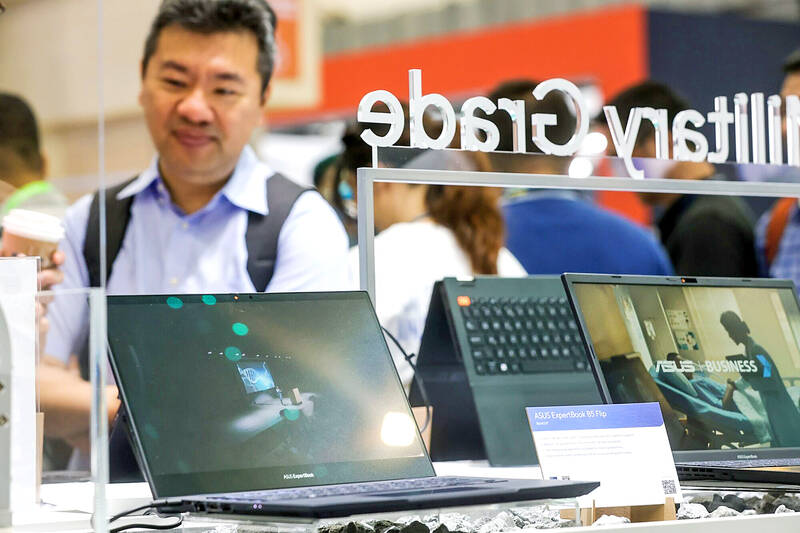
Photo: Cheng I-hwa, Bloomberg
Lenovo Group Ltd (聯想) maintained its top position, with shipments of 16.15 million units and 25.1 percent of the global market, while Dell Inc ranked third with shipments of 10.32 million units, down 14.2 percent from a year earlier, Gartner said.
Taiwanese PC vendors Asustek Computer Inc (華碩) and Acer Inc (宏碁) saw their shipments drop 11.5 percent and 2.4 percent to 4.88 million and 4.39 million units respectively, the market researcher’s data showed.
Total PC shipments hit 64.28 million units in the third quarter, down from 70.6 million a year earlier, Gartner said.
IDC put last quarter’s overall shipments at 68.2 million units, versus 73.8 million the previous year, it said in a separate statement on Monday.
After falling for eight consecutive quarters, “there is evidence that the PC market’s decline has finally bottomed out,” Gartner analyst Mikako Kitagawa said.
Corporate customers might be reaching their next purchasing cycle, spurred by Microsoft Corp’s Windows 11 software upgrades, and consumers might be ready to replace PCs bought earlier during the COVID-19 pandemic, Kitagawa said.
“The good news for PC vendors is that the worst could be over by the end of 2023,” Kitagawa said.
IDC analysts said the PC industry is on a slow path to recovery, as inventory has become leaner in the past few months and is near healthy levels in most channels.
However, downward pressure on pricing persists and would likely remain an issue within the consumer and business sectors, they said.
Moreover, “the slowness in the industry is giving the supply chain an opportunity to explore procurement and production options outside China and this will likely remain a key issue going forward, second only to the advancement of artificial intelligence [AI] within PCs,” IDC senior research manager Jitesh Ubrani said.
IDC research vice president for devices and displays Linn Huang (黃琳) said she expects generative AI to become a “watershed moment” for the PC industry.
“As more of these devices [AI PCs] launch next year, we expect a significant boost to overall selling prices,” she said.

Elon Musk’s lieutenants have reached out to chip industry suppliers, including Applied Materials Inc, Tokyo Electron Ltd and Lam Research Corp, for his envisioned Terafab, early steps in an audacious and likely arduous attempt to break into the production of cutting-edge chips. Staff working for the joint venture between Tesla Inc and Space Exploration Technologies Corp (SpaceX) have sought price quotes and delivery times for an array of chipmaking gear, people familiar with the matter said. In past weeks, they’ve contacted makers of photomasks, substrates, etchers, depositors, cleaning devices, testers and other tools, according to the people, who asked not to

The EU and US are nearing an agreement to coordinate on producing and securing critical minerals, part of a push to break reliance on Chinese supplies. The potential deal would create incentives, such as minimum prices, that could advantage non-Chinese suppliers, according to a draft of an “action plan” seen by Bloomberg. The EU and US would also cooperate on standards, investments and joint projects, as well as coordinate on any supply disruptions by countries like China. The two sides are additionally seeking other “like-minded partners” to join a multicountry accord to help create these new critical mineral supply chains, which feed into

Japan approved ¥631.5 billion (US$3.97 billion) in additional subsidies to hasten Rapidus Corp’s entry into the high-stakes artificial intelligence (AI) chipmaking arena, ramping up support for a project widely regarded as a long shot. The capital is intended to bankroll Rapidus’ work for information technology firm Fujitsu Ltd, one of the initial customers that Tokyo hopes would get the signature endeavor off the ground. The new money raises the fees and investments that the government is injecting into the start-up to ¥2.6 trillion by the end of the current fiscal year to March next year, the Japanese Ministry of Economy, Trade and

The founder of Chinese property giant Evergrande Group (恆大集團) has pleaded guilty to charges of fraud and bribery, a court said yesterday, the latest blow for what was once the country’s leading developer. Evergrande’s rise was propelled by decades of rapid urbanization and rising living standards, but in 2020, its access to credit dramatically narrowed when the government introduced curbs on excessive borrowing and speculation. The company defaulted in 2021 after struggling to repay creditors. Founder Xu Jiayin (許家印), 67, known as Hui Ka Yan in Cantonese, was reportedly held by police in 2023, with Evergrande saying he had been subjected to


 RSS
RSS