


Northrop Grumman Corp will allocate US$100 million annually to Taiwan-related projects starting next year, an executive with the U.S.-based defense contractor said yesterday.
Northrop Grumman corporate vice president and global business development officer Stephen O'Bryan made the pledge during a press event at the Taipei Aerospace & Defense Technology Expo (TADTE), which opened at the Taipei Nangang Exhibition Center's Hall 1 yesterday.
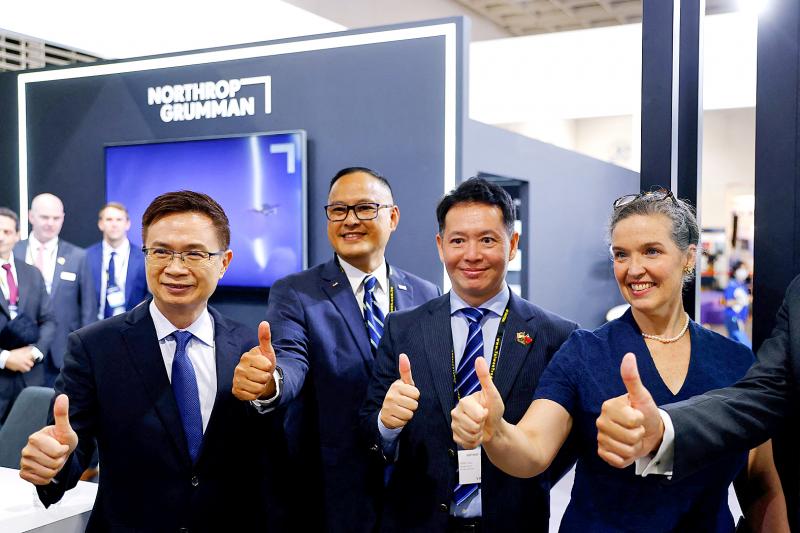
Photo: REUTERS
In his address, O'Bryan said his company, a global giant in the aerospace and defense business, just opened an office in Taipei last month to accelerate access to strengthen partnerships with customers and local industry.
"Keeping with the last component of engagement with Taiwan's industry, I'm happy to announce today that Northrop Grumman will be committing to US$100 million annually of opportunities for Taiwan to become part of Northrop Grumman's global supply chain," he said.
Over the coming months, the company will ask its newly-appointed Taiwan office chief Fisher Huang (黃思勳) to engage with Taiwan's defense industries and to understand their capabilities, O'Bryan said.
"And then in early 2024, we will have a team from the United States to come in with more advanced discussions and requests for proposals with our global supply chain with Taiwan," he added.
Huang, a retired Taiwanese Air Force officer, told reporters in the same press event that the pledged amount of money will be spent on working with potential Taiwanese partners and help boost the nation's domestic defense industry.
The US$100 million annual budget could be subject to change after the first year, depending on the capabilities of Taiwanese defense industry partners and the scale of cooperation, he added.
Huang said Northrop Grumman has long been a partner of Taiwan's Air Force by making its F-5Es that have served in the country for more than 40 years. Taiwan's E-2K Hawkeye early-warning aircraft is also a product of the American company, he said.
The US company is looking forward to potential cooperation with Taiwan in building advanced trainer jets, UAVs as well as a domestic satellite program being developed by the Taiwan Space Agency, Huang said.
Northrop Grumman is one of the prominent participants in this year's TADTE, which runs until tomorrow, after a four-year break.
Other American companies, including Lockheed Martin Corp, L3Harris Technologies Inc, Raytheon Co and BAE Systems, together with 41 small to medium-sized companies are showcasing their products at the debut USA Pavilion in the three-day show.
The last time TADTE was held was in 2019. The 2021 edition was canceled due to the COVID-19 pandemic.
Shares of contract chipmaker Taiwan Semiconductor Manufacturing Co (TSMC, 台積電) came under pressure yesterday after a report that Apple Inc is looking to shift some orders from the Taiwanese company to Intel Corp. TSMC shares fell NT$55, or 2.4 percent, to close at NT$2,235 on the local main board, Taiwan Stock Exchange data showed. Despite the losses, TSMC is expected to continue to benefit from sound fundamentals, as it maintains a lead over its peers in high-end process development, analysts said. “The selling was a knee-jerk reaction to an Intel-Apple report over the weekend,” Mega International Investment Services Corp (兆豐國際投顧) analyst Alex Huang
Taiwan Semiconductor Manufacturing Co (TSMC, 台積電) is expected to remain Apple Inc’s primary chip manufacturing partner despite reports that Apple could shift some orders to Intel Corp, industry experts said yesterday. The comments came after The Wall Street Journal reported on Friday that Apple and Intel had reached a preliminary agreement following more than a year of negotiations for Intel to manufacture some chips for Apple devices. Taiwan Institute of Economic Research (台灣經濟研究院) economist Arisa Liu (劉佩真) said TSMC’s advanced packaging technologies, including integrated fan-out and chip-on-wafer-on-substrate, remain critical to the performance of Apple’s A-series and M-series chips. She said Intel and Samsung
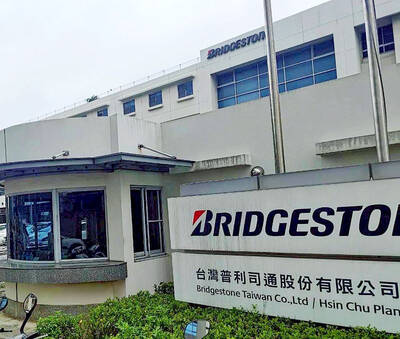
TRANSITION: With the closure, the company would reorganize its Taiwanese unit to a sales and service-focused model, Bridgestone said Bridgestone Corp yesterday announced it would cease manufacturing operations at its tire plant in Hsinchu County’s Hukou Township (湖口), affecting more than 500 workers. Bridgestone Taiwan Co (台灣普利司通) said in a statement that the decision was based on the Tokyo-based tire maker’s adjustments to its global operational strategy and long-term market development considerations. The Taiwanese unit would be reorganized as part of the closure, effective yesterday, and all related production activities would be concluded, the statement said. Under the plan, Bridgestone would continue to deepen its presence in the Taiwanese market, while transitioning to a sales and service-focused business model, it added. The Hsinchu
Taiwan Semiconductor Manufacturing Co (TSMC, 台積電) has approved a capital budget of US$31.28 billion for production expansion to meet long-term development needs during the artificial intelligence (AI) boom. The company’s board meeting yesterday approved the capital appropriation plan for purposes such as the installation of advanced technology capacity and fab construction, the world’s largest contract chipmaker said in a statement. At an earnings conference last month, TSMC forecast that its capital expenditure for this year would be at the higher end of the US$52 billion to US$56 billion range it forecast in January in response to robust demand for 5G, AI and


 RSS
RSS