


One of Vietnam’s largest shoemakers for brands such as Nike Inc, Adidas AG and Reebok International Ltd is to cut jobs for the third time this year, state media said yesterday, citing a lack of orders.
The Southeast Asian country is among the world’s largest exporters of clothing, footwear and furniture, but its economic growth has been slow in the first half of the year as a slump in demand hits exports.
PouYuen Vietnam Co, a unit of Taiwan-based Pou Chen Group (寶成), is to lay off about 1,200 workers with permanent contracts from the end of this month, VnExpress said, citing a local official in Ho Chi Minh City.
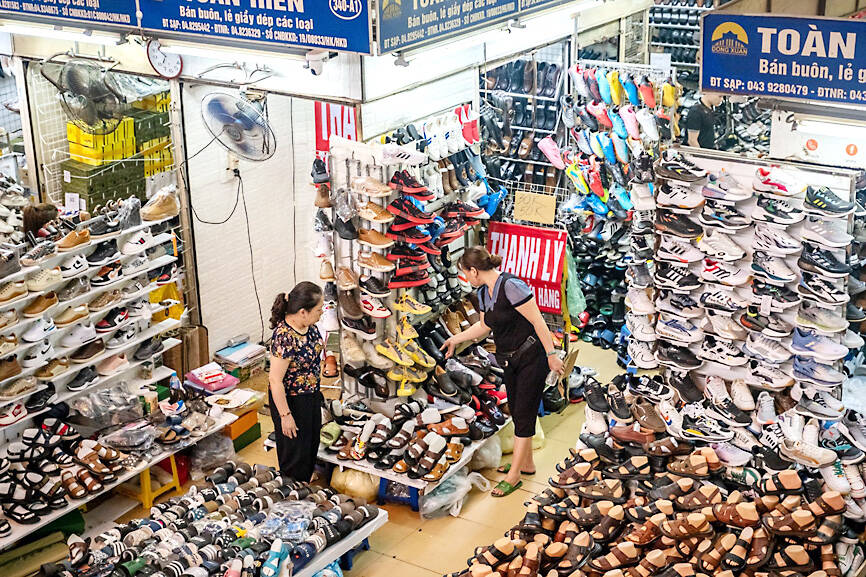
Photo: Bloomberg
“PouYuen Vietnam said the job cuts are due to no recovery in terms of orders. Only a few clients made orders,” VnExpress reported.
The firm is among the largest employers in Ho Chi Minh City, Vietnam’s commercial capital, with an estimated 40,000 workers.
This is the third time this year that it has cut jobs. It announced in May that almost 6,000 workers with permanent contracts would be laid off, after letting go almost 3,000 permanent staff in February.
That came after PouYuen put 20,000 of its workers on paid leave in rotation last year.
More than 217,000 workers lost their jobs in Vietnam during the second quarter of this year, the Vietnamese General Statistics Office said.
They were mainly working to produce textiles, footwear and electronics.

The government yesterday approved applications by Alphabet Inc’s Google to invest NT$27.08 billion (US$859.98 million) in Taiwan, the Ministry of Economic Affairs said in a statement. The Department of Investment Review approved two investments proposed by Google, with much of the funds to be used for data processing and electronic information supply services, as well as inventory procurement businesses in the semiconductor field, the ministry said. It marks the second consecutive year that Google has applied to increase its investment in Taiwan. Google plans to infuse NT$25.34 billion into Charter Investments Ltd (特許投資顧問) through its Singapore-based subsidiary Fructan Holdings Singapore Pte Ltd, and

SECOND-RATE: Models distilled from US products do not perform the same as the original and undo measures that ensure the systems are neutral, the US’ cable said The US Department of State has ordered a global push to bring attention to what it said are widespread efforts by Chinese companies, including artificial intelligence (AI) start-up DeepSeek (深度求索), to steal intellectual property from US AI labs, according to a diplomatic cable. The cable, dated Friday and sent to diplomatic and consular posts around the world, instructs diplomatic staff to speak to their foreign counterparts about “concerns over adversaries’ extraction and distillation of US AI models.” Distillation is the process of training smaller AI models using output from larger, more expensive ones to lower the costs of training a powerful new

Micron Technology Inc is a driving force pushing the US Congress to pass legislation that would put new export restrictions on equipment its Chinese competitors use to make their chips, according to people familiar with the matter. A US House of Representatives panel yesterday was to vote on the “MATCH Act,” a bill designed to close gaps in restrictions on chipmaking equipment. It would also pressure foreign companies that sell equipment to Chinese chipmaking facilities to align with export curbs on US companies like Lam Research Corp and Applied Materials Inc. The bill targets facilities operated by China’s ChangXin Memory Technologies Inc

Singapore-based ride-hailing and delivery giant Grab Holdings’ planned acquisition of Foodpanda’s Taiwan operations has yet to enter the formal review stage, as regulators await supplementary documents, the Fair Trade Commission (FTC) said yesterday. Acting FTC Chairman Chen Chih-min (陳志民) told the legislature’s Economics Committee that although Grab submitted its application on March 27, the case has not been officially accepted because required materials remain incomplete. Once the filing is finalized, the FTC would launch a formal probe into the deal, focusing on issues such as cross-shareholding and potential restrictions on market competition, Chen told lawmakers. Grab last month announced that it would acquire


 RSS
RSS