


Shares in Aerospace Industrial Development Corp (AIDC, 漢翔航空) yesterday surged by the 10 percent daily limit after the military aircraft manufacturer laid out a bullish outlook amid rising threats from China.
AIDC expects revenue and earnings per share to reach a record high this year due to demand from the defense industry and a rebound in the global air transport market, AIDC chairman Hu Kai-hung (胡開宏) said in an interview on Tuesday.
The company’s sales have grown 43.31 percent over the first seven months of this year, compared with the same period a year earlier, to NT$22.74 billion (US$712.27 million).
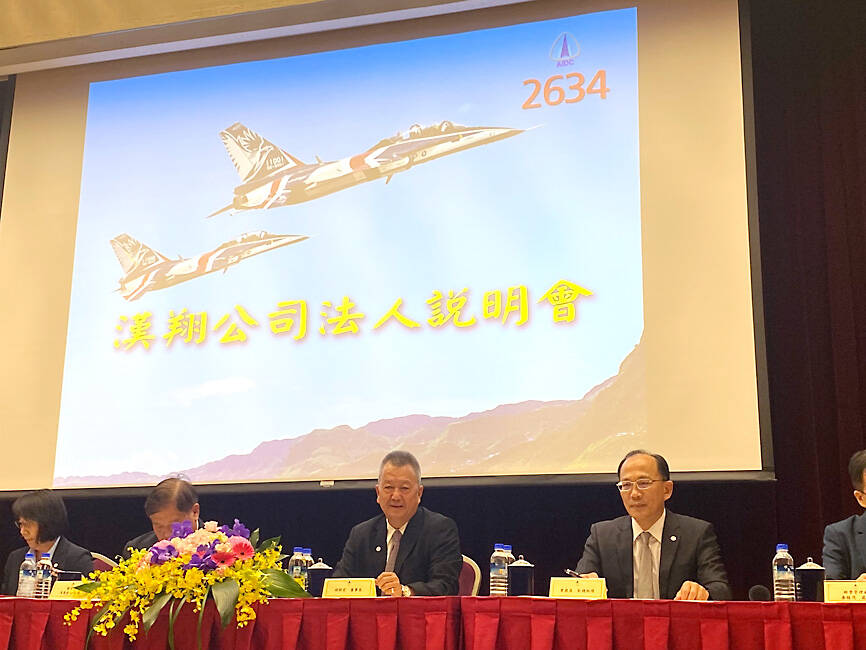
Photo: CNA
Net profit in the first half of this year rose 61.72 percent year-on-year to NT$1.3 billion, or earnings per share of NT$1.38, company data showed.
AIDC shares have surged 65 percent this year so far, outperforming the benchmark TAIEX’s 17 percent gain.
Taiwan faces increased pressure to fend off daily Chinese incursions across the median line of the Taiwan Strait, a tacit barrier that has separated the two rivals for decades.
Taipei is to raise its total defense spending to a record NT$606.8 billion, accounting for about 2.5 percent of GDP, a statement released on Monday by the Presidential Office said.
The partly state-backed Taiwanese company is aiming to deepen ties with Lockheed Martin Corp and other system suppliers over F-16 maintenance in an effort to bolster the nation’s defense capabilities.
The F-16 Maintenance and Support Center in Taichung, set up in 2020 with the help of the two companies, has significantly reduced the repair time needed for the air force, with some jobs previously taking as long as years, Hu said.
He declined to give details about how much time or cost the center has helped save over the years due to confidentiality.
“Deepening localization of maintenance is [a] top priority of the industry and the country” in response to rising tension across the Strait, Hu said. “This increases fighter jets’ availability, enhances technology and expands business for Taiwan’s industries.”
The F-16 maintenance center only serves the air force, but AIDC hopes it would one day handle orders from Lockheed Martin for fighter jets from elsewhere, Hu said.
The move would further integrate Taiwanese suppliers into the supply chain of the US company with more technology transfer, he added.
AIDC has received more than NT$50 billion of orders for commercial products in the first half of this year, including a 10-year contract of more than NT$35 billion to provide engine components to GE Aerospace. It also expects to deliver 66 trainer jets for Taiwan’s military by 2026, including 17 jets for this year.
Additional reporting by staff writer

The domestic unit of the Chinese-owned, Dutch-headquartered chipmaker Nexperia BV will soon be able to produce semiconductors locally within China, according to two company sources. Nexperia is at the center of a global tug-of-war over critical semiconductor technology, with a Dutch court in February ordering a probe into alleged mismanagement at the company. The geopolitical tussle has disrupted supply chains, with some carmakers reportedly forced to cut production due to chip shortages. Local production would allow Nexperia’s domestic arm, Nexperia Semiconductors (China) Ltd (安世半導體中國), to bypass restrictions in place since October on the supply of silicon wafers — etched with tiny components to

Singapore-based ride-hailing and delivery giant Grab Holdings Ltd has applied for regulatory approval to acquire the Taiwan operations of Germany-based Delivery Hero SE's Foodpanda in a deal valued at about US$600 million. Grab submitted the filing to the Fair Trade Commission on Friday last week, with the transaction subject to regulatory review and approval, the company said in a statement yesterday. Its independent governance structure would help foster a healthy and competitive market in Taiwan if the deal is approved, Grab said. Grab, which is listed on the NASDAQ, said in the filing that US-based Uber Technologies Inc holds about 13 percent of

Taiwan Semiconductor Manufacturing Co (TSMC, 台積電) yesterday received government approval to deploy its advanced 3-nanometer (3nm) process at its second fab currently under construction in Japan, the Ministry of Economic Affairs said in a news release. The ministry green-lit the plan for the facility in Kumamoto, which is scheduled to start installing equipment and come online in 2028 with a monthly production capacity of 15,000 12-inch wafers, the ministry said. The Department of Investment Review in June 2024 authorized a US$5.26 billion investment for the facility, slated to manufacture 6- to 12nm chips, significantly less advanced than 3nm process. At a meeting with

Taiwan’s food delivery market could undergo a major shift if Singapore-based Grab Holdings Ltd completes its planned acquisition of Delivery Hero SE’s Foodpanda business in Taiwan, industry experts said. Grab on Monday last week announced it would acquire Foodpanda’s Taiwan operations for US$600 million. The deal is expected to be finalized in the second half of this year, with Grab aiming to complete user migration to its platform by the first half of next year. A duopoly between Uber Eats and Foodpanda dominates Taiwan’s delivery market, a structure that has remained intact since the Fair Trade Commission (FTC) blocked Uber Technologies Inc’s


 RSS
RSS