


A decline in premiums in the life insurance industry could moderate over the next 12 to 18 months, primarily due to a low comparison base, as local insurers adapt to regulatory tightening and economic uncertainty, Fitch Ratings said yesterday.
The premium retreat slowed to 11 percent in the first half of this year, compared with a 21 percent plunge last year due to a muddy global economic outlook and a shift away from unprofitable savings-type products amid stricter regulations, Fitch insurance analyst Stella Ng (吳傑佩) told a media briefing in Taipei.
Shares of investment-type products have been falling amid financial market volatility and regulatory restrictions in the past few years, noticeably with the prohibition of sales of new policies with negative contractual service margins, Ng said.
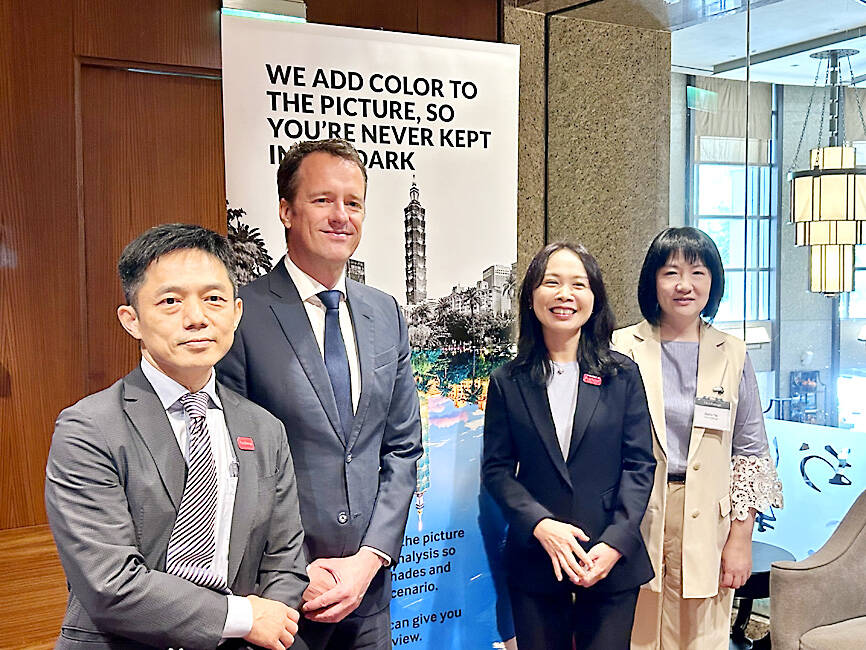
Photo: Wu Hsin-tien, Taipei Times
The changes led to a decline in the sales of savings products, including traditional annuity and interest variable life policies, she said.
However, Fitch said it sees an increase in health insurance policies, which might prove to be sustainable and more profitable growth drivers in the long term.
“We see health insurance expanding in line with an aging society, and rising awareness of health risks and healthcare needs,” Ng said.
Taiwan is on track to become a super-aged society in 2025 when people aged 65 or older would exceed 20 percent of its population, the National Development Council has said. Authorities have encouraged sales of protection insurance policies to help bolster the nation’s social safety net.
In the meantime, Fitch said it expects local insurers to face higher interest-rate charges under the Insurance Capital Standard framework that is to be implemented in 2026, in line with international accounting rule changes.
The new framework would set higher capital requirement on asset and interest-rate risks, it said.
The more stringent requirement could increase interest-rate-related capital charges to three to four times that of current levels, because the savings-type products local insurers sold in the past offer high guaranteed yields, Fitch said
New accounting rules would provide clarity on local insurers’ profitability outlook, as they would better reveal the movement of contractual service margins, it said.
The financial regulator is likely to clarify any localized adjustments and transitional measures for interest-rate risks, suitable for local business characteristics and conditions, in the near term, Fitch said.
Taiwanese insurers are running calculations under the current rules as well as the new framework, it said.
Fitch expects life insurers to continue raising capital through equity and subordinated debt.
Year to date, several major life insurers have issued or plan to issue subordinated debt of about NT$100 billion (US$3.13 billion).

The domestic unit of the Chinese-owned, Dutch-headquartered chipmaker Nexperia BV will soon be able to produce semiconductors locally within China, according to two company sources. Nexperia is at the center of a global tug-of-war over critical semiconductor technology, with a Dutch court in February ordering a probe into alleged mismanagement at the company. The geopolitical tussle has disrupted supply chains, with some carmakers reportedly forced to cut production due to chip shortages. Local production would allow Nexperia’s domestic arm, Nexperia Semiconductors (China) Ltd (安世半導體中國), to bypass restrictions in place since October on the supply of silicon wafers — etched with tiny components to

Singapore-based ride-hailing and delivery giant Grab Holdings Ltd has applied for regulatory approval to acquire the Taiwan operations of Germany-based Delivery Hero SE's Foodpanda in a deal valued at about US$600 million. Grab submitted the filing to the Fair Trade Commission on Friday last week, with the transaction subject to regulatory review and approval, the company said in a statement yesterday. Its independent governance structure would help foster a healthy and competitive market in Taiwan if the deal is approved, Grab said. Grab, which is listed on the NASDAQ, said in the filing that US-based Uber Technologies Inc holds about 13 percent of

Taiwan Semiconductor Manufacturing Co (TSMC, 台積電) yesterday received government approval to deploy its advanced 3-nanometer (3nm) process at its second fab currently under construction in Japan, the Ministry of Economic Affairs said in a news release. The ministry green-lit the plan for the facility in Kumamoto, which is scheduled to start installing equipment and come online in 2028 with a monthly production capacity of 15,000 12-inch wafers, the ministry said. The Department of Investment Review in June 2024 authorized a US$5.26 billion investment for the facility, slated to manufacture 6- to 12nm chips, significantly less advanced than 3nm process. At a meeting with

Taiwan’s food delivery market could undergo a major shift if Singapore-based Grab Holdings Ltd completes its planned acquisition of Delivery Hero SE’s Foodpanda business in Taiwan, industry experts said. Grab on Monday last week announced it would acquire Foodpanda’s Taiwan operations for US$600 million. The deal is expected to be finalized in the second half of this year, with Grab aiming to complete user migration to its platform by the first half of next year. A duopoly between Uber Eats and Foodpanda dominates Taiwan’s delivery market, a structure that has remained intact since the Fair Trade Commission (FTC) blocked Uber Technologies Inc’s


 RSS
RSS