


The production value of Taiwan’s semiconductor industry this year is expected to fall 12.7 percent from a year earlier to NT$4.22 trillion (US$132.1 billion), the Industrial Technology Research Institute’s (ITRI) Industrial Economics and Knowledge Center (IEK) forecast on Monday last week.
The IEK projection represented a downgrade from an earlier estimate of a 12.1 percent fall to NT$4.24 trillion issued in May, which the center said was due to weaker-than-expected global demand from end users resulting from high inflation and aggressive interest rate hikes worldwide.
The output value of the pure-play wafer foundry business, the largest segment of the semiconductor industry, is expected to fall 11.3 percent to NT$2.38 trillion, a downgrade from NT$2.43 trillion estimated in May, the report said.
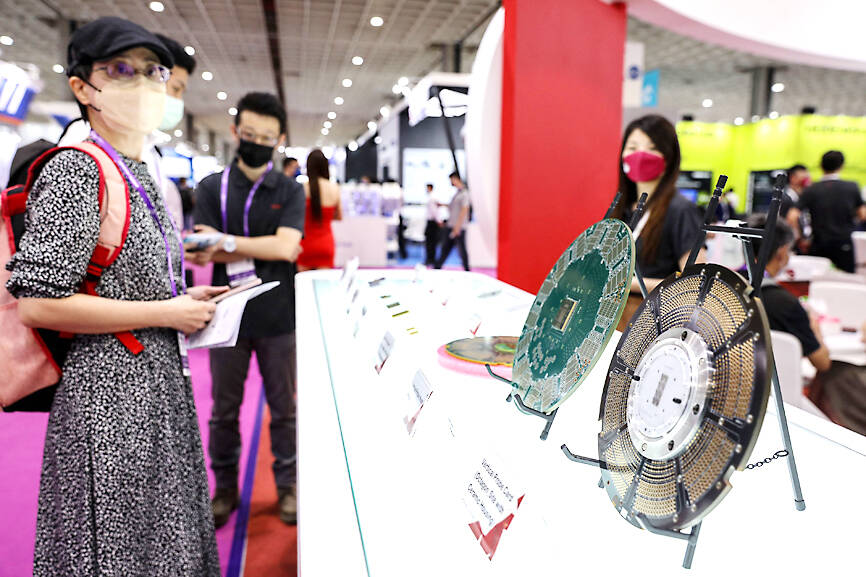
Photo: AFP
The output value of memorychip suppliers is expected to fall 23.6 percent to NT$180 billion, the steepest decline in any of the major segments in the industry, while IC packaging and testing service providers are expected to see their production value fall by 18.5 percent and 13.0 percent to NT$379.7 billion and NT$190.3 billion respectively, the center projected.
IC designers’ output value is expected to drop 11.6 percent to about NT$1.09 trillion, it said.
The local semiconductor industry generated NT$1.01 trillion in output value in the second quarter this year, down 18.0 percent from a year earlier, but up 0.7 percent from a quarter earlier, the report said.
The production value of pure-play wafer foundry operators was NT$564.7 billion, down 13.3 percent from a year earlier and down 3.8 percent from a quarter earlier.
Memorychip suppliers had a production value of NT$42.8 billion in the second quarter, down 37.3 percent from a year earlier, but up 5.4 percent from a quarter earlier, while IC designers totaled NT$268.5 billion in output, down 22.2 percent year-on-year, but up 11.9 percent quarter-on-quarter.
The production value of IC packaging firms for the second quarter totaled NT$92.7 billion, down 19.4 percent from a year earlier and down 1.4 percent from a quarter earlier, while IC testing services generated NT$46.3 billion in output, down 19.5 percent from a year earlier and down 0.4 percent from a quarter earlier.
In the third quarter, the industry’s traditional peak season, the output of the local semiconductor industry is expected to grow 7.5 percent from the second quarter to NT$1.09 trillion, the IEK forecast.
Some IC designers, however, in particular in the display driver IC design business, appeared downbeat about the quarter and were unsure whether they would benefit from traditional peak-season effects, with Novatek Microelectronics Corp (聯詠科技) expecting its third-quarter revenue to fall 4-7 percent from the second quarter, while Himax Technologies Inc (奇景光電) said its third-quarter sales could stay little changed from the second quarter or fall by up to 7 percent.

NEW IDENTITY: Known for its software, India has expanded into hardware, with its semiconductor industry growing from US$38bn in 2023 to US$45bn to US$50bn India on Saturday inaugurated its first semiconductor assembly and test facility, a milestone in the government’s push to reduce dependence on foreign chipmakers and stake a claim in a sector dominated by China. Indian Prime Minister Narendra Modi opened US firm Micron Technology Inc’s semiconductor assembly, test and packaging unit in his home state of Gujarat, hailing the “dawn of a new era” for India’s technology ambitions. “When young Indians look back in the future, they will see this decade as the turning point in our tech future,” Modi told the event, which was broadcast on his YouTube channel. The plant would convert

‘SEISMIC SHIFT’: The researcher forecast there would be about 1.1 billion mobile shipments this year, down from 1.26 billion the prior year and erasing years of gains The global smartphone market is expected to contract 12.9 percent this year due to the unprecedented memorychip shortage, marking “a crisis like no other,” researcher International Data Corp (IDC) said. The new forecast, a dramatic revision down from earlier estimates, gives the latest accounting of the ongoing memory crunch that is affecting every corner of the electronics industry. The demand for advanced memory to power artificial intelligence (AI) tasks has drained global supply until well into next year and jeopardizes the business model of many smartphone makers. IDC forecast about 1.1 billion mobile shipments this year, down from 1.26 billion the prior
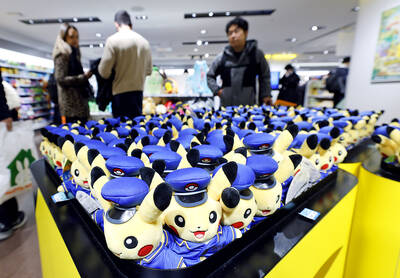
People stand in a Pokemon store in Tokyo on Thursday. One of the world highest-grossing franchises is celebrated its 30th anniversary yesterday.

Zimbabwe’s ban on raw lithium exports is forcing Chinese miners to rethink their strategy, speeding up plans to process the metal locally instead of shipping it to China’s vast rechargeable battery industry. The country is Africa’s largest lithium producer and has one of the world’s largest reserves, according to the US Geological Survey (USGS). Zimbabwe already banned the export of lithium ore in 2022 and last year announced it would halt exports of lithium concentrates from January next year. However, on Wednesday it imposed the ban with immediate effect, leaving unclear what the lithium mining sector would do in the


 RSS
RSS