


As Taiwan’s only large international bank with a global presence, HSBC Holdings PLC reiterated its commitment to investing in Taiwan to build new wealth centers and expand the number of relationship managers to serve the fast-growing market.
To maintain its position as the best retail and wealth management bank in Taiwan, HSBC said it would continue its investments to accelerate wealth expansion, grow its cross-border international customer franchise, develop its lending capabilities, and foster innovation and digitalization.
“We are well-positioned to be the only international bank in Taiwan that serves the full spectrum of customers, from retail, mass affluent, high-net-worth to ultra-high-net-worth customer groups, with diversified and high-quality services,” said Anthony Yu (游天立), head of Wealth and Personal Banking at HSBC Bank Taiwan Ltd (匯豐台灣商銀).
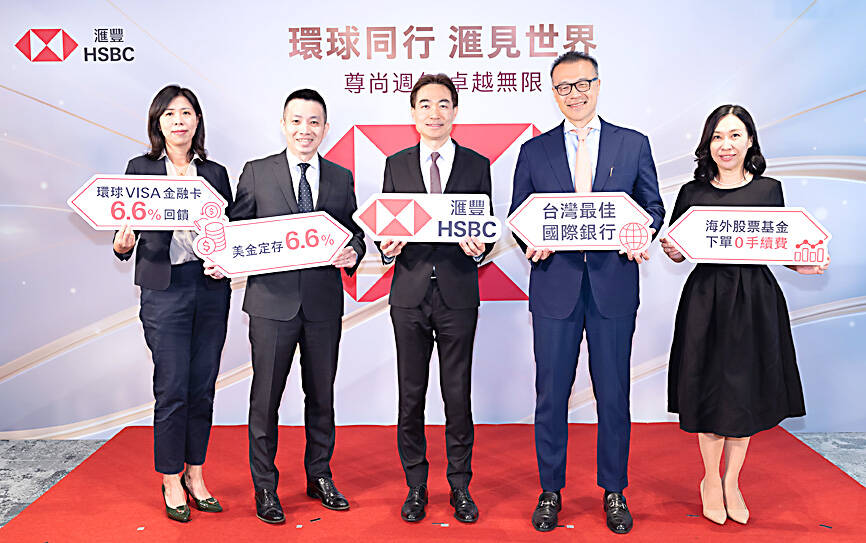
Photo courtesy of HSBC Bank Taiwan Ltd
Yu highlighted the three major strengths of the bank’s international banking services, including providing customers with professional insights and products backed by a global team of 4,000 wealth experts. Clients can enjoy free Global Transfers between all of their HSBC accounts in 26 markets worldwide.
In addition, with just one HSBC Everyday Global Visa Debit Card, they can access up to nine foreign currencies without foreign exchange or administrative fees, including zero handling fees for cash withdrawals.
“These international banking service capabilities make us the bank that can best meet the needs of high-net-worth clients,” Yu said.
Eyeing the strong potential of Taiwan’s wealth management market, HSBC is expanding its group of relationship managers, which grew 42 percent year-on-year in the first quarter this year, Yu said.
In the meantime, HSBC Taiwan is scheduled to open its third wealth management center in Taichung by the end of this year, following the launch of its first two in Taipei and Taoyuan since late last year — a testament to the bank’s commitment to investing in the market, Yu added.
As of the end of the first quarter this year, HSBC Taiwan saw its assets under management increase 37 percent from the same period last year.
By leveraging its international connectivity and local expertise, HSBC is committed to providing customers with world-class and full-suite wealth management services. It launched the Premier Elite service last year to offer customized financial planning services for high-net-worth clients with assets of more than NT$15 million (US$472,441). Over the past year, its Premier Elite customer pool has grown more than 80 percent year-on-year, demonstrating the strong potential of Taiwan’s wealth market.
In celebration of the first anniversary of the launch of its Premier Elite service, HSBC Taiwan is offering a series of market-leading campaigns for its new Premier customers, including US dollar time deposit preferential rates, high cash rebates for users of the HSBC Everyday Global Visa Debit Card, and zero handling fees for fund and overseas stock transactions.
According to the results of a global survey of HSBC’s Premier clients last year, among Taiwan’s Premier Elite customers, 66 percent rated global investment products and cross-national financial planning as the most important services when they choose a bank; 61 percent said they need multicurrency accounts; and 45 percent said they require international financial transfer services.
These highlight that HSBC’s customers value the most the cross-border services that their bank provides to fulfill their needs in business operations, investment planning and children’s overseas education.
With its unique global network and customer-centric services, HSBC was recently named the Best International Bank in Taiwan by both FinanceAsia and Asiamoney. It is the top honor awarded by these two authoritative financial magazines in Taiwan.

The domestic unit of the Chinese-owned, Dutch-headquartered chipmaker Nexperia BV will soon be able to produce semiconductors locally within China, according to two company sources. Nexperia is at the center of a global tug-of-war over critical semiconductor technology, with a Dutch court in February ordering a probe into alleged mismanagement at the company. The geopolitical tussle has disrupted supply chains, with some carmakers reportedly forced to cut production due to chip shortages. Local production would allow Nexperia’s domestic arm, Nexperia Semiconductors (China) Ltd (安世半導體中國), to bypass restrictions in place since October on the supply of silicon wafers — etched with tiny components to

Singapore-based ride-hailing and delivery giant Grab Holdings Ltd has applied for regulatory approval to acquire the Taiwan operations of Germany-based Delivery Hero SE's Foodpanda in a deal valued at about US$600 million. Grab submitted the filing to the Fair Trade Commission on Friday last week, with the transaction subject to regulatory review and approval, the company said in a statement yesterday. Its independent governance structure would help foster a healthy and competitive market in Taiwan if the deal is approved, Grab said. Grab, which is listed on the NASDAQ, said in the filing that US-based Uber Technologies Inc holds about 13 percent of

Taiwan is open to joining a global liquefied natural gas (LNG) program if one is created, but on the condition that countries provide delivery even in a scenario where there is a conflict with China, an energy department official said yesterday. While Taiwan’s priority is to have enough LNG at home, the nation is open to exploring potential strategic reserves in other countries such as Japan or South Korea, Energy Administration Deputy Director-General Chen Chung-hsien (陳崇憲) said. While the LNG market does not have a global reserve for emergencies like that of oil, the concept has been raised a few times —

Taiwan Semiconductor Manufacturing Co (TSMC, 台積電) yesterday received government approval to deploy its advanced 3-nanometer (3nm) process at its second fab currently under construction in Japan, the Ministry of Economic Affairs said in a news release. The ministry green-lit the plan for the facility in Kumamoto, which is scheduled to start installing equipment and come online in 2028 with a monthly production capacity of 15,000 12-inch wafers, the ministry said. The Department of Investment Review in June 2024 authorized a US$5.26 billion investment for the facility, slated to manufacture 6- to 12nm chips, significantly less advanced than 3nm process. At a meeting with


 RSS
RSS