

Amid growing enthusiasm about the development of artificial intelligence (AI), the number of job openings related to AI technologies in Taiwan has surpassed 26,000 and jobseekers with AI expertise are expected to enjoy a wage increase of about 10 percent, according to the online 104 Job Bank (104人力銀行).
Citing statistics compiled from its data, 104 said almost 60 percent of the 26,390 AI-related jobs this month came from electronics information, software and semiconductor industries, while about 20 percent were offered by traditional manufacturers and about 10 percent by the service sector, such as retail, wholesale, direct selling, legal and accounting businesses.
According to the job bank, most of the AI-related jobs — 15,343 — were in the local high-tech sector, which accounted for 58.2 percent of the total openings, with traditional manufacturing industries posting 5,171 such positions, making up 19.6 percent of the total.
In the service sector, the retail, wholesale and direct selling industries sought 1,540 employees with AI knowhow, accounting for about 5.8 percent of the total openings, while the legal, accounting, consultancy, R&D and design industries offered 1,047 AI-related jobs, making up 4 percent of the total.
Another 858 openings were available in the financial and insurance industry, representing 3.3 percent of the total, the job bank said.
104 Job Bank chief data officer Neil Li (李魁林) said in a statement that employers were recruiting newcomers who have expertise in popular AI applications such as ChatGPT, an AI chatbot developed by OpenAI to enable users to refine and steer a conversation toward a desired length, format, style, level of detail and language.
In addition, Li said, those who have expertise in Midjourney, an image-generation tool that can create art based on text prompts, were also welcome, while jobs were also created for those who have skills using Stable Diffusion, a deep learning text-to-image model.
MORE MONEY
Li said jobseekers with AI knowledge can expect a salary increase of no less than 10 percent compared with what their original jobs offered.
Among the AI-related jobs offered by traditional industries, the job bank said, AI marketing specialists were required to work with their teams to plan offline and online promotional campaigns, while taking advantage of the new technology to optimize international business-to-business marketing activities and manage social media.
AI has become a buzzword worldwide. In Taiwan, the AI frenzy has been especially talked up by US graphics processing unit designer Nvidia Corp’s founder and CEO Jensen Huang (黃仁勳), who featured prominently at the Computex Taipei trade show from late May to early last month.
Last week, a visit to Taiwan by Lisa Su (蘇姿丰), chairperson and CEO of another US-based IC design giant, Advanced Micro Devices Inc, gave an additional boost to AI development.

INFRINGEMENT: The investigation comes after a complaint from Vicor Corp, with the company seeking a limited exclusion order as well as cease-and-desist orders, the ITA said The US International Trade Commission (USITC) has launched a Section 337 investigation naming Taiwanese technology companies, including Hon Hai Precision Industry Co (鴻海), Delta Electronics Inc (台達電) and Quanta Computer Inc (廣達), as respondents. The Ministry of Economic Affairs (MOEA) pledged assistance if needed. The USITC said on Friday in a statement that it had voted to institute an investigation under Section 337 of the US Tariff Act of 1930 into certain vertical power delivery systems, related components and computing devices incorporating such systems. The investigation covers 20 companies from Taiwan, China, Germany and the US, the commission said, adding that it

IN GOOD FAITH: Lai said he appreciates Micron’s commitment to Taiwan and that it would continue expanding its investment in the country, while also working with labor President William Lai (賴清德) yesterday called for US memory maker Micron Technology Inc and its workers to negotiate “sincerely” ahead of a possible strike by the company’s union in Taiwan. Last week, a Taiwanese union representing workers at Micron said it had secured authorization from its members to strike over a dispute concerning the company’s bonus scheme, escalating a labor conflict at the chipmaker’s largest manufacturing hub. Micron employs about 15,000 people in Taiwan and has said it invested more than NT$1.6 trillion (US$49.6 billion) in the country. Speaking in Taichung at the opening of a new Micron advanced assembly and testing facility,

A man charged along with Super Micro Computer Inc co-founder Yih-Shyan “Wally” Liaw (廖益賢) of conspiring to send cutting-edge chips to China in violation of US export controls pleaded guilty, court documents said. Ting-Wei “Willy” Sun (孫廷瑋), a former outside contractor described by US authorities as a “fixer” who allegedly aided in the sales, pleaded guilty on Thursday at a hearing in federal court in New York as part of an agreement with prosecutors, court filings showed. Prosecutors claimed the men were part of a scheme to send Nvidia Corp-powered servers to an unnamed Southeast Asian company and then divert them to
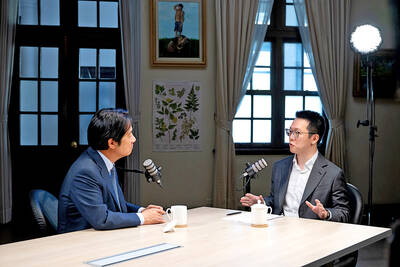
Taiwan should not rule out any energy source or abandon environmental sustainability in favor of ideology and short-term benefits, President William Lai (賴清德) said in an interview, calling for a “professional assessment” of whether nuclear power should be reintroduced into Taiwan’s energy mix. In an online interview with influencer Yu Ting-hao (游庭皓) that aired yesterday, Lai reiterated his position on nuclear power. SHIFT Lai’s remarks marked a shift from the Democratic Progressive Party’s (DPP’s) longstanding opposition to nuclear power. As premier from 2017 to 2019, Lai pushed for more gas-fired power capacity while sticking to the DPP’s nuclear free homeland ideology and rejected the


 RSS
RSS