


The decline in Taiwan’s exports last month widened 23.4 percent year-on-year to US$32.2 billion, the steepest in 14 years, as demand for all product categories tumbled from all major trading partners, the Ministry of Finance said in a report yesterday.
It is the 10th straight month of declines and the downtrend would persist this month by 16 to 19 percent, Department of Statistics Director-General Beatrice Tsai (蔡美娜) told a news conference.
Domestic and international clients largely maintained a cautious inventory approach and preferred to place rush orders when necessary, Tsai said.
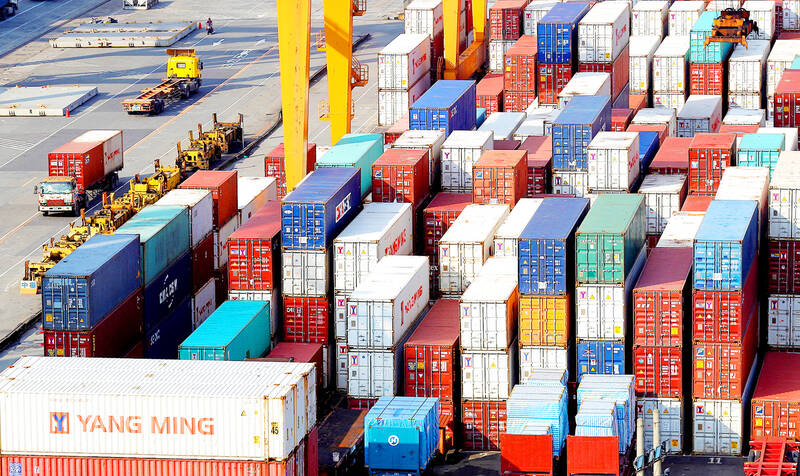
Photo: Pichi Chuang, Reuters
Poor order visibility rendered projection difficult, she said.
The official last month predicted a retreat of 14 to 16 percent.
The bleak showings are related to sticky global inflation and interest rate hikes by major central banks, which continued to hurt demand for technology gadgets, Tsai said.
Taiwan is home to the world’s largest suppliers of electronics used in smartphones, computers, big data analyses and artificial intelligence applications.
“The chance of a recovery for exports in September now appears to be diminishing,” Tsai said, adding that lingering inventory corrections and insignificant positive impact of China’s reopening affect projections negatively.
Shipments of electronics, notably chips, fell 21.3 percent annually to US$13.58 billion, as demand for chips failed to peak despite the arrival of the high season, the official said.
Exports of information and communications technology products shed 6.2 percent to US$5.04 billion, snapping two months of gains, Tsai said.
Shipments of optical and precision devices shrank 10.2 percent to US$1.25 billion even though local suppliers said they had come out of the woods, the ministry’s report said.
Demand for non-tech products fared worse, with declines of 30 to 50 percent for plastic, chemical, mineral and textile products, it said.
Meanwhile, imports dropped 29.9 percent to US$26.36 billion as local firms shunned buying agricultural and industrial raw materials as well as capital equipment amid economic uncertainty, Tsai said.
The data last month gave Taiwan a trade surplus of US$5.96 billion, an increase of 30.3 percent year-on-year due in part to a low comparison base, the report said.
In the second quarter, exports fell 16.9 percent while imports weakened 24 percent, both worse than the forecast in May by the Directorate-General of Budget, Accounting and Statistics at 14.58 percent and 18.63 percent respectively.
That might warrant a downward revision in GDP growth for this year, unless other components such as private consumption put up stronger showings.
In the first half of this year, exports shrank 18 percent to US$202.11 billion, while imports retreated 20 percent to US$175.65 billion, the ministry said.

Singapore-based ride-hailing and delivery giant Grab Holdings Ltd has applied for regulatory approval to acquire the Taiwan operations of Germany-based Delivery Hero SE's Foodpanda in a deal valued at about US$600 million. Grab submitted the filing to the Fair Trade Commission on Friday last week, with the transaction subject to regulatory review and approval, the company said in a statement yesterday. Its independent governance structure would help foster a healthy and competitive market in Taiwan if the deal is approved, Grab said. Grab, which is listed on the NASDAQ, said in the filing that US-based Uber Technologies Inc holds about 13 percent of

The domestic unit of the Chinese-owned, Dutch-headquartered chipmaker Nexperia BV will soon be able to produce semiconductors locally within China, according to two company sources. Nexperia is at the center of a global tug-of-war over critical semiconductor technology, with a Dutch court in February ordering a probe into alleged mismanagement at the company. The geopolitical tussle has disrupted supply chains, with some carmakers reportedly forced to cut production due to chip shortages. Local production would allow Nexperia’s domestic arm, Nexperia Semiconductors (China) Ltd (安世半導體中國), to bypass restrictions in place since October on the supply of silicon wafers — etched with tiny components to

Taiwan Semiconductor Manufacturing Co (TSMC, 台積電) yesterday received government approval to deploy its advanced 3-nanometer (3nm) process at its second fab currently under construction in Japan, the Ministry of Economic Affairs said in a news release. The ministry green-lit the plan for the facility in Kumamoto, which is scheduled to start installing equipment and come online in 2028 with a monthly production capacity of 15,000 12-inch wafers, the ministry said. The Department of Investment Review in June 2024 authorized a US$5.26 billion investment for the facility, slated to manufacture 6- to 12nm chips, significantly less advanced than 3nm process. At a meeting with

Taiwan’s food delivery market could undergo a major shift if Singapore-based Grab Holdings Ltd completes its planned acquisition of Delivery Hero SE’s Foodpanda business in Taiwan, industry experts said. Grab on Monday last week announced it would acquire Foodpanda’s Taiwan operations for US$600 million. The deal is expected to be finalized in the second half of this year, with Grab aiming to complete user migration to its platform by the first half of next year. A duopoly between Uber Eats and Foodpanda dominates Taiwan’s delivery market, a structure that has remained intact since the Fair Trade Commission (FTC) blocked Uber Technologies Inc’s


 RSS
RSS