


The nation’s foreign exchange reserves last month grew US$1.97 billion to a record US$564.83 billion, as its assets denominated in European currencies gained value, the central bank said yesterday.
The US dollar index shed 1.36 percent in last month, while the euro advanced 1.63 percent, the British pound increased 1.87 percent, the Canadian dollar grew 2.94 percent and the Australian dollar rose 2.05 percent, Department of Foreign Exchange Director-General Eugene Tsai (蔡炯民) told in an online news conference.
The changes in value came after the US Federal Reserve kept its policy rate unchanged and other advanced countries raised interest rates to tame inflation, Tsai said.
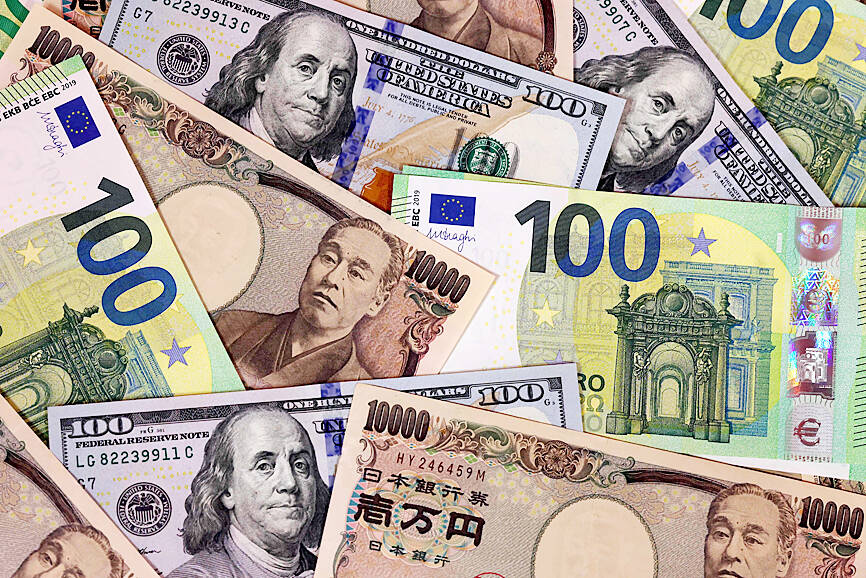
Photo: AFP
By contrast, Asian currencies weakened against the US dollar, with the yuan losing 1.96 percent, the yen declining 3.44 percent, and the New Taiwan dollar depreciated 1.22 percent, Tsai said.
The central banks in Taiwan and Japan opted to maintain their monetary policy and China loosened lending terms a bit to support its economy, Tsai said.
Foreign fund flows played a neutral role after remitting US$3.43 billion of capital and wiring over US$3 billion of profit abroad, Tsai said.
The central bank largely refrained from intervention this year to help stabilize the foreign exchange market, except for a few times when it spotted abnormal massive fund movements, the official said.
As of Tuesday, the local currency dropped 1.31 percent against the US dollar, staying within a “stable” range, Tsai said.
The fund movements likely had to do with market expectations that the Fed would raise interest rates through September, in a continued bid to fight inflation, Tsai said.
Tsai declined to comment on the Fed’s potential moves except to say that the financial markets have reached the consensus that it would not cut interest rate this year and economic data would guide its policy decisions.

Singapore-based ride-hailing and delivery giant Grab Holdings Ltd has applied for regulatory approval to acquire the Taiwan operations of Germany-based Delivery Hero SE's Foodpanda in a deal valued at about US$600 million. Grab submitted the filing to the Fair Trade Commission on Friday last week, with the transaction subject to regulatory review and approval, the company said in a statement yesterday. Its independent governance structure would help foster a healthy and competitive market in Taiwan if the deal is approved, Grab said. Grab, which is listed on the NASDAQ, said in the filing that US-based Uber Technologies Inc holds about 13 percent of

The domestic unit of the Chinese-owned, Dutch-headquartered chipmaker Nexperia BV will soon be able to produce semiconductors locally within China, according to two company sources. Nexperia is at the center of a global tug-of-war over critical semiconductor technology, with a Dutch court in February ordering a probe into alleged mismanagement at the company. The geopolitical tussle has disrupted supply chains, with some carmakers reportedly forced to cut production due to chip shortages. Local production would allow Nexperia’s domestic arm, Nexperia Semiconductors (China) Ltd (安世半導體中國), to bypass restrictions in place since October on the supply of silicon wafers — etched with tiny components to

Taiwan Semiconductor Manufacturing Co (TSMC, 台積電) yesterday received government approval to deploy its advanced 3-nanometer (3nm) process at its second fab currently under construction in Japan, the Ministry of Economic Affairs said in a news release. The ministry green-lit the plan for the facility in Kumamoto, which is scheduled to start installing equipment and come online in 2028 with a monthly production capacity of 15,000 12-inch wafers, the ministry said. The Department of Investment Review in June 2024 authorized a US$5.26 billion investment for the facility, slated to manufacture 6- to 12nm chips, significantly less advanced than 3nm process. At a meeting with

Taiwan’s food delivery market could undergo a major shift if Singapore-based Grab Holdings Ltd completes its planned acquisition of Delivery Hero SE’s Foodpanda business in Taiwan, industry experts said. Grab on Monday last week announced it would acquire Foodpanda’s Taiwan operations for US$600 million. The deal is expected to be finalized in the second half of this year, with Grab aiming to complete user migration to its platform by the first half of next year. A duopoly between Uber Eats and Foodpanda dominates Taiwan’s delivery market, a structure that has remained intact since the Fair Trade Commission (FTC) blocked Uber Technologies Inc’s


 RSS
RSS