


In Japan, a nation reputed for loyalty to companies and lifetime employment, people who job-hop are often viewed as quitters, and that is considered shameful.
Enter “taishoku daiko,” or “job-leaving agents.” Dozens of such services have sprung up in the past few years to help people who simply want out.
“Imagine a messy divorce,” said Yoshihito Hasegawa, who heads Tokyo-based TRK, whose Guardian service last year advised 13,000 people on how to resign with minimal hassle.

Photo: Reuters
People often stick with jobs even when they are unhappy, feeling as if they are “kamikaze” sacrificing their lives for the greater good, he said.
“It’s the way things are done, the same way younger people are taught to honor older people,” he said. “Quitting would be a betrayal.”
Founded in 2020, Guardian, a taishoku daiko service, has helped many people, mostly in their 20s and 30s, escape less painfully from jobs they want to quit. That includes people who worked in a Shinto shrine, a dentist’s office and law firm to convenience store and restaurant staff.
Nearly half of Guardian’s clients are women. Some work for a day or two and then discover promises of pay or work hours were false.
Guardian charges ¥29,800 (US$206) for its service, which includes a three-month membership in a union that would represent an employee in what can quickly turn into a delicate and awkward negotiation process in Japan.
Generally, Guardian’s clients have worked for the small and medium-sized businesses that employ most Japanese. Sometimes people working for major companies seek help. In many cases, bosses have a huge say over how things are run, and sometimes simply refuse to let a worker leave, especially as many places are shorthanded to begin with, given the Japan’s chronic labor shortage.
Japanese law basically guarantees people the right to quit, but some employers used to an old-style hierarchy just cannot accept that someone they have trained would want to walk away.
Those tackling the quitting battle used terms like “fanatics,” “bullies” and “mini-Hitlers” to describe such bosses.
Conformist “workaholic” pressures in Japanese culture are painfully heavy. Workers do not want to be seen as troublemakers, are reluctant to question authority and can be afraid to speak up. They might fear harassment after they quit. Some worry about the opinions of their families or friends.
Although most of Guardian’s clients prefer to be anonymous, a young man who goes by the online name of Twichan sought help after he was criticized for his sales performance and became so depressed he thought about killing himself. With Guardian’s help he was able to quit in 45 minutes.
Taku Yamazaki, who went to a different taishoku daiko, said his former employer was a subsidiary of a major IT vendor, and he knew his departure would be complicated and time-consuming because he was doing well there.
“I felt a certain amount of gratitude toward the place I was leaving, but I wanted to switch gears mentally and move forward as soon as possible,” he said.
Lawyer Akiko Ozawa, whose law firm advises job-leavers, although usually it represents companies, said it might be hard to believe that people cannot just pick up and leave.
“But switching jobs is a major challenge in Japan that requires tremendous courage,” Ozawa said.
Given the shortage of workers in Japan, finding and training replacements is tough and bosses sometimes erupt in outrage when someone resigns.
“As long as this Japanese mindset exists, the need for my job isn’t going away,” said Ozawa, who charges ¥65,000 for her service. “If you are so unhappy that you’re starting to feel ill, then you should make that choice to take control over your own life.”
Toshiyuki Niino founded Exit Inc, a frontrunner in the taishoku daiko sector, in 2018, after encountering a boss who constantly yelled at him. Another threatened to kill him.
He quit both jobs, and saw an opportunity.
“I am proud I started this genre of work,” he said.
Exit charges ¥20,000. Niino, who says he never once expressed an opinion in school, blames the Japanese educational system for turning out obedient workers who are unable to assert themselves.
He’s thinking about branching out to include mental health counseling, job referrals and perhaps an overseas expansion.
Niino laughs, recounting how one of his own employees used a rival agency to resign and then went on to set up his own taishoku daiko company.
“It’s best if you yourself can say you want to quit,” he said.
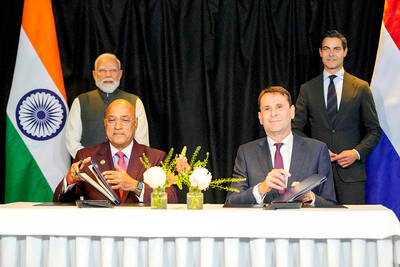
NEW MARKET: The partnership opens up India to the Dutch company, which already has a strong hold in the semiconductor market of South Korea, Taiwan and China ASML Holding NV entered into a partnership agreement with Tata Electronics Pvt Ltd aimed at ramping up India’s goal to develop domestic chip-manufacturing capabilities. The Dutch company’s technology would help power Tata Electronics’ planned 300 millimeter (mm) semiconductor foundry in Gujarat, according to a joint statement from the two companies on Saturday. The signing of a memorandum of understanding coincides with a visit by Indian Prime Minister Narendra Modi to the Netherlands, which is looking to deepen bilateral relations with New Delhi. ASML, whose top customers include Taiwan Semiconductor Manufacturing Co (台積電) and Samsung Electronics Co, makes lithography machines that can print
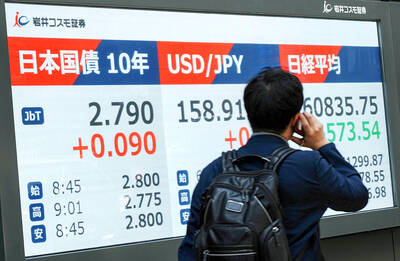
ROUGH RECORDS: Bonds in Japan, as well is in New Zealand, Australia and the US, are seeing the effects of a nervy market as stock exchanges across Asia edge down A deepening slump in Japanese government bonds added fuel to the selloff in global debt markets as rising oil prices stoked inflation fears and pushed yields to multi-decade highs. Japan’s 30-year yield yesterday surged as much as 20 basis points to the highest level since the tenor’s debut in 1999, before paring some of the move. Shorter-maturity Japanese debt was also under pressure, underscored by weak demand at a sale of five-year notes that offered a record-high coupon of 2 percent. Concerns over inflation and government spending rippling through markets including the US, Australia and New Zealand are being amplified in Japan,
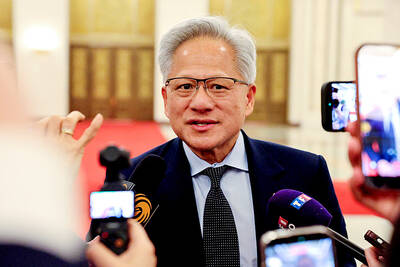
The US has cleared about 10 Chinese firms to buy Nvidia Corp’s second-most powerful artificial intelligence (AI) chip, the H200, but not a single delivery has been made so far, three people familiar with the matter said, leaving a major technology deal in limbo as chief executive officer Jensen Huang (黃仁勳) seeks a breakthrough in China this week. Huang, who was not initially listed in a White House delegation to Beijing, joined the trip after an invitation from US President Donald Trump, a source said. Trump picked him up in Alaska en route to a summit with Chinese President Xi Jinping

Wall Street is licking its chops over an unprecedented slate of massive initial public offerings (IPOs) set to arrive in the coming months, beginning with Elon Musk’s Space Exploration Technologies Corp (SpaceX) next month. That is expected to be followed by artificial intelligence (AI) rivals OpenAI and Anthropic PBC. The trio of mega listings, each eyeing valuations around US$1 trillion or more, constitutes a heady period of elevated risk and reward. SpaceX is targeting an IPO that would raise up to US$80 billion — about double the funds generated from all IPOs last year. OpenAI and Anthropic are eyeing IPOs raising US$60 billion. “We’re


 RSS
RSS