


Geopolitics and the national security concerns of some countries are threatening the globalization of the world’s chip industry and its future growth, the chairman and acting CEO of memorychip maker Yangtze Memory Technologies Co (YMTC, 長江存儲) said on Thursday.
Chen Nanxiang (陳南翔) said in a speech at the opening ceremony of the Semicon China conference in Shanghai that this made him doubt whether the global semiconductor industry could realize an earlier forecast of US$1 trillion in sales by 2030.
“There is a lot of government intervention, and a lot of political content is added in the middle,” he said, adding that he fully agreed with the comments Taiwan Semiconductor Manufacturing Co (台積電) founder Morris Chang (張忠謀) made in March about how globalization in the chip sector was “dead.” He did not name any countries.
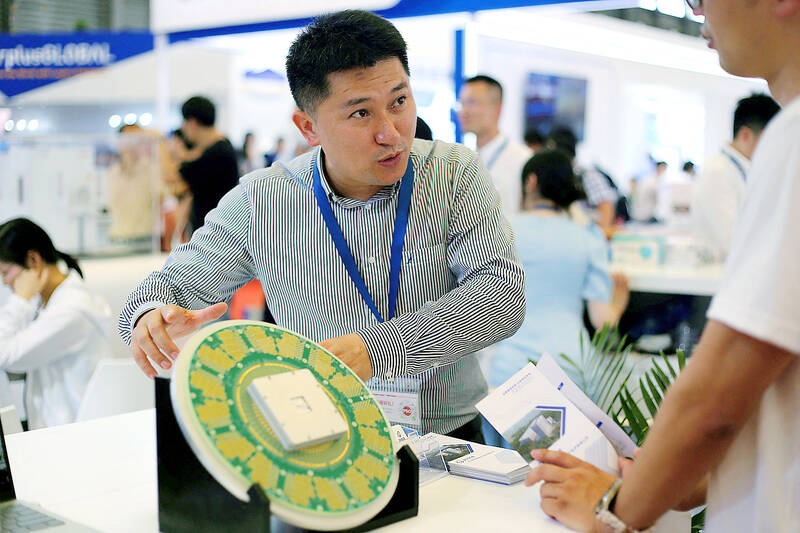
Photo: Reuters/Nicoco Chan
“Our industry itself is cyclical, and each practitioner has his own way of dealing with the cycle. However, the high degree of uncertainty we face is precisely due to the destruction of globalization,” he said, adding that he felt that the global industry was entering a “period of turmoil.”
Modern chipmaking involves more than 1,000 steps and requires complex intellectual property, tools and chemicals from around the world.
China, one of the largest chip markets, has been trying to build up its own manufacturing capability.
However, in recent years it has come under pressure from the US, which is keen to undercut these efforts.
YMTC is among key Chinese firms caught in the crossfire, after Washington enacted export controls last year against it and more than a dozen other players in the Chinese artificial intelligence chip sector on a trade blacklist over fears it could divert US technology to previously blacklisted Chinese tech giants Huawei Technologies Co (華為) and Hikvision Digital Technology Co (海康威視).
The move barred YMTC’s suppliers from shipping US goods to it without a difficult-to-obtain license.
Chen hinted at YMTC’s own troubles during his speech, with a direct appeal to equipment suppliers in attendance.
“For YMTC that I manage, we can no longer procure parts and components for equipment we had legally bought. If it is fair, please set up some fair rules to buy back the equipment,” he said.

The domestic unit of the Chinese-owned, Dutch-headquartered chipmaker Nexperia BV will soon be able to produce semiconductors locally within China, according to two company sources. Nexperia is at the center of a global tug-of-war over critical semiconductor technology, with a Dutch court in February ordering a probe into alleged mismanagement at the company. The geopolitical tussle has disrupted supply chains, with some carmakers reportedly forced to cut production due to chip shortages. Local production would allow Nexperia’s domestic arm, Nexperia Semiconductors (China) Ltd (安世半導體中國), to bypass restrictions in place since October on the supply of silicon wafers — etched with tiny components to

Singapore-based ride-hailing and delivery giant Grab Holdings Ltd has applied for regulatory approval to acquire the Taiwan operations of Germany-based Delivery Hero SE's Foodpanda in a deal valued at about US$600 million. Grab submitted the filing to the Fair Trade Commission on Friday last week, with the transaction subject to regulatory review and approval, the company said in a statement yesterday. Its independent governance structure would help foster a healthy and competitive market in Taiwan if the deal is approved, Grab said. Grab, which is listed on the NASDAQ, said in the filing that US-based Uber Technologies Inc holds about 13 percent of

Taiwan Semiconductor Manufacturing Co (TSMC, 台積電) yesterday received government approval to deploy its advanced 3-nanometer (3nm) process at its second fab currently under construction in Japan, the Ministry of Economic Affairs said in a news release. The ministry green-lit the plan for the facility in Kumamoto, which is scheduled to start installing equipment and come online in 2028 with a monthly production capacity of 15,000 12-inch wafers, the ministry said. The Department of Investment Review in June 2024 authorized a US$5.26 billion investment for the facility, slated to manufacture 6- to 12nm chips, significantly less advanced than 3nm process. At a meeting with

Taiwan’s food delivery market could undergo a major shift if Singapore-based Grab Holdings Ltd completes its planned acquisition of Delivery Hero SE’s Foodpanda business in Taiwan, industry experts said. Grab on Monday last week announced it would acquire Foodpanda’s Taiwan operations for US$600 million. The deal is expected to be finalized in the second half of this year, with Grab aiming to complete user migration to its platform by the first half of next year. A duopoly between Uber Eats and Foodpanda dominates Taiwan’s delivery market, a structure that has remained intact since the Fair Trade Commission (FTC) blocked Uber Technologies Inc’s


 RSS
RSS