


Nvidia Corp, the world’s most valuable chipmaker, is “extremely likely” to invest in Europe, chief executive officer Jensen Huang (黃仁勳) said.
Huang said European Commissioner for the Internal Market Thierry Breton said “that Nvidia should invest a great deal more in Europe and that Europe is going to be a wonderful place to build the future of Nvidia.”
The pair met on Friday as part of Breton’s discussions about content moderation and artificial intelligence with some of the largest tech companies in Silicon Valley.
Photo: Bloomberg
Nvidia’s value has jumped as its graphics processors have become the most popular for data centers needed to power generative artificial intelligence. The company’s sales in its data center unit gained 41 percent to US$15 billion last year.
At the same time, the US, the EU, Japan and India have agreed to spend more than US$100 billion in subsidies to attract the likes of Taiwan Semiconductor Manufacturing Co (台積電), Intel Corp and Micron Technology Inc.
Intel last week announced plans for new plants in Germany, Israel and Poland, spurred by government incentives.
Nvidia would also look to invest in Europe, Huang said.
“The reason for that is Nvidia would like to be a global international company and what a better place to — and [who] can imagine a better place to invest,” he told reporters after meeting with Breton.
Breton invited Huang to continue the discussion in Brussels next month.
While the semiconductor industry still faces inventory adjustment issues in the second quarter, some IC designers are expected to benefit from the launch of new products, TrendForce Corp (集邦科技) said last week.
In particular, Nvidia is expected to see sales grow further in the second quarter because of its development of AI-related chips, and it could take the top spot in the global IC design market, TrendForce said.
Nvidia’s revenue in the first quarter rose 13.5 percent from a quarter earlier to US$6.73 billion.
That gave it a 19.9 percent share of the global IC design market to rank third-largest, TrendForce said in a report on Tuesday.
Smartphone IC designer Qualcomm Inc led this sector with revenue of US$7.94 billion, up 0.6 percent from a quarter earlier, giving it a 23.5 percent market share.
Wireless and broadband communication IC designer Broadcom Corp took the second spot with US$6.91 billion in revenue in the quarter, down 2.7 percent from a quarter earlier, to secure a 20.4 percent market share.
IC designer Advanced Micro Devices Inc ranked fourth with a market share of 15.8 percent on sales of US$5.35 billion, while MediaTek Inc (聯發科) remained the fifth-largest with sales of US$3.15 billion and a 9.3 percent market share, TrendForce said.
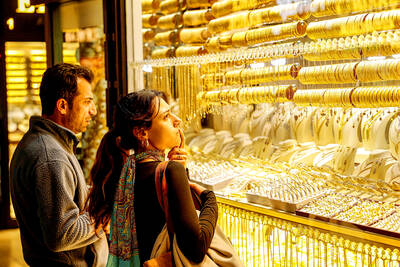
In Italy’s storied gold-making hubs, jewelers are reworking their designs to trim gold content as they race to blunt the effect of record prices and appeal to shoppers watching their budgets. Gold prices hit a record high on Thursday, surging near US$5,600 an ounce, more than double a year ago as geopolitical concerns and jitters over trade pushed investors toward the safe-haven asset. The rally is putting undue pressure on small artisans as they face mounting demands from customers, including international brands, to produce cheaper items, from signature pieces to wedding rings, according to interviews with four independent jewelers in Italy’s main
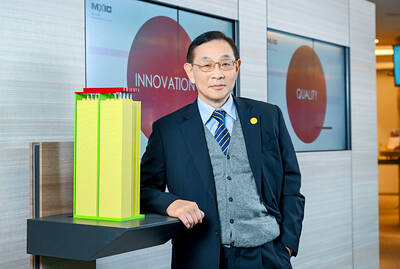
Macronix International Co (旺宏), the world’s biggest NOR flash memory supplier, yesterday said it would spend NT$22 billion (US$699.1 million) on capacity expansion this year to increase its production of mid-to-low-density memory chips as the world’s major memorychip suppliers are phasing out the market. The company said its planned capital expenditures are about 11 times higher than the NT$1.8 billion it spent on new facilities and equipment last year. A majority of this year’s outlay would be allocated to step up capacity of multi-level cell (MLC) NAND flash memory chips, which are used in embedded multimedia cards (eMMC), a managed

Japanese Prime Minister Sanae Takaichi has talked up the benefits of a weaker yen in a campaign speech, adopting a tone at odds with her finance ministry, which has refused to rule out any options to counter excessive foreign exchange volatility. Takaichi later softened her stance, saying she did not have a preference for the yen’s direction. “People say the weak yen is bad right now, but for export industries, it’s a major opportunity,” Takaichi said on Saturday at a rally for Liberal Democratic Party candidate Daishiro Yamagiwa in Kanagawa Prefecture ahead of a snap election on Sunday. “Whether it’s selling food or

In the wake of strong global demand for AI applications, Taiwan’s export-oriented economy accelerated with the composite index of economic indicators flashing the first “red” light in December for one year, indicating the economy is in booming mode, the National Development Council (NDC) said yesterday. Moreover, the index of leading indicators, which gauges the potential state of the economy over the next six months, also moved higher in December amid growing optimism over the outlook, the NDC said. In December, the index of economic indicators rose one point from a month earlier to 38, at the lower end of the “red” light.


 RSS
RSS