


The Greater Phoenix Economic Council (GPEC), a major business group in the US city, on Friday promised Taiwan Semiconductor Manufacturing Co (TSMC, 台積電) that it would gain access to sufficient water supplies for its fabs under construction in the drought-affected state of Arizona.
TSMC has obtained a large volume of water as the city had promised since the company began its investments in Phoenix, GPEC president and CEO Chris Camacho said, adding that if it is planning to build more fabs in the city, his group would help the Taiwanese chipmaker gain sufficient water.
On its Web site, the GPEC said it has fueled the regional economy in the past 33 years by helping 950 companies, creating more than 174,000 jobs and US$36 billion in capital investments.

Photo: CNA
The GPEC has been named one of the top economic development organizations in the US by the non-profit International Economic Development Council, which serves economic developers.
Concerns over water supplies in Arizona have been running deep since a March 31 report in the financial weekly Barron’s, which speculated that TSMC could face competition for water in the state from agricultural users and nearby native American people.
US rival Intel Corp’s advanced fabs in Arizona are expected to add pressure on TSMC’s water needs, the report said.
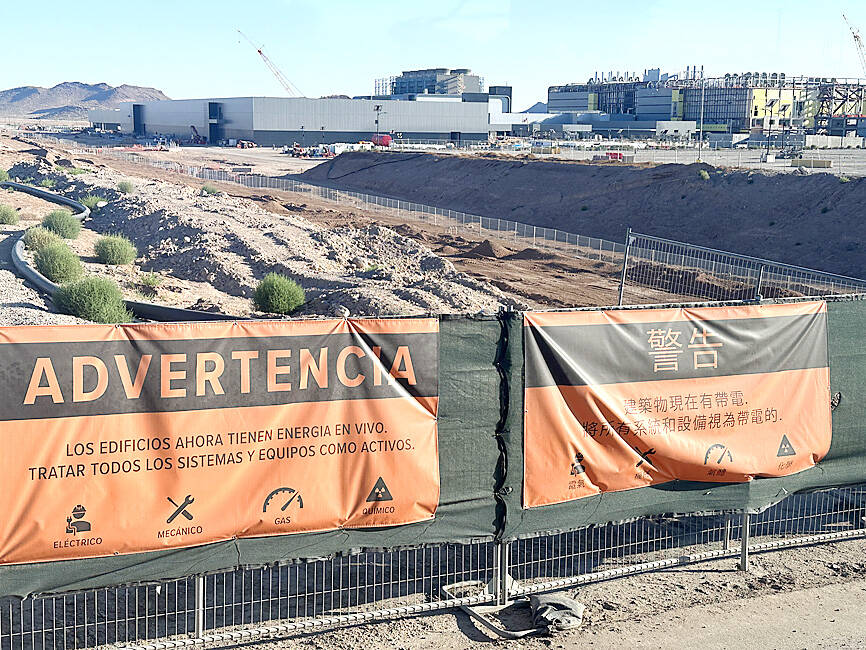
Photo: CNA
TSMC is investing US$40 billion to build two wafer fabs in Phoenix, with one scheduled to start mass production next year, using the company’s advanced 4-nanometer process, and the other to begin commercial production in 2026, using the more advanced 3-nanometer process, the latest technology the chipmaker has mass produced in Taiwan.
International news media have reported that TSMC could build up to six fabs in Arizona.
Citing an estimate from Phoenix officials, Barron’s said that TSMC could require up to 40,000 acre-foot (49.3 gigaliters) of water a year if it builds six fabs in Arizona, enough for 160,000 homes.
Camacho said that water has become a scarce resource to the western US, but Arizona has made great efforts in water resource planning in the past few decades to tackle this problem.
Camacho said the manufacturing sector only accounted for 5 percent of the total water allocation in Arizona, so future investors are expected to gain sufficient water resources.
TSMC is highly interested in water recycling and about 90 percent of the company’s water is recycled, which has drawn much attention from Phoenix, Chamacho said.
After the Barron’s report was published, TSMC tried to assuage fears over water supplies in Arizona, issuing a statement in early April reiterating its plans to construct a water recycling facility to meet the needs of its advanced wafer fabs in Phoenix, and build a comprehensive waste water treatment system to reduce consumption and increase efficiency.
TSMC said it has been in close contact with officials in Phoenix since the initial planning stages for its Arizona fabs, to ensure sufficient water resources.
Although TSMC’s water recycling efforts are expected to reduce the effect from Arizona’s water supply issues to some extent, electricity supply, much of which is generated by water, could pose another challenge to the chipmaker, Kirkland Capital (柯克蘭資本) chairman Kirk Yang (楊應超) said, adding that as Intel’s advanced fabs in Arizona are expected to exacerbate the situation, TSMC would face competition for water and power.
On Friday, the government-sponsored trade promotion organization Taiwan External Trade Development Council signed a memorandum of understanding with the GPEC to set up a partnership to push for economic development.
Camacho said that 24 TSMC suppliers have followed the chipmaker to go to the US, and another 27 are in talks with the GPEC about possible investments.
In addition to cooperation in semiconductors, the GPEC is eyeing investments in aviation, medical equipment and bioscience, renewable resources, and information and communications from Taiwan, he said.
In Italy’s storied gold-making hubs, jewelers are reworking their designs to trim gold content as they race to blunt the effect of record prices and appeal to shoppers watching their budgets. Gold prices hit a record high on Thursday, surging near US$5,600 an ounce, more than double a year ago as geopolitical concerns and jitters over trade pushed investors toward the safe-haven asset. The rally is putting undue pressure on small artisans as they face mounting demands from customers, including international brands, to produce cheaper items, from signature pieces to wedding rings, according to interviews with four independent jewelers in Italy’s main

Macronix International Co (旺宏), the world’s biggest NOR flash memory supplier, yesterday said it would spend NT$22 billion (US$699.1 million) on capacity expansion this year to increase its production of mid-to-low-density memory chips as the world’s major memorychip suppliers are phasing out the market. The company said its planned capital expenditures are about 11 times higher than the NT$1.8 billion it spent on new facilities and equipment last year. A majority of this year’s outlay would be allocated to step up capacity of multi-level cell (MLC) NAND flash memory chips, which are used in embedded multimedia cards (eMMC), a managed

Japanese Prime Minister Sanae Takaichi has talked up the benefits of a weaker yen in a campaign speech, adopting a tone at odds with her finance ministry, which has refused to rule out any options to counter excessive foreign exchange volatility. Takaichi later softened her stance, saying she did not have a preference for the yen’s direction. “People say the weak yen is bad right now, but for export industries, it’s a major opportunity,” Takaichi said on Saturday at a rally for Liberal Democratic Party candidate Daishiro Yamagiwa in Kanagawa Prefecture ahead of a snap election on Sunday. “Whether it’s selling food or

In the wake of strong global demand for AI applications, Taiwan’s export-oriented economy accelerated with the composite index of economic indicators flashing the first “red” light in December for one year, indicating the economy is in booming mode, the National Development Council (NDC) said yesterday. Moreover, the index of leading indicators, which gauges the potential state of the economy over the next six months, also moved higher in December amid growing optimism over the outlook, the NDC said. In December, the index of economic indicators rose one point from a month earlier to 38, at the lower end of the “red” light.


 RSS
RSS