


Foreign companies are shifting investments and their Asian headquarters out of China as confidence plunges following the expansion of an anti-spying law and other challenges, a business group said yesterday.
The report by the EU Chamber of Commerce in China adds to growing signs of pessimism, despite the Chinese Communist Party’s efforts to revive interest in the world’s No. 2 economy following the end of COVID-19 control measures.
Companies are uneasy about security controls, government protection of their Chinese rivals and a lack of action on reform promises, the European chamber said.

Photo: AP
They also are being squeezed by slowing Chinese economic growth and rising costs, it said.
Business confidence in China is “pretty much the lowest we have on record,” chamber president Jens Eskelund told reporters ahead of the report’s release.
“There’s no expectation that the regulatory environment is really going to improve over the next five years,” Eskelund said.
Chinese President Xi Jinping’s (習近平) government, trying to shore up economic growth that sank to 3 percent last year, is trying to encourage foreign companies to invest and bring in technology.
However, foreign firms are uneasy about security rules and plans to create competitors to global suppliers of computer chips, commercial jetliners and other technology. That often involves subsidies and market barriers that Washington and the EU say violate Beijing’s free-trade commitments.
Two-thirds of the 570 companies that responded to the chamber’s survey said that doing business in China has become more difficult, up from less than half before the COVID-19 pandemic.
Three out of five said the business environment is “more political,” up from half the previous year.
Companies are on edge after police raided offices of two consultancies, Bain & Co and Capvision, and a due diligence firm, Mintz Group, without public explanation. Authorities said companies are obliged to obey the law, but have given no indication of possible breaches.
Companies are also uneasy about Beijing’s promotion of national self-reliance. Xi’s government is pressing manufacturers, hospitals and others to use Chinese suppliers even if that raises their costs. Foreign companies worry they might be shut out of their markets.
Last month, the government banned using products from the biggest US maker of memory chips, Micron Technology Inc, in computers that handle sensitive information.
One in 10 firms in the survey said they had shifted investments out of China. Another one in five are delaying or considering shifting investments.
China has long been a top investment destination due to its huge and growing consumer market, but companies complain about market access restrictions, pressure to hand over technology and other irritants.
The chamber said it was not just foreign companies that are moving: two out of five in its survey reported Chinese customers or suppliers are shifting investments out of the country.
The biggest concern is the CCP’s sweeping expansion of its definition of national security to include the economy, food, energy and politics, Eskelund said.
In the survey, the top destination for companies moving their Asian headquarters out of China was Singapore, capturing 43 percent of companies that moved, followed by Malaysia.
Only 9 percent went or plan to go to Hong Kong.

The domestic unit of the Chinese-owned, Dutch-headquartered chipmaker Nexperia BV will soon be able to produce semiconductors locally within China, according to two company sources. Nexperia is at the center of a global tug-of-war over critical semiconductor technology, with a Dutch court in February ordering a probe into alleged mismanagement at the company. The geopolitical tussle has disrupted supply chains, with some carmakers reportedly forced to cut production due to chip shortages. Local production would allow Nexperia’s domestic arm, Nexperia Semiconductors (China) Ltd (安世半導體中國), to bypass restrictions in place since October on the supply of silicon wafers — etched with tiny components to

Singapore-based ride-hailing and delivery giant Grab Holdings Ltd has applied for regulatory approval to acquire the Taiwan operations of Germany-based Delivery Hero SE's Foodpanda in a deal valued at about US$600 million. Grab submitted the filing to the Fair Trade Commission on Friday last week, with the transaction subject to regulatory review and approval, the company said in a statement yesterday. Its independent governance structure would help foster a healthy and competitive market in Taiwan if the deal is approved, Grab said. Grab, which is listed on the NASDAQ, said in the filing that US-based Uber Technologies Inc holds about 13 percent of
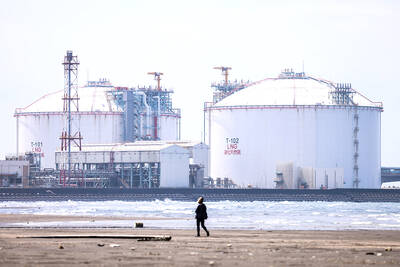
Taiwan is open to joining a global liquefied natural gas (LNG) program if one is created, but on the condition that countries provide delivery even in a scenario where there is a conflict with China, an energy department official said yesterday. While Taiwan’s priority is to have enough LNG at home, the nation is open to exploring potential strategic reserves in other countries such as Japan or South Korea, Energy Administration Deputy Director-General Chen Chung-hsien (陳崇憲) said. While the LNG market does not have a global reserve for emergencies like that of oil, the concept has been raised a few times —

Taiwan Semiconductor Manufacturing Co (TSMC, 台積電) yesterday received government approval to deploy its advanced 3-nanometer (3nm) process at its second fab currently under construction in Japan, the Ministry of Economic Affairs said in a news release. The ministry green-lit the plan for the facility in Kumamoto, which is scheduled to start installing equipment and come online in 2028 with a monthly production capacity of 15,000 12-inch wafers, the ministry said. The Department of Investment Review in June 2024 authorized a US$5.26 billion investment for the facility, slated to manufacture 6- to 12nm chips, significantly less advanced than 3nm process. At a meeting with


 RSS
RSS