


Taiwan was ranked the seventh-most popular destination for travelers from the Asia-Pacific region in a report released by Mastercard Inc last week.
Taiwan first entered the top 10 destinations for Asia-Pacific travelers in February in seventh place and retained that position in March, the Travel Industry Trends 2023 report said.
Australia was the most favored destination among Asia-Pacific travelers, ahead of the US, Hong Kong, Singapore, Japan and the UK, in that order, said the report, which was released on Tuesday by the Mastercard Economics Institute.

Photo courtesy of Mastercard Taiwan
Canada placed eighth, followed by Indonesia and Thailand, the report said.
“Across Asia-Pacific, rapid urbanization, technological advancements and a burgeoning middle class contribute to the rise in outbound tourism,” the report said.
“This growth is further fueled by the proliferation of low-cost carriers, improved visa policies and an increasing emphasis on experiences and adventure travel,” it said. “As a result, Asia-Pacific travelers are eager to explore regional and international destinations, creating diverse opportunities for the travel industry.”
Citing the report, Mastercard Taiwan general manager Eva Chen (陳懿文) said that the reopening of China has also benefited the global tourism industry.
China’s reopening following tight COVID-19 regulations is likely to have a positive effect on the experience economy as pent-up demand for travel is expected to drive strong tailwinds, the report said.
As more enterprises resume offline work in the post-COVID-10 era, business travel demand is increasing, Chen said.
Travelers are also likely to seek out traveling experiences rather than buy durable goods during their trips, she added.
In a survey conducted by Mastercard from May 16 to 30 to shed light on Taiwan’s tourism market, 43.4 percent of 1,000 Taiwanese respondents aged 20 to 65 who were frequent travelers said they had traveled outside the country since it had eased border controls late last year.
Of the respondents, 93.1 percent said they plan to go overseas within the next year, while 42.5 percent said they are planning to increase the frequency of their overseas trips, as well as the number of days they spend traveling.
Due to global inflation, 35.3 percent of respondents said that their travel expenses had risen by more than NT$10,000 compared with the pre-COVID-19 era, while 28.6 percent said they had adjusted their traveling plans accordingly, such as by avoiding peak seasons, reducing their spending on lodging and scaling back shopping.

The domestic unit of the Chinese-owned, Dutch-headquartered chipmaker Nexperia BV will soon be able to produce semiconductors locally within China, according to two company sources. Nexperia is at the center of a global tug-of-war over critical semiconductor technology, with a Dutch court in February ordering a probe into alleged mismanagement at the company. The geopolitical tussle has disrupted supply chains, with some carmakers reportedly forced to cut production due to chip shortages. Local production would allow Nexperia’s domestic arm, Nexperia Semiconductors (China) Ltd (安世半導體中國), to bypass restrictions in place since October on the supply of silicon wafers — etched with tiny components to

Singapore-based ride-hailing and delivery giant Grab Holdings Ltd has applied for regulatory approval to acquire the Taiwan operations of Germany-based Delivery Hero SE's Foodpanda in a deal valued at about US$600 million. Grab submitted the filing to the Fair Trade Commission on Friday last week, with the transaction subject to regulatory review and approval, the company said in a statement yesterday. Its independent governance structure would help foster a healthy and competitive market in Taiwan if the deal is approved, Grab said. Grab, which is listed on the NASDAQ, said in the filing that US-based Uber Technologies Inc holds about 13 percent of

Taiwan Semiconductor Manufacturing Co (TSMC, 台積電) yesterday received government approval to deploy its advanced 3-nanometer (3nm) process at its second fab currently under construction in Japan, the Ministry of Economic Affairs said in a news release. The ministry green-lit the plan for the facility in Kumamoto, which is scheduled to start installing equipment and come online in 2028 with a monthly production capacity of 15,000 12-inch wafers, the ministry said. The Department of Investment Review in June 2024 authorized a US$5.26 billion investment for the facility, slated to manufacture 6- to 12nm chips, significantly less advanced than 3nm process. At a meeting with
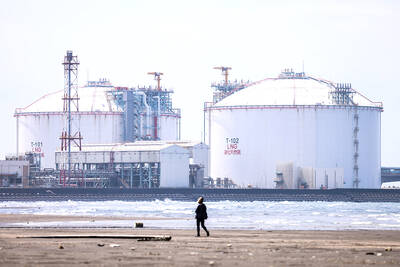
Taiwan is open to joining a global liquefied natural gas (LNG) program if one is created, but on the condition that countries provide delivery even in a scenario where there is a conflict with China, an energy department official said yesterday. While Taiwan’s priority is to have enough LNG at home, the nation is open to exploring potential strategic reserves in other countries such as Japan or South Korea, Energy Administration Deputy Director-General Chen Chung-hsien (陳崇憲) said. While the LNG market does not have a global reserve for emergencies like that of oil, the concept has been raised a few times —


 RSS
RSS