


Ever since poem-churning ChatGPT burst on the scene six months ago, expert Gary Marcus has voiced caution against artificial intelligence’s (AI) ultra-fast development and adoption.
However, against AI’s apocalyptic doomsayers, the New York University emeritus professor said in an interview that the technology’s existential threats could be “overblown.”
“I’m not personally that concerned about extinction risk, at least for now, because the scenarios are not that concrete,” Marcus said in San Francisco.
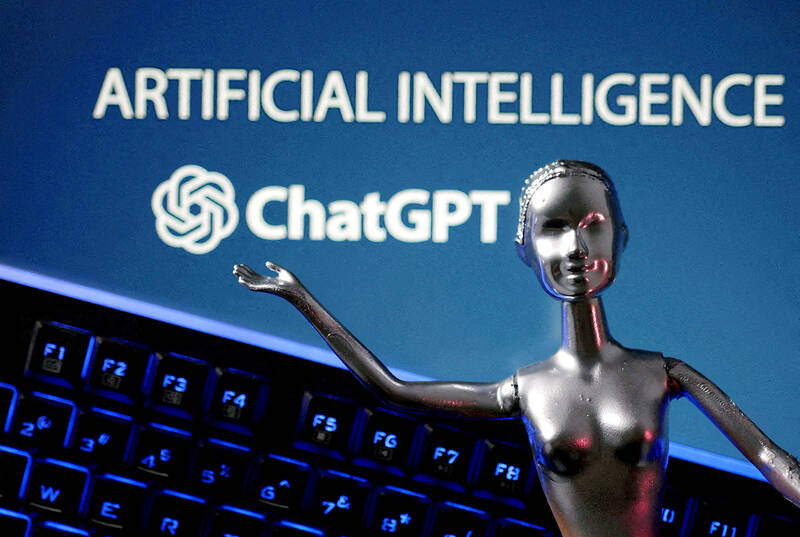
Photo: Reuters
“A more general problem that I am worried about ... is that we’re building AI systems that we don’t have very good control over and I think that poses a lot of risks, [but] maybe not literally existential,” he said.
Long before the advent of ChatGPT, Marcus designed his first AI program in high school — software to translate Latin into English — and after years of studying child psychology, he founded Geometric Intelligence, a machine learning company later acquired by Uber Technologies Inc.
In March, alarmed that ChatGPT creator OpenAI was releasing its latest and more powerful AI model with Microsoft Corp, Marcus signed an open letter with more than 1,000 people including Tesla Inc chief executive officer Elon Musk calling for a global pause in AI development.
However, last week he did not sign the more succinct statement by business leaders and specialists — including OpenAI founder Sam Altman — that caused a stir.
Global leaders should be working to reduce “the risk of extinction” from AI technology, the signatories said.
The one-line statement said that tackling the risks from AI should be “a global priority alongside other societal-scale risks such as pandemics and nuclear war.”
Signatories included those who are building systems with a view to achieving “general” AI, a technology that would hold the cognitive abilities on par with those of humans.
“If you really think there’s existential risk, why are you working on this at all? That’s a pretty fair question to ask,” Marcus said.
Instead of putting the focus on more far-fetched scenarios in which no one survives, society should be paying attention to where real dangers lie, Marcus said.
“People might try to manipulate the markets by using AI to cause all kinds of mayhem and then we might, for example, blame the Russians and say: ‘Look what they’ve done to our country,’ when the Russians actually weren’t involved,” he said.
“You [could] have this escalation that winds up in nuclear war or something like that. So I think there are scenarios where it was pretty serious. Extinction? I don’t know,” he said.
In the short term, Marcus is worried about democracy.
Generative AI software produces increasingly convincing fake photographs, and could soon produce videos, at little cost.
“Elections are going to be won by people who are better at spreading disinformation, and those people may change the rules and make it really difficult to have democracy proceed,” he said. “Democracy is premised on having reasonable information and making good decisions. If nobody knows what to believe, then how do you even proceed with democracy?”
The author of the book Rebooting AI does not think hope should be abandoned, as there is still "a lot of upside."
There is a chance that AI not yet invented could "help with science, with medicine, with elder care," Marcus said.
"But in the short term, I feel like we're just not ready. There's going to be some harm along the way and we really need to up our game, we have to figure out serious regulation," he said.
At a US Senate hearing last month, seated beside Altman, Marcus argued for the creation of a national or international agency responsible for AI governance.
The idea is backed by Altman, who has returned from a European tour in which he urged political leaders to find the "right balance" between safety and innovation.
However, beware of leaving the power to corporations, Marcus said.
"The last several months have been a real reminder that the big companies calling the shots here are not necessarily interested in the rest of us," he said.

The domestic unit of the Chinese-owned, Dutch-headquartered chipmaker Nexperia BV will soon be able to produce semiconductors locally within China, according to two company sources. Nexperia is at the center of a global tug-of-war over critical semiconductor technology, with a Dutch court in February ordering a probe into alleged mismanagement at the company. The geopolitical tussle has disrupted supply chains, with some carmakers reportedly forced to cut production due to chip shortages. Local production would allow Nexperia’s domestic arm, Nexperia Semiconductors (China) Ltd (安世半導體中國), to bypass restrictions in place since October on the supply of silicon wafers — etched with tiny components to

Singapore-based ride-hailing and delivery giant Grab Holdings Ltd has applied for regulatory approval to acquire the Taiwan operations of Germany-based Delivery Hero SE's Foodpanda in a deal valued at about US$600 million. Grab submitted the filing to the Fair Trade Commission on Friday last week, with the transaction subject to regulatory review and approval, the company said in a statement yesterday. Its independent governance structure would help foster a healthy and competitive market in Taiwan if the deal is approved, Grab said. Grab, which is listed on the NASDAQ, said in the filing that US-based Uber Technologies Inc holds about 13 percent of

Taiwan Semiconductor Manufacturing Co (TSMC, 台積電) yesterday received government approval to deploy its advanced 3-nanometer (3nm) process at its second fab currently under construction in Japan, the Ministry of Economic Affairs said in a news release. The ministry green-lit the plan for the facility in Kumamoto, which is scheduled to start installing equipment and come online in 2028 with a monthly production capacity of 15,000 12-inch wafers, the ministry said. The Department of Investment Review in June 2024 authorized a US$5.26 billion investment for the facility, slated to manufacture 6- to 12nm chips, significantly less advanced than 3nm process. At a meeting with

Taiwan’s food delivery market could undergo a major shift if Singapore-based Grab Holdings Ltd completes its planned acquisition of Delivery Hero SE’s Foodpanda business in Taiwan, industry experts said. Grab on Monday last week announced it would acquire Foodpanda’s Taiwan operations for US$600 million. The deal is expected to be finalized in the second half of this year, with Grab aiming to complete user migration to its platform by the first half of next year. A duopoly between Uber Eats and Foodpanda dominates Taiwan’s delivery market, a structure that has remained intact since the Fair Trade Commission (FTC) blocked Uber Technologies Inc’s


 RSS
RSS