


Standing by vast, ash-colored coalfields, miner Rabi Behera expressed few doubts about the job at hand. To cope with increasingly brutal temperatures, India has to keep its power grid standing — and for now that means digging up ever-expanding quantities of the dirtiest fossil fuel.
“It’s hard to survive without electricity during the summer,” he said, as giant trucks rumbled past in clouds of black dust. “Our production target is raised every year. Every year we’re producing more coal.”
So far, this year has been less blistering than last year, when temperatures in New Delhi climbed past 49°C, but February still broke records, April saw lethal conditions and forecasters issued warnings for this month, when pre-monsoon heat tends to peak.
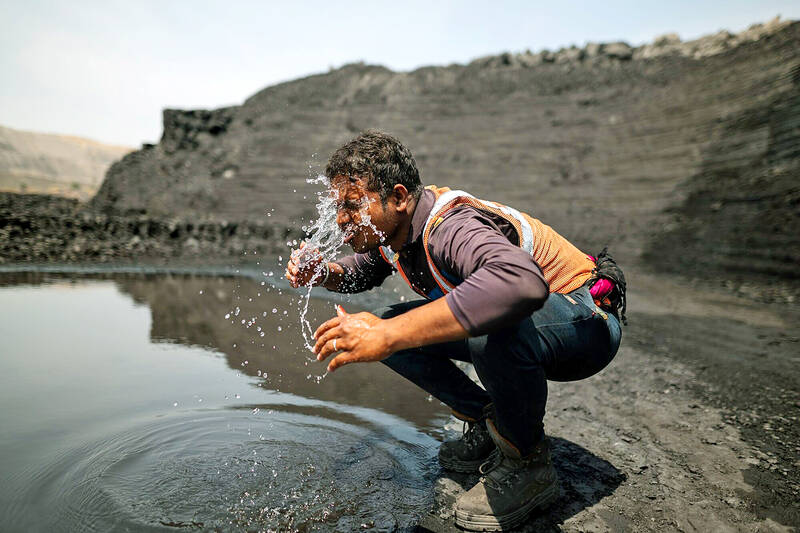
Photo: Bloomberg
Extreme temperatures are increasingly frequent, and that’s driving electricity consumption surges, which in turn push up demand for fuel from vast pits such as one in Gevra in the eastern state of Chhattisgarh, where Behera works — soon to become the largest coal mine in the world.
Wealthy nations are, by and large, moving away from coal, the single largest contributor to climate change, the International Energy Agency says.
However, even with considerable advances in renewable energy, the world’s most populous country still relies on the black stuff for roughly three-quarters of power generation, and would need it for years to come. The fuel is relatively cheap, and, crucially for an energy-importing economy, readily available domestically.
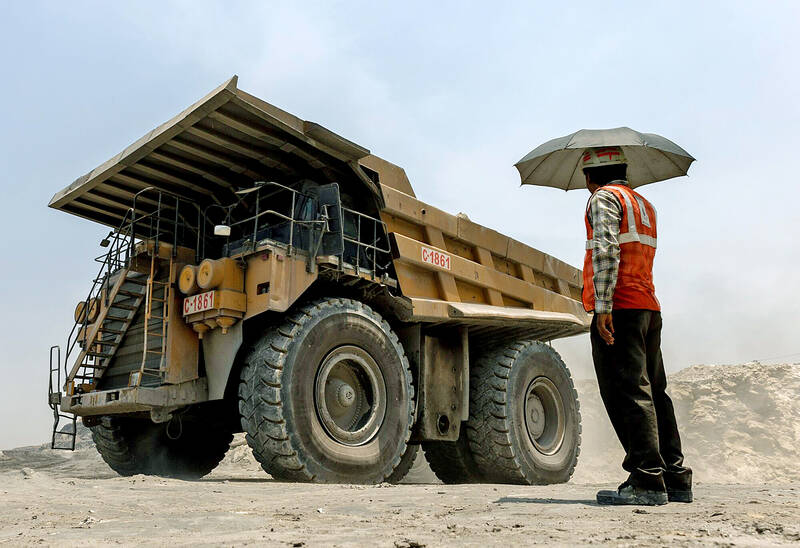
Photo: Bloomberg
As a result, India is now the third-largest emitter of greenhouse gases, even if it still lags China and the US, and per-capita figures remain below the global average. A vast, climate-vulnerable nation is making its own predicament worse, leaving hundreds of millions of its workers caught in a vicious heat cycle — with all the health and economic productivity costs that come with toiling in sweltering conditions.
A 2020 McKinsey Global Institute report said that as of 2017, heat-exposed work contributed to about half of India’s GDP, and a third of GDP growth.
It is not just about rising mercury. The combination of heat and humidity might make parts of India some of the world’s first uninhabitable places. At high humidity even relatively modest temperatures can compromise the body’s ability to cool itself by sweating. This can lead to fainting, heat stroke and heart attacks.
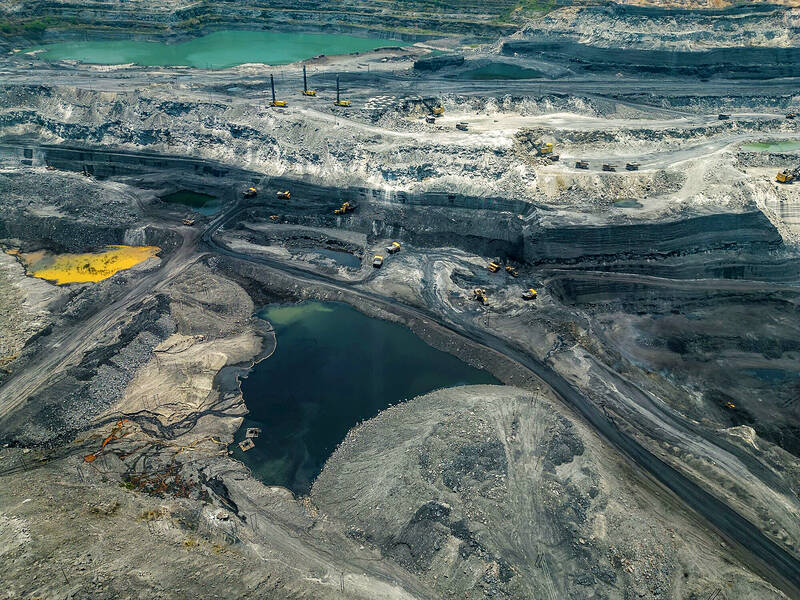
Photo: Bloomberg
“Heat is not foreign to most countries in South and Southeast Asia. However, at present level of global warming, it is just going beyond the survivability limit,” said Fahad Saeed, an Islamabad-based scientist with Climate Analytics. “The heat is incredibly serious and points to the need for us to reduce emissions as fast and as hard as we can.”
Miners such as Behera find themselves at both ends of the problem.
He helps dig coal for state-owned Coal India Ltd, one of the largest producers globally.
He said he sees the benefit of strong demand and his family enjoys the appliances electricity can power.
He is also among those risking the worst of the consequences, laboring daily in a black, shade-free moonscape. Unlike truck drivers who can take refuge in air-conditioned vehicles, Behera, a supervisor, spends his days outside, in a region where temperatures have topped 49°C.
Behera pointed out a small kiosk, insulated with wooden sheets, where workers can rest or eat in the shade, one of the measures the company has taken to mitigate the heat. Workers in hard hats and sunglasses walked past, their faces covered with scarves to protect against the heat and debris. Most employees carry oral rehydration salts, just in case. An ambulance is always on stand-by.
Temperatures always spike before the monsoon hits around June, but blistering, life-threatening levels like those reached last year, and tested again this year, are becoming more common. A changing climate has made extreme heat 30 times more likely in India.
There are consequences for agriculture in a country that has 1.4 billion people to feed, already frets about import bills and can roil world markets. Last year, severe heat forced the second-biggest producer of wheat to ban exports, fueling fears about global shortages as the war in Ukraine upended supply chains.
In the eastern state of Odisha, dairy farmer Manoj Kumar Behera described falling milk output as even mixed breeds among his 25 cows and calves struggle to tolerate the heat. With intermittent electricity supply, he has few options but to deal with the losses.
“When we ask about power cuts, we are told it’s happening due to abnormal demand for electricity during summer months,” he said, as his workers fed the cows nearby. “Sometimes when it gets too hot in the shed, we have to bring the cows out to rest under the trees.”
Production falls by close to one-third in such heat, he said.
The effect is far wider, threatening overall productivity, long-term health and even survival, as hundreds of millions are exposed to extreme conditions — a greater proportion of the population than anywhere else globally. Heat might lower the quality of life for almost 600 million Indians by 2100.
That means the myth that India, a hot country, can cope with extreme heat must be dispelled, said engineer and computational social scientist Ramit Debnath at the University of Cambridge.
He researches climate misinformation and last month published a study on the effects of heat on development.
“I received comments, including from doctors, saying Indians have their own way of coping with heat wave, so, it’s not a very big problem,” he said. “The notion that Indians are more resilient to heat than people elsewhere is misinformation.”
Awareness is growing. The government has developed heat action plans, providing guidelines for state, district and city authorities on how to respond.
Indian Prime Minister Narendra Modi led a meeting in March to review preparedness for hot weather conditions.
However, heat waves are not explicitly among the disasters eligible for relief under the National and State Disaster Response Funds, and a study of state and city-level heat action plans by the Centre for Policy Research think tank found significant gaps.
The blueprints for New Delhi, a metropolis of 33 million which smashed temperature records last year, have yet to be released.
The state government directed a request for comment to the local disaster management authority, which directed queries to the pollution control board. The pollution control board did not comment.
Meanwhile, official definitions of heat waves still focus only on temperature thresholds — not on the effects of high humidity or the link to smog.
“Heat waves can intensify air pollution and that’s simple physics: Pollutants won’t be able to escape because of the heat,” said Ronita Bardhan, an architectural engineer at the University of Cambridge who researches sustainability and also worked on the heat study.
Companies have largely been left to deal with the problem as they see fit.
Food delivery start-up Zomato Ltd provides rest stops for riders to take a break between deliveries, offering clean drinking water, first-aid kits and access to washrooms. Other e-commerce firms provide sports drinks or replace less breathable uniforms with material suited for hot weather.
There are also pressures to meet targets. In the Talcher coalfields in Odisha, run by a unit of Coal India, a local government directive means outside work should stop in the middle of the day, to prevent heatstroke.
However, work in the opencast mines rarely does, said workers who asked not to be identified as they are not authorized to speak to the media.
Some coal mine officials said they simply do whatever it takes to meet production targets.
Mahanadi Coalfields Ltd, the unit of Coal India, said the order does allow coal mining to continue as it is linked to essential services, specifically power supply.
The company tries to ensure the safety of field workers by limiting their exposure to the sun and maximizing output during cooler times of the day or at night.
“It is possible that [a] couple of workers may not be aware of the order. However, this does not mean we are not conscious of our duties to protect our workers,” it said in response to queries.
The trouble is that India’s power demand is growing. Green development, climate finance and sustainability have been a priority for its G20 presidency this year, but coal is to remain a major part of India’s power sector in the coming decades.
The Indian Central Electricity Authority said coal would account for 54 percent of generation in 2030, and the country is still building coal-fired plants.
“This will delay the amount of emissions that could have been cut off, and that’s a major concern — not just for India, but for across the world,” Bardhan said. “We are not saying that India needs to stop using coal completely at this point, but probably phasing out and understanding the opportunities and potential in renewables, understanding where the investments can happen ... those areas need more discussion.”
The opportunity should appeal as multilateral lenders and even wealthy nations and capital markets push cash toward the energy transition.
BloombergNEF calculates that India would need US$12.7 trillion in supply and demand-side investment to become net zero by 2050. The country aims to reach net zero by 2070.
Modi’s administration raised its goals for clean energy capacity last year. India is offering incentives to add more solar or wind power and aims to become a global hub for production of green hydrogen and green ammonia.
However, New Delhi has also opposed international efforts to set firm deadlines to phase out the use of coal.
With the monsoon still days from making landfall further south, the news is good mostly for air-conditioner sellers such as Vishnu Moorarka, sitting in his electronics shop in Bilaspur, a city on the Chhattisgarh plain, about a two-hour drive from the Gevra mine.
He has been anticipating the start of nautapa later this month, a nine-day period in the Hindu calendar that is traditionally considered the hottest of the season.
“We have stocked up inventory in expectation of high demand,” Moorarka said, with a cluster of air-conditioner units neatly stacked behind him.
His staff have not been allowed to take time off, and his eyes are constantly on his phone for weather alerts, he said.
After a long day at the Gevra mine, Rabi Behera is less optimistic.
“It’s getting hotter than earlier. Trees are being cut, industries and mines are coming up,” he said, at home with his two children. “It will only rise from here.”

The domestic unit of the Chinese-owned, Dutch-headquartered chipmaker Nexperia BV will soon be able to produce semiconductors locally within China, according to two company sources. Nexperia is at the center of a global tug-of-war over critical semiconductor technology, with a Dutch court in February ordering a probe into alleged mismanagement at the company. The geopolitical tussle has disrupted supply chains, with some carmakers reportedly forced to cut production due to chip shortages. Local production would allow Nexperia’s domestic arm, Nexperia Semiconductors (China) Ltd (安世半導體中國), to bypass restrictions in place since October on the supply of silicon wafers — etched with tiny components to

Singapore-based ride-hailing and delivery giant Grab Holdings Ltd has applied for regulatory approval to acquire the Taiwan operations of Germany-based Delivery Hero SE's Foodpanda in a deal valued at about US$600 million. Grab submitted the filing to the Fair Trade Commission on Friday last week, with the transaction subject to regulatory review and approval, the company said in a statement yesterday. Its independent governance structure would help foster a healthy and competitive market in Taiwan if the deal is approved, Grab said. Grab, which is listed on the NASDAQ, said in the filing that US-based Uber Technologies Inc holds about 13 percent of

Taiwan Semiconductor Manufacturing Co (TSMC, 台積電) yesterday received government approval to deploy its advanced 3-nanometer (3nm) process at its second fab currently under construction in Japan, the Ministry of Economic Affairs said in a news release. The ministry green-lit the plan for the facility in Kumamoto, which is scheduled to start installing equipment and come online in 2028 with a monthly production capacity of 15,000 12-inch wafers, the ministry said. The Department of Investment Review in June 2024 authorized a US$5.26 billion investment for the facility, slated to manufacture 6- to 12nm chips, significantly less advanced than 3nm process. At a meeting with
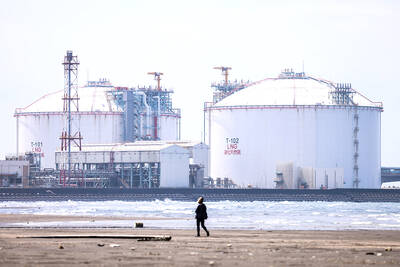
Taiwan is open to joining a global liquefied natural gas (LNG) program if one is created, but on the condition that countries provide delivery even in a scenario where there is a conflict with China, an energy department official said yesterday. While Taiwan’s priority is to have enough LNG at home, the nation is open to exploring potential strategic reserves in other countries such as Japan or South Korea, Energy Administration Deputy Director-General Chen Chung-hsien (陳崇憲) said. While the LNG market does not have a global reserve for emergencies like that of oil, the concept has been raised a few times —


 RSS
RSS