


The energy required to make chips for electronics, used in everything from smartphones to artificial intelligence hardware and vehicles, would skyrocket this decade, Greenpeace said yesterday.
This requires major firms to commit to seriously cutting emissions, the group said.
The global semiconductor manufacturing industry is projected to emit 86 million tonnes of carbon dioxide equivalent in 2030 — more than double Portugal’s total emissions in 2021, Greenpeace said in a new report.
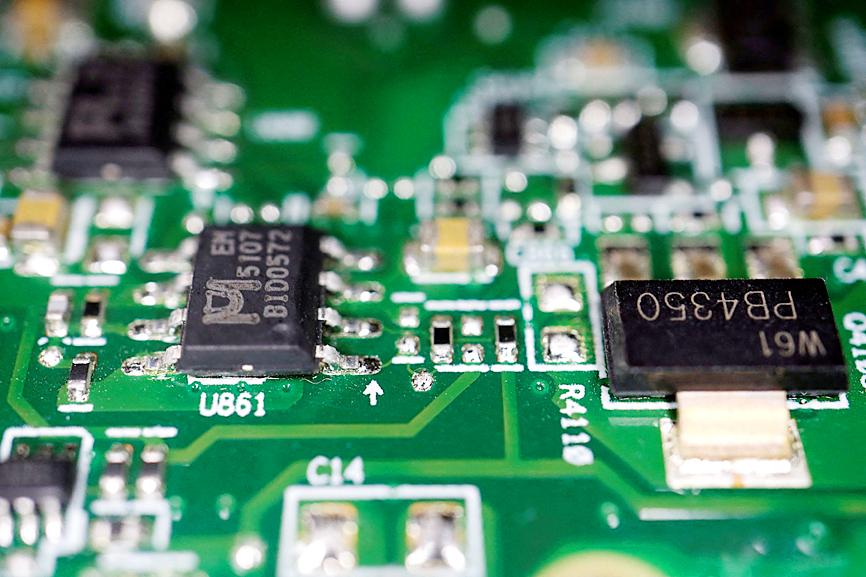
Photo: REUTERS
The group flagged high electricity use by semiconductor manufacturers as one of the major reasons behind rising emissions from the global electronics industry.
Its report focused on companies with operations in East Asia, home to major global semiconductor manufacturers including Apple Inc chip supplier Taiwan Semiconductor Manufacturing Co (TSMC, 台積電) and Samsung Electronics Co, South Korea’s largest chipmaker.
Electricity grids in East Asia are highly dependent on natural gas and coal-fired power generation, Greenpeace said.
None of the companies analyzed in the report has climate commitments in line with the Intergovernmental Panel on Climate Change recommendations to limit global warming to 1.5°C, nor to adopt 100 percent renewable energy by 2030, the report said.
“Most electronics industry suppliers studied have set long-term targets for carbon reduction, but their timelines do not reflect the level of ambition that is necessary in the face of catastrophic climate change,” it said.
Greenpeace said TSMC’s electricity consumption was projected to grow the most among all the semiconductor manufacturers studied — 267 percent by 2030, when it would consume as much power as about one-quarter of Taiwan’s population.
Samsung Electronics has not made firm 2030 climate commitments for its operations in South Korea, despite 75 percent of its electricity use happening on home soil, Greenpeace said.
Samsung last year announced a commitment to achieving net zero carbon emissions across global operations by 2050.
“We are committed to achieving our goal announced last year and will continue to share our progress with various stakeholders and listen to their feedback,” the company said in a statement when contacted for comment about the Greenpeace report.
Emissions from South Korea’s semiconductor manufacturing industry are projected to rise due in large part to Samsung’s “continued emissions growth,” Greenpeace said.
Samsung would use more electricity to make chips in 2030 than all of Singapore did in 2020, the group said.

Contract chipmaker United Microelectronics Corp (UMC, 聯電) yesterday said it has signed a memorandum of understanding (MOU) with Polar Semiconductor LLC to collaborate on the production of 8-inch wafers in the US. The collaboration aims to strengthen 8-inch wafer manufacturing in the US amid Washington’s efforts to increase onshore manufacturing of semiconductors, contribute to supply chain resilience against shifting geopolitical dynamics, and ensure a secure domestic supply of power semiconductors critical to automotive, electric grids, robotic manufacturing and data centers, the companies said in a joint statement. Under the MOU, Polar and UMC will identify devices for Polar to manufacture at

TECH TITANS: Amazon’s latest chip joins Google in competing for the 90 percent market share held by Nvidia, which claims it is ‘a generation ahead of the industry’ Amazon Web Services (AWS) on Tuesday launched its in-house-built Trainium3 artificial intelligence (AI) chip, marking a significant push to compete with Nvidia Corp in the lucrative market for AI computing power. The move intensifies competition in the AI chip market, where Nvidia dominates with an estimated 80 to 90 percent market share for products used in training large language models that power the likes of ChatGPT. Google last week caused tremors in the industry when it was reported that Facebook-parent Meta Platforms Inc would employ Google AI chips in data centers, signaling new competition for Nvidia. This followed the release last month of

Two companies wholly owned by the daughter of the founder of Hon Hai Precision Industry Co (鴻海精密) on Monday reported to the Taiwan Stock Exchange that they would dispose of all of the Hon Hai shares they hold. In filings with the exchange, Hong Wei Investment Co (鋐維) said it would sell the 2.771 million Hon Hai shares it holds and Frontier Investment Corp (承鋒投資) said it would sell its 2.409 million Hon Hai shares from tomorrow until Jan. 3 next year. The two companies are wholly owned and chaired by Shirley Gou (郭曉玲), the eldest daughter of Hon Hai founder Terry

TARIFF TALKS: The US secretary of commerce is eyeing more than US$300 billion in investments and said Taiwan would train US workers, but Taipei has denied the latter US Secretary of Commerce Howard Lutnick said the US is expecting a large investment pledge from Taiwan in trade talks, while President William Lai (賴清德) listed areas that need improvement in order for projects to be completed. “We’re in the midst of discussions,” Lutnick said on Wednesday. “But the fact is, this administration’s goal is to bring semiconductor manufacturing to America.” Lai on Wednesday said Taiwan is supportive of US President Donald Trump’s goal of reindustrializing the US, including efforts to ramp up semiconductor production. Such a goal would require the US to reduce its reliance on Taiwan as a key source


 RSS
RSS