


US Secretary of Commerce Howard Lutnick said the US is expecting a large investment pledge from Taiwan in trade talks, while President William Lai (賴清德) listed areas that need improvement in order for projects to be completed.
“We’re in the midst of discussions,” Lutnick said on Wednesday. “But the fact is, this administration’s goal is to bring semiconductor manufacturing to America.”
Lai on Wednesday said Taiwan is supportive of US President Donald Trump’s goal of reindustrializing the US, including efforts to ramp up semiconductor production.
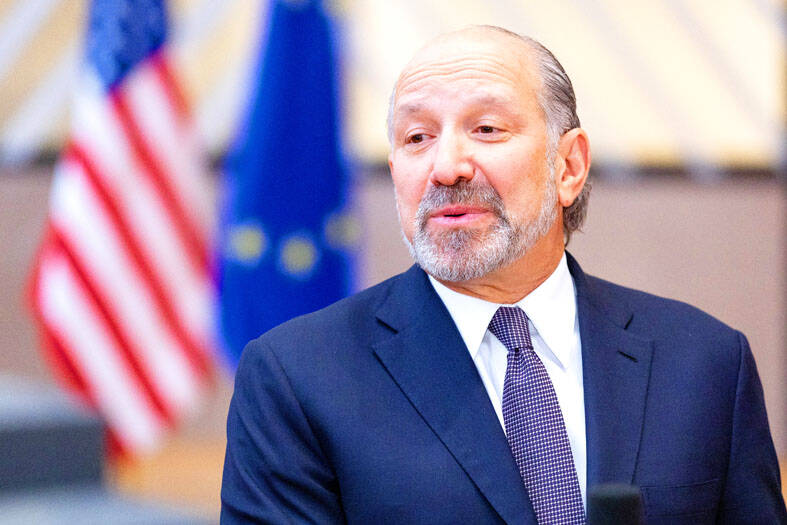
Photo: AP
Such a goal would require the US to reduce its reliance on Taiwan as a key source of chips.
To bring those plans to fruition, Taiwanese firms need some assurances on moves to facilitate investment, Lai said.
Lutnick has said he wants between 40 percent and 50 percent of US semiconductor consumption sourced domestically.
“We understand President Trump’s sense of urgency,” Lai said in an interview recorded for the DealBook Summit hosted by the New York Times. “Whether this target of 40 percent to 50 percent can be achieved within this time frame depends not only on Taiwan’s support, but also on the US government’s ability to facilitate land acquisition, water and electricity supply, workforce and talent development and investment incentives.”
“If the US government manages to do this well and effectively, then this goal becomes much more achievable,” Lai added.
Lutnick suggested he might be eyeing more than US$300 billion investment from Taiwan.
“TSMC [Taiwan Semiconductor Manufacturing Co, 台積電] announced a US$100 billion increase in their build in Arizona — up to US$165 billion. Micron invested more. Texas Instruments invested more. So we’re up to, like, US$300 billion in investment in America,” Lutnick said. “I think when we do a deal with Taiwan, that’s even going to be bigger.”
He did not indicate whether TSMC’s plans already are included in the administration’s hoped-for commitments from Taipei.
Lai also said that “we hope US tariff negotiations will not only help reduce the US trade deficit, but also deepen bilateral economic cooperation, further integrate Taiwan’s industries with the American economic structure and strengthen the Taiwan-US relationship.”
Taiwan last month said it had proposed a model for investment in the US that would see its industries pursue global expansion independently, with the government providing financial guarantees. The US would offer administrative support and incentives to help Taiwanese companies secure land and regulatory assistance when establishing service parks in the US.
“Our government supports TSMC and other Taiwanese semiconductor firms as they invest in the US, Japan, Europe or wherever they believe is needed. This contributes to global progress and prosperity,” Lai said.
Lutnick also said Taiwan would help train US workers for advanced semiconductor production, even as Taipei maintains such training is not part of bilateral tariff negotiations.
There is discussion of a plan for Taiwan to provide training for US workers to support advanced semiconductor production, he said.
However, Minister Without Portfolio Yang Jen-ni (楊珍妮), head of the Executive Yuan’s Office of Trade Negotiations, on Monday said that Taiwan has not agreed to train US technical personnel, adding that such a commitment is not part of the negotiations.
Minister of Economic Affairs Kung Ming-hsin (龔明鑫) said that workforce planning is essential for Taiwanese companies building fabs in the US, and that firms such as TSMC are already running their own training programs.
Additional reporting by CNA
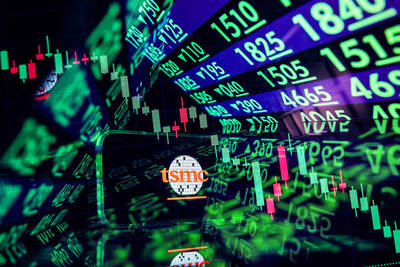
Taiwan Semiconductor Manufacturing Co (TSMC, 台積電) last week recorded an increase in the number of shareholders to the highest in almost eight months, despite its share price falling 3.38 percent from the previous week, Taiwan Stock Exchange data released on Saturday showed. As of Friday, TSMC had 1.88 million shareholders, the most since the week of April 25 and an increase of 31,870 from the previous week, the data showed. The number of shareholders jumped despite a drop of NT$50 (US$1.59), or 3.38 percent, in TSMC’s share price from a week earlier to NT$1,430, as investors took profits from their earlier gains
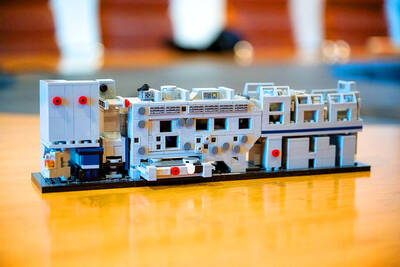
In a high-security Shenzhen laboratory, Chinese scientists have built what Washington has spent years trying to prevent: a prototype of a machine capable of producing the cutting-edge semiconductor chips that power artificial intelligence (AI), smartphones and weapons central to Western military dominance, Reuters has learned. Completed early this year and undergoing testing, the prototype fills nearly an entire factory floor. It was built by a team of former engineers from Dutch semiconductor giant ASML who reverse-engineered the company’s extreme ultraviolet lithography (EUV) machines, according to two people with knowledge of the project. EUV machines sit at the heart of a technological Cold
Taiwan’s long-term economic competitiveness will hinge not only on national champions like Taiwan Semiconductor Manufacturing Co. (TSMC, 台積電) but also on the widespread adoption of artificial intelligence (AI) and other emerging technologies, a US-based scholar has said. At a lecture in Taipei on Tuesday, Jeffrey Ding, assistant professor of political science at the George Washington University and author of "Technology and the Rise of Great Powers," argued that historical experience shows that general-purpose technologies (GPTs) — such as electricity, computers and now AI — shape long-term economic advantages through their diffusion across the broader economy. "What really matters is not who pioneers
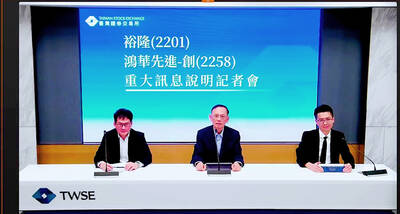
TAIWAN VALUE CHAIN: Foxtron is to fully own Luxgen following the transaction and it plans to launch a new electric model, the Foxtron Bria, in Taiwan next year Yulon Motor Co (裕隆汽車) yesterday said that its board of directors approved the disposal of its electric vehicle (EV) unit, Luxgen Motor Co (納智捷汽車), to Foxtron Vehicle Technologies Co (鴻華先進) for NT$787.6 million (US$24.98 million). Foxtron, a half-half joint venture between Yulon affiliate Hua-Chuang Automobile Information Technical Center Co (華創車電) and Hon Hai Precision Industry Co (鴻海精密), expects to wrap up the deal in the first quarter of next year. Foxtron would fully own Luxgen following the transaction, including five car distributing companies, outlets and all employees. The deal is subject to the approval of the Fair Trade Commission, Foxtron said. “Foxtron will be


 RSS
RSS