


China Steel Corp (中鋼) yesterday held steady domestic steel prices for delivery next month, snapping four straight months of upticks as customers digest the effects of price hikes and macroeconomic factors.
The steelmaker said its move matched steps made by Chinese peers Baowu Steel Group Ltd (寶武鋼鐵), the world’s biggest steelmaker, and Angang Steel Co (鞍山鋼鐵), which both paused price hikes for hot-rolled and cold-rolled steel for domestic delivery next month.
“China Steel has been hiking prices following the global steel market’s uptrends since the beginning of this year, but it will take more time for the supply chains to pass the higher costs to downstream clients,” China Steel said in a statement.
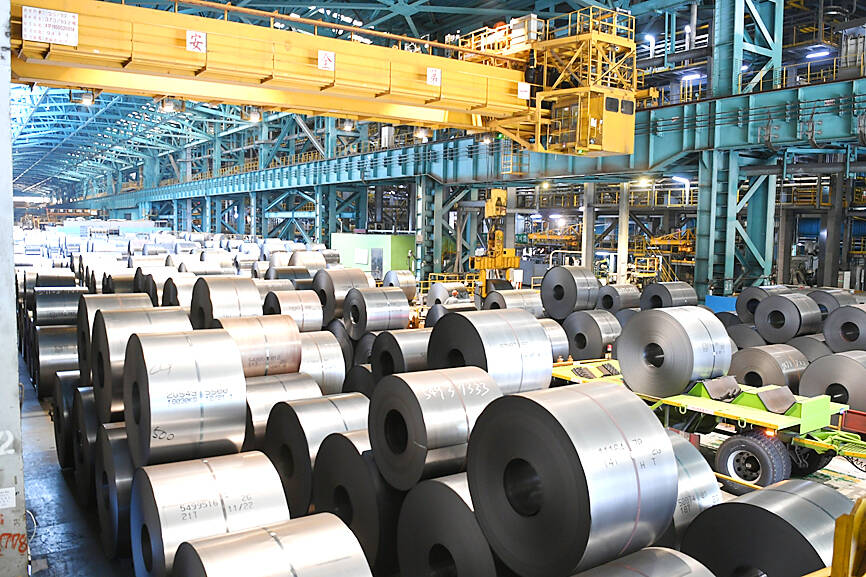
Photo courtesy of China Steel Corp
Customers have reduced inventory to healthy levels, but they became conservative about building inventory to cope with the steel industry’s peak season this quarter, as banking turmoil in the US and Europe as well as escalating geopolitical tensions weakened their confidence, the Kaohsiung-based company said.
“Steel prices would enter a transition period in the short term,” it said.
The company said that steel prices would probably start trending upward again after the short pause, given that most Asian steel markets are entering a benign consolidation phase before any breakouts.
Steel prices in the US and Europe are rebounding thanks to improved consumer confidence, it said.
In addition, a pull back in raw material costs is also keeping global steel prices from climbing, the statement said.
Iron ore prices have fallen to between US$120 and US$130 per tonne, while coking coal prices fell to between US$285 and US$300 per tonne, it said.
However, China Steel has a positive view, expecting that demand would bounce back later this year due to improving demand for housing projects and home appliances as the government rolls out tax incentives to upgrade to green products.
To align with the muted market sentiment in Taiwan and the rest of Asia, China Steel said it did not adjust its domestic prices, although manufacturing costs are on the rise.
The company expects its electricity bill to surge by NT$1.2 billion (US$39.39 million) annually after Taiwan Power Co (台電) increased electricity rates by 17 percent for industrial heavy users starting this month.
Higher global crude oil prices and rising water prices also pushed up manufacturing costs, China Steel said.
Prices for its hot-rolled and cold-rolled steel plates, electro-galvanized steel coil used in building construction, as well as galvannealed steel coil used in home appliances and computers would remain at last month’s levels, it said.
PRICE HIKES: The war in the Middle East would not significantly disrupt supply in the short term, but semiconductor companies are facing price surges for materials Taiwan’s semiconductor companies are not facing imminent supply disruptions of essential chemicals or raw materials due to the war in the Middle East, but surges in material costs loom large, industry association SEMI Taiwan said yesterday. The association’s comments came amid growing concerns that supplies of helium and other key raw materials used in semiconductor production could become a choke point after Qatar shut down its liquefied natural gas (LNG) production and helium output earlier this month due to the conflict. Qatar is the second-largest LNG supplier in the world and accounts for about 33 percent of global helium output. Helium is
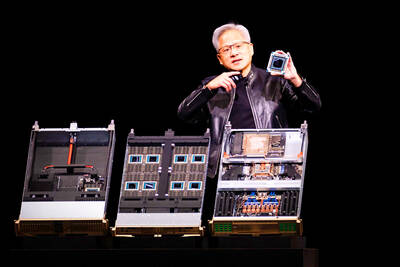
DOMESTIC COMPONENT: Huang identified several Taiwanese partners to be a key part of Nvidia’s Vera Rubin supply chain, including Asustek, Hon Hai and Wistron Nvidia Corp chief executive officer Jensen Huang (黃仁勳), addressing crowds at the company’s biggest annual event, unveiled a variety of new products while predicting that its flagship artificial intelligence (AI) processors would help generate US$1 trillion in sales through next year. During a two-and-a-half-hour keynote address, Huang announced plans to push deeper into central processing units (CPUs) — Intel Corp’s home turf — and introduced semiconductors made with technology acquired from start-up Groq Inc. The company even said it was developing chips for data centers in outer space. At the heart of Huang’s speech was the message that demand for computing power
OPTIMISTIC: Inflation still has a chance of remaining below the central bank’s 2 percent alert level, as Taiwan’s economy is resilient with healthy exports, the NDC minister said Taiwan’s inflation could exceed 2 percent this year if oil prices continue to surge amid escalating tensions in the Middle East, prompting the government to reassess its economic outlook, the Directorate-General of Budget, Accounting and Statistics (DGBAS) said yesterday. DGBAS Minister Chen Shu-tzu (陳淑姿) told lawmakers at a meeting of the legislature’s Finance Committee that the agency’s earlier growth forecast of 1.68 percent in the consumer price index (CPI) and 7.71 percent for GDP this year did not account for the ongoing Middle East conflict and would need revision, if tensions persist. The previous forecast assumed an average international crude price of

ELECTRIC DREAMS: Smart cities would use ‘virtual power plants,’ which integrate idle electricity use from households, businesses and factories, Asustek said Asustek Computer Inc (華碩) yesterday showcased key components of its artificial intelligence (AI)-driven smart city initiatives at a trade show in Taipei, eyeing new business opportunities as cities develop sovereign AI infrastructure. Advances in generative, multimodal and physical AI are driving cities toward a new phase of “sovereign AI,” Asustek cochief executive officer Samson Hu (胡書賓) told reporters on the sidelines of the Smart City Summit and Expo at Taipei Nangang Exhibition Center’s Hall 2. The company showcased its “AI City” framework, which comprises three layers — computing infrastructure centered on AI servers, AI models and a platform layer for data processing


 RSS
RSS