


The US is prepared to speed up interest rate hikes — and could raise them higher than anticipated — if needed to cool inflation and a strong jobs market, Federal Reserve Chair Jerome Powell said on Tuesday.
An “unseasonably warm” January across much of the country was likely behind the robust employment, consumer spending, manufacturing and inflation figures, which pointed to a partial reversal of earlier softening trends, Powell told the US Senate Committee on Banking, Housing and Urban Affairs.
“If the totality of the data were to indicate that faster tightening is warranted, we would be prepared to increase the pace of rate hikes,” he said.
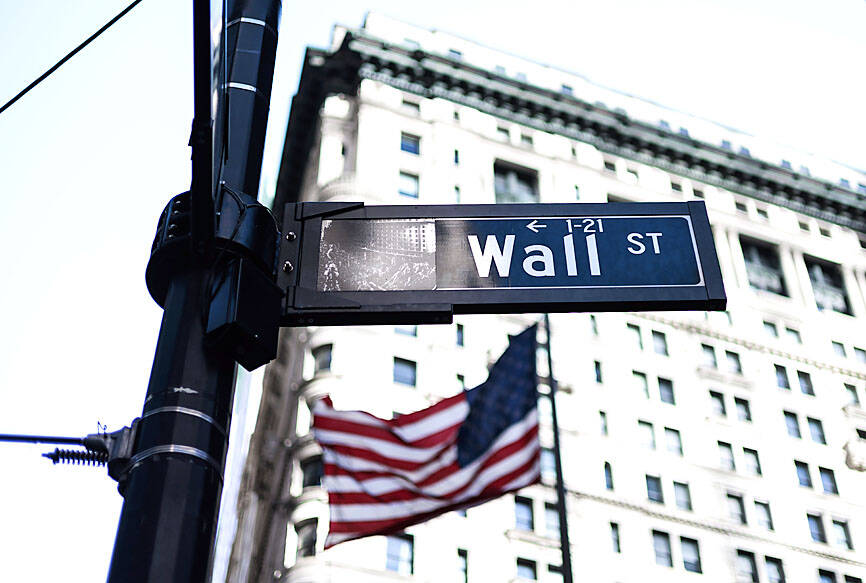
Photo: EPA-EFE
He added that the “ultimate level of interest rates” is likely to be higher than previously anticipated.
All three main indices on Wall Street closed deep in the red, and most of Asia followed suit, following Powell’s comments.
Hong Kong shed more than 2 percent, while Shanghai, Sydney, Seoul, Singapore, Taipei, Mumbai, Bangkok, Wellington and Jakarta were also well down.
However, Tokyo ended slightly higher, as exporters won support from a weaker yen.
The Japanese unit on Tuesday tumbled against the US dollar, along with other major currencies in the wake of Powell’s testimony.
The US central bank has already raised its benchmark lending rate eight times since early last year, as it contends with inflation that remains stubbornly above its long-term target of 2 percent.
It raised rates last month by a quarter percentage point to 4.50 to 4.75 percent, its highest level since the global financial crisis.
Powell’s comments raise the likelihood of the Fed lifting rates by 50 basis points at its next meeting this month, Evercore ISI economists Krishna Guha and Peter Williams wrote in a note to investors.
“We must accept that this option appears to be somewhat more live than we had previously believed,” they said, though adding that a quarter-point hike was still the more likely option.
Markets are now roughly evenly split on the chances of a larger half-point rate hike, Convera USA LLC senior market analyst Joe Manimbo said.
Despite its forceful moves, the Fed’s favored inflation measure, the personal consumption expenditures (PCE) price index, rose slightly to an annual rate of 5.4 percent in January.
Core PCE inflation, which excludes volatile energy and food prices, also rose 4.7 percent.
At the same time, the labor market remains “extremely tight,” with close to two jobs available for every one unemployed person in December last year, Powell said.
US job creation surged in January, with employers creating more than half a million new jobs and driving the unemployment rate to its lowest level since the 1960s.
A strong labor market supports incomes and, in turn, demand.
“To restore price stability, we will need to see lower inflation in this sector, and there will very likely be some softening in labor market conditions,” Powell said.
At Tuesday’s hearing, Powell also faced questions about ongoing negotiations between US President Joe Biden’s administration and Republicans in the US Congress over raising the debt ceiling.
“Whatever else may happen Congress really needs to raise the debt ceiling,” Powell said, adding to calls for the two sides to come to an agreement.
Powell’s appearance comes shortly after the US central bank released a semiannual report on monetary policy, which pointed to a tight labor market, robust job gains, historically low unemployment and elevated nominal wage growth.
“The process of getting inflation back down to 2 percent has a long way to go and is likely to be bumpy,” Powell said. “We will stay the course until the job is done.”

HORMUZ ISSUE: The US president said he expected crude prices to drop at the end of the war, which he called a ‘minor excursion’ that could continue ‘for a little while’ The United Arab Emirates (UAE) and Kuwait started reducing oil production, as the near-closure of the crucial Strait of Hormuz ripples through energy markets and affects global supply. Abu Dhabi National Oil Co (ADNOC) is “managing offshore production levels to address storage requirements,” the company said in a statement, without giving details. Kuwait Petroleum Corp said it was lowering production at its oil fields and refineries after “Iranian threats against safe passage of ships through the Strait of Hormuz.” The war in the Middle East has all but closed Hormuz, the narrow waterway linking the Persian Gulf to the open seas,

Nanya Technology Corp (南亞科技) yesterday said the DRAM supply crunch could extend through 2028, as the artificial intelligence (AI) boom has led the world’s major memory makers to dramatically reduce production of standard DRAM and allocate a significant portion of their capacity for high-bandwidth memory (HBM) chips. The most severe supply constraints would stretch to the first half of next year due to “very limited” increases in new DRAM capacity worldwide, Nanya Technology president Lee Pei-ing (李培瑛) told a news briefing. The company plans to increase monthly 12-inch wafer capacity to 20,000 in the first half of 2028 after a

Taiwan has enough crude oil reserves for more than 100 days and sufficient natural gas reserves for more than 11 days, both above the regulatory safety requirement, Minister of Economic Affairs Kung Ming-hsin (龔明鑫) said yesterday, adding that the government would prioritize domestic price stability as conflicts in the Middle East continue. Overall, energy supply for this month is secure, and the government is continuing efforts to ensure sufficient supply for next month, Kung told reporters after meeting with representatives from business groups at the ministry in Taipei. The ministry has been holding daily cross-ministry meetings at the Executive Yuan to ensure

RATIONING: The proposal would give the Trump administration ample leverage to negotiate investments in the US as it decides how many chips to give each country US officials are debating a new regulatory framework for exporting artificial intelligence (AI) chips and are considering requiring foreign nations to invest in US AI data centers or security guarantees as a condition for granting exports of 200,000 chips or more, according to a document seen by Reuters. The rules are not yet final and could change. They would be the first attempt to regulate the flow of AI chips to US allies and partners since US President Donald Trump’s administration said it rescinded its predecessor’s so-called AI diffusion rules. Those rules sought to keep a significant amount of AI


 RSS
RSS