


China Renaissance Holdings Ltd’s (華興資本) shares plummeted by as much as 50 percent yesterday after the investment bank said that it was unable to contact its chairman and chief executive officer, Bao Fan (包凡).
The disappearance of Bao, the company’s founder and controlling shareholder, drove China Renaissance’s Hong Kong-listed stock to hit a record low of HK$5 in early trade, wiping off HK$2.8 billion (US$357 million) in market value.
The stock regained some ground later in the day to be off by 28 percent in the Hong Kong market, which was down 0.7 percent. Nearly 30 million shares of the boutique investment bank changed hands yesterday, the highest on record.
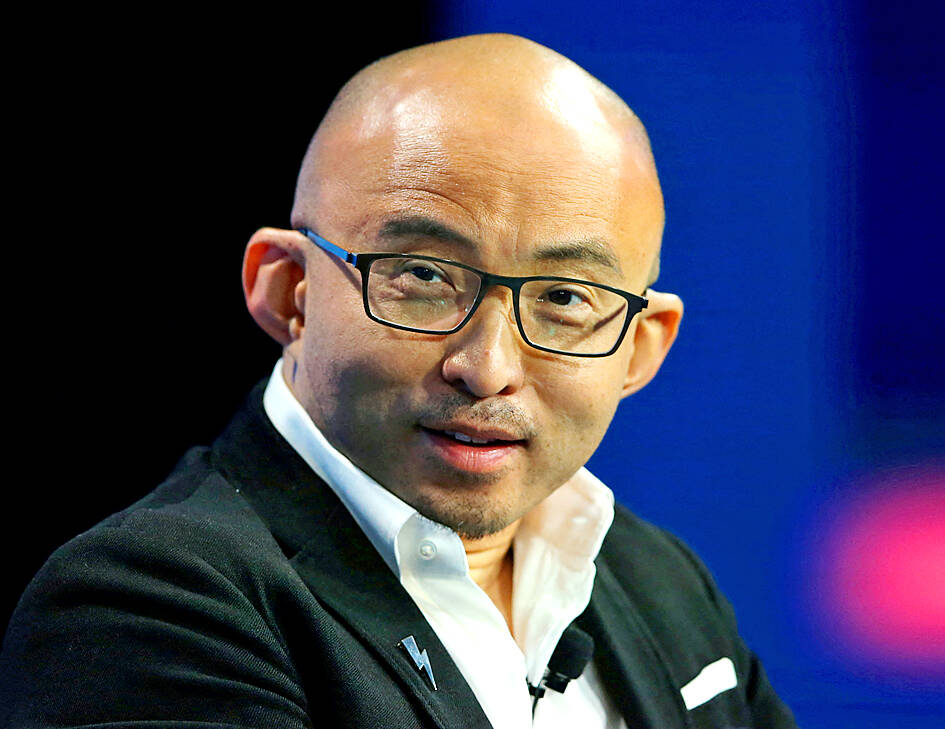
Photo: Reuters
“The board is not aware of any information that indicates that Mr Bao’s unavailability is or might be related to the business and/or operations of the group, which is continuing normally,” the mainland China-based bank said in a filing late on Thursday.
A China Renaissance spokesperson referred a request for comment yesterday to the investment bank’s public filing.
Bao’s disappearance is the latest in a series of cases of high-profile Chinese executives going missing with little explanation during a sweeping anti-corruption campaign spearheaded by Chinese President Xi Jinping (習近平).
In 2015 alone, at least five executives became unreachable without prior notice to their companies, including Fosun Group (復興集團) chairman Guo Guangchang (郭廣昌), who Fosun later said was assisting with investigations regarding a personal matter.
The disappearance comes after China’s border reopening and renewed focus on boosting the sagging economy has brightened the outlook for deals, as has an easing of a regulatory crackdown on technology firms.
Bao, who previously worked at Credit Suisse Group AG and Morgan Stanley, has been hailed as one of China’s best-connected bankers.
He was involved with major technology mergers including the tie-up of ride-hailing firms Didi (滴滴) and Kuaidi (快遞網), food delivery giants Meituan (美團) and Dianping (大眾點評), and travel devices platforms Ctrip (攜程旅行網) and Qunar (去哪兒網).
“If a listed company voluntarily discloses that a senior manager or a major shareholder cannot be contacted, it’s truly unusual, as the person might have been out of reach for some time,” said Dickie Wong (黃德几), executive director of research at Kingston Securities.
Investors’ worst nightmare is that a company’s ability to continue operating is impaired, so a stock sell-off is not surprising given the uncertainty, Wong said.
At the helm of China Renaissance, Bao has taken an increasingly active role in the group’s private equity business in the past few years, two sources with direct knowledge of matter said.
The sources declined to named due to sensitivity of the matter.
China Renaissance is ranked ninth on China’s equity capital markets leagues table for this year, according to Refinitiv, after it advised on Jiangsu Sanfame Polyester Material’s US$363 million convertible bond last month.
The firm earned US$20.6 million in Chinese-related investment banking fees last year, down from US$43.13 million a year earlier, the data showed.
Bao’s disappearance comes days after property developer Seazen Group Ltd (新城發展) said it was unable to contact or reach its vice chairman.

The domestic unit of the Chinese-owned, Dutch-headquartered chipmaker Nexperia BV will soon be able to produce semiconductors locally within China, according to two company sources. Nexperia is at the center of a global tug-of-war over critical semiconductor technology, with a Dutch court in February ordering a probe into alleged mismanagement at the company. The geopolitical tussle has disrupted supply chains, with some carmakers reportedly forced to cut production due to chip shortages. Local production would allow Nexperia’s domestic arm, Nexperia Semiconductors (China) Ltd (安世半導體中國), to bypass restrictions in place since October on the supply of silicon wafers — etched with tiny components to

Singapore-based ride-hailing and delivery giant Grab Holdings Ltd has applied for regulatory approval to acquire the Taiwan operations of Germany-based Delivery Hero SE's Foodpanda in a deal valued at about US$600 million. Grab submitted the filing to the Fair Trade Commission on Friday last week, with the transaction subject to regulatory review and approval, the company said in a statement yesterday. Its independent governance structure would help foster a healthy and competitive market in Taiwan if the deal is approved, Grab said. Grab, which is listed on the NASDAQ, said in the filing that US-based Uber Technologies Inc holds about 13 percent of

Taiwan Semiconductor Manufacturing Co (TSMC, 台積電) yesterday received government approval to deploy its advanced 3-nanometer (3nm) process at its second fab currently under construction in Japan, the Ministry of Economic Affairs said in a news release. The ministry green-lit the plan for the facility in Kumamoto, which is scheduled to start installing equipment and come online in 2028 with a monthly production capacity of 15,000 12-inch wafers, the ministry said. The Department of Investment Review in June 2024 authorized a US$5.26 billion investment for the facility, slated to manufacture 6- to 12nm chips, significantly less advanced than 3nm process. At a meeting with

Taiwan’s food delivery market could undergo a major shift if Singapore-based Grab Holdings Ltd completes its planned acquisition of Delivery Hero SE’s Foodpanda business in Taiwan, industry experts said. Grab on Monday last week announced it would acquire Foodpanda’s Taiwan operations for US$600 million. The deal is expected to be finalized in the second half of this year, with Grab aiming to complete user migration to its platform by the first half of next year. A duopoly between Uber Eats and Foodpanda dominates Taiwan’s delivery market, a structure that has remained intact since the Fair Trade Commission (FTC) blocked Uber Technologies Inc’s


 RSS
RSS