


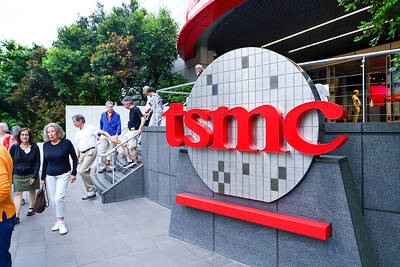
Taiwan Semiconductor Manufacturing Co (TSMC, 台積電), the world’s largest contract chipmaker, took the top spot among patent applicants in the country for the seventh consecutive year last year, the Intellectual Property Office of the Ministry of Economic Affairs said on Friday.
TSMC last year filed 1,534 patent applications, down 21 percent from a year earlier, but remained the top applicant in Taiwan, the office said.
All of TSMC’s patent applications were invention patents, it added.
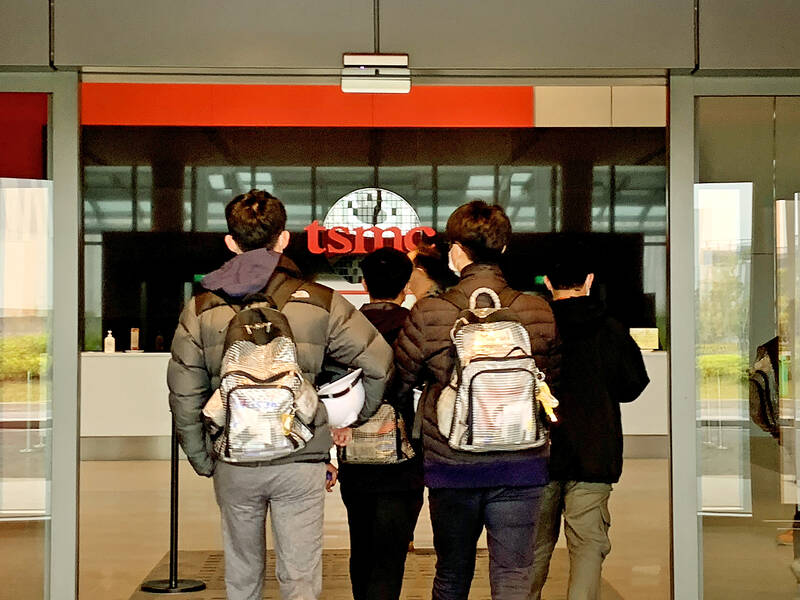
Photo: Grace Hung, Taipei Times
Patents are categorized into three groups by law — invention, utility model and design — with invention patents being the most important in the creation of new technical ideas.
Of foreign applications, US-based semiconductor equipment supplier Applied Materials Inc last year was Taiwan’s largest patent seeker, after filing 881 applications comprising 847 invention patents, two utility model patents and 32 design patents, the office said.
Applied Materials replaced smartphone IC designer Qualcomm Inc as the largest foreign patent applicant in Taiwan, the office said, adding that Qualcomm fell one spot to second place, with 763 applications, down 10 percent from a year earlier.
PC brand Acer Inc (宏碁) last year was second among local applicants with 530 patent applications, up 15 percent from a year earlier, ahead of flat panel maker AUO Corp (友達) with 505, up 7 percent.
Acer was also ahead of smartphone IC designer MediaTek Inc (聯發科) with 412 applications, up 58 percent, and DRAM chipmaker Nanya Technology Corp (南亞科技) with 371, up 28 percent.
Rounding out the top 10 local patent applicants were flat panel supplier Innolux Corp (群創) with 336 applications, up 2,700 percent; communication network IC designer Realtek Semiconductor Corp (瑞昱半導體) with 332, down 25 percent; government-sponsored Industrial Technology Research Institute with 331, down 18 percent; contract notebook computer maker Inventec Corp (英業達) with 289, up 24 percent; and China Steel Corp (中鋼) with 249, up 18 percent.
Intellectual Property Office Director Hong Shu-min (洪淑敏) said applications from Nanya Technology and Innolux hit 10-year highs.
Innolux’s impressive growth resulted from a relatively low comparison base a year earlier, as well as its efforts to develop Micro LED devices and precision medical equipment, Hong said.
Commenting on iPhone assembler Hon Hai Precision Industry Co (鴻海精密) not being among the top 10 local patent applicants for the second consecutive year, Hong said the company has changed its research-and-development strategies by assigning more of its efforts overseas.
Hon Hai, known globally as Foxconn Technology Group (富士康科技集團), focuses its research and development in the US and Japan, with each accounting for about 30 percent of patent applications, while China and Taiwan made up 20 percent and 10 percent respectively.
After Applied Materials and Qualcomm, South Korean Samsung Electronics Co last year took third spot among foreign patent applicants in Taiwan by filing 675 patents, up 30 percent from a year earlier, ahead of Japan-based semiconductor supplier Tokyo Electron Ltd with 487, up 2 percent, and Japanese electrical product maker Nitto Denko Corp with 445, down 16 percent, the office said.
Japanese memorychip supplier Kioxia Holdings Corp came in sixth with 436 applications, down 5 percent from a year earlier, followed by Facebook parent company Meta Platforms Inc with 293, up 281 percent; Japan’s Shin-Etsu Chemical Co with 275, up 35 percent; Japan’s Fujifilm Corp with 270, up 3 percent; and Japanese precision processing tool supplier Disco Corp with 266, up 18 percent, the office said.
Meta and Shin-Etsu Chemical were for the first time among the top 10 foreign patent applicants in Taiwan, with Meta benefiting from its efforts to develop technologies related to the metaverse, it said.
The top 10 foreign patent applicants were largely from the semiconductor, information technology and chemical industries, the office said.
A total of 72,059 patent applications last year were filed in Taiwan, down 0.8 percent, although invention patent applications bucked the downturn, rising 2 percent to a 10-year high of 50,242, the office said.
Among foreign applicants, Japan was the largest with 13,128 applications, ahead of the US with 8,517 and China with 4,424, it said.
Japan was the largest invention and design patent applicant, with China the largest utility model patent applicant last year, it added.
DOWNTURN FORECAST: Revenue grew to NT$200.05 billion last month, making it TSMC’s best January ever, but revenue could dip by up to 16 percent this quarter Taiwan Semiconductor Manufacturing Co (TSMC, 台積電) yesterday reported annual revenue growth of 16.2 percent to NT$200.05 billion (US$6.64 billion) last month, indicating that the world’s biggest contract chipmaker and a sole chip supplier for iPhones was unfazed by quarters-long supply chain inventor
Global index provider MSCI Inc has raised Taiwan’s weighting in one of its major indices, but left the country’s weighting in two others unchanged.MSCI yesterday said in a statement that following a quarterly review, it increased Taiwan’s weighting in the MSCI All-Country Asia ex-Japan Index by 0.03
QUICK REVERSAL: The move sent the chipmaker’s share price down 3.67 percent, after the billionaire investor’s company in October disclosed a major TSMC stake Warren Buffett slashed his holding of Taiwan Semiconductor Manufacturing Co (TSMC, 台積電) just months after disclosing a major stake, an unusually quick reversal by the billionaire investor that is chilling investor sentiment toward the chip giant.Buffett’s Berkshire Hathaway Inc cut its holding of TS
TSMC MEETING: The US lawmakers said the visit is not meant to provoke China, but to deepen cooperation in economic and political matters, as cross-party talks are planned The US and Taiwan should increase cooperation in manufacturing and innovation to benefit the world, a visiting US delegation said after meeting with Taiwan Semiconductor Manufacturing Co (TSMC, 台積電) founder Morris Chang (張忠謀) yesterday.US representatives Ro Khanna, Jake Auchincloss, Jonathan Jackson

Cairo’s new monorail slices across the city skyline, running above the familiar chaos of blaring horns and aging buses’ exhaust fumes that mark rush hour below. The US$4.5 billion monorail, opened this month, is among Egypt’s most prominent new transport projects, part of a debt-funded infrastructure drive criticized for sapping state finances while bringing limited benefits to most of the country’s 109 million people. “It feels like you’re in a different country,” said Ramy Sayed, a restaurant manager, aboard a driverless Innovia 300 train. “No noise, no traffic, we’re not used to this.” The eastern line runs 56km from the bustling middle-class
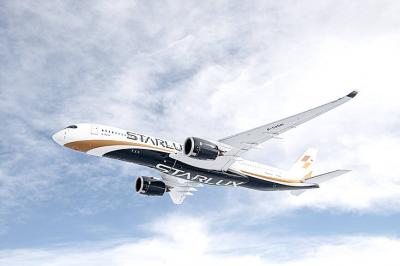
Starlux Airlines Co (星宇航空) today unveiled a long-haul network expansion plan at a shareholders’ meeting in Taipei, including direct flights to Barcelona, Spain, and Zurich, Switzerland, as well as a service connecting Taipei, Sydney and New Zealand. Starlux is to become the first Taiwanese carrier to offer non-stop services to the two European cities, while the inaugural oceanic route is expected to expand transit opportunities within the Australia-New Zealand market, Starlux said. Flight services to Chicago, Dallas, Washington and New York are under evaluation, the airline added. Prior to the shareholders’ meeting, the airline earlier this year announced that it would be
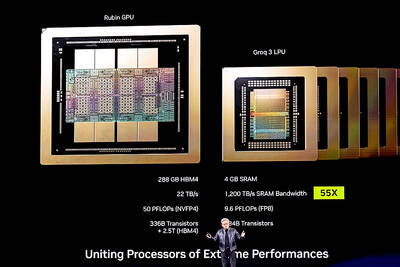
Taiwanese prosecutors suspect that three people successfully smuggled at least one shipment of Nvidia Corp artificial intelligence (AI) chips to China after first exporting them to Japan, people familiar with the matter said. The trio was detained last week by the Keelung District Prosecutors’ Office for allegedly falsifying documents related to exports of Super Micro Computer Inc servers containing advanced Nvidia chips, which the US has barred from sale to China without a license from Washington. The move marked Taiwan’s first public crackdown on AI chip diversion after years of pressure from the US to take a more active role in curtailing
Taiwan Semiconductor Manufacturing Co (TSMC, 台積電) employee bonuses are likely to grow more than 30 percent this year, in line with the past few years as the company’s profits continue to set new records, an anonymous source cited TSMC chairman C.C. Wei (魏哲家) as saying yesterday. TSMC, the world’s largest contract chipmaker, is committed to taking care of its workers, the source said, citing Wei’s meeting with employees yesterday morning. Wei also expressed gratitude to employees for their contribution to the company’s improving bottom line, the source added. Since 2023, TSMC’s employee bonuses have grown at an annual rate of


 RSS
RSS