


Flat-panel maker AUO Corp (友達) yesterday reported an annual loss of NT$21.1 billion (US$701.9 million), its worst in a decade, as surging inflation and macroeconomic uncertainty depressed consumer spending, leading to inventory buildup and record-low panel prices.
AUO said that losses improved slightly in the final quarter of last year to NT$10.21 billion from NT$10.43 billion in the third quarter.
On an annual basis, that was a stark contrast from the fourth quarter of 2021, when it posted a net profit of NT$11.79 billion.
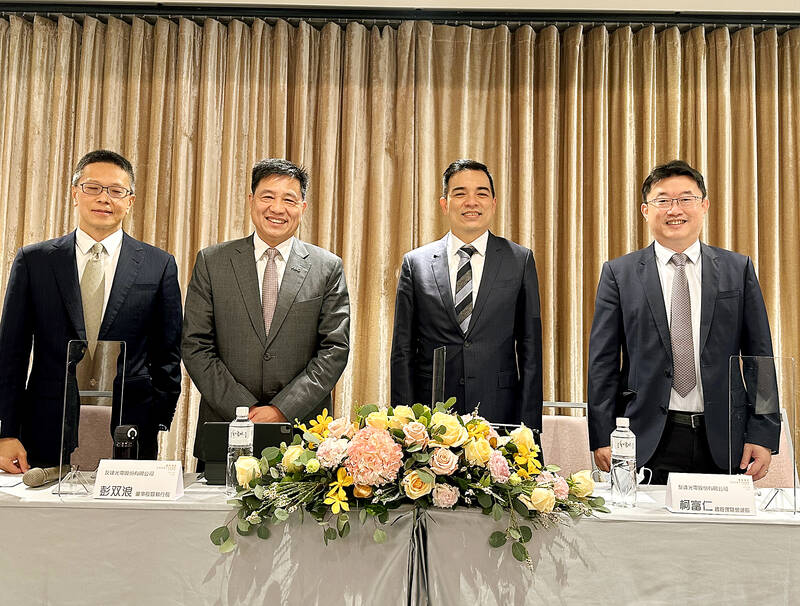
Photo: Chen Mei-ying, Taipei Times
Factory utilization bounced back to about 65 percent last quarter from 50 percent in the prior quarter, thanks to a rash of orders for lower-priced panels, AUO said.
As a result, its average selling price dropped 14 percent quarter-on-quarter, it said.
“It was a challenging year in 2022,” AUO chairman Paul Peng (彭双浪) told an investors’ conference in Taipei.
“Demand has sagged following an end to the high demand driven by the COVID-19 pandemic over the past two years,” he said.
“Since the second half of last year, most electronics brands have made inventory digestion their top priority,” he said.
Since then, the supply chain has entered about four to five quarters of inventory corrections, Peng said.
AUO has started to see signs of a pickup, especially in the TV panel area, with inventory gradually returning to healthy levels, Peng said.
It would take a longer period to see PC panel inventory return to normal, he said.
As overall supply chain inventory is falling, AUO hopes demand will pick up in the second half of this year, historically its high season, Peng said.
To minimize the impact of the panel industry’s boom-and-bust cycles, AUO said it is accelerating its diversification into non-display areas and aims to boost the new businesses’ revenue contribution to 20 percent in the next two to three years from more than 10 percent last year, which largely came from its solar energy plant operations.
The panel maker said that it would continue efforts to rein in operating expenses and capital spending this year.
The company plans to spend NT$35 billion this year — lower than last year’s NT$36 billion — to expand advanced panel capacity and new products.
AUO said its microLED technology is to enter volume production in the second half of the year, making it the first to mass produce microLED displays for wearable devices.
AUO expects panel shipments this quarter to drop by a mid-to-high single-digit percentage sequentially, while its blended average selling price would rise by a low-to-mid single-digit percentage.
Separately, the company’s board of directors has approved a plan to invest NT$1 billion to build a production line to assemble flat panels for monitors, it said.
It is making the investment at the request of customers and to diversify its manufacturing base, AUO president Frank Ko (柯富仁) said.
The new production line is to start operating in the first quarter of next year, he said.
The board also approved a NT$1 billion investment to create a three-way solar energy venture, which is to have initial capital of NT$3 billion, the company said in a filing with the Taiwan Stock Exchange.

The domestic unit of the Chinese-owned, Dutch-headquartered chipmaker Nexperia BV will soon be able to produce semiconductors locally within China, according to two company sources. Nexperia is at the center of a global tug-of-war over critical semiconductor technology, with a Dutch court in February ordering a probe into alleged mismanagement at the company. The geopolitical tussle has disrupted supply chains, with some carmakers reportedly forced to cut production due to chip shortages. Local production would allow Nexperia’s domestic arm, Nexperia Semiconductors (China) Ltd (安世半導體中國), to bypass restrictions in place since October on the supply of silicon wafers — etched with tiny components to

Singapore-based ride-hailing and delivery giant Grab Holdings Ltd has applied for regulatory approval to acquire the Taiwan operations of Germany-based Delivery Hero SE's Foodpanda in a deal valued at about US$600 million. Grab submitted the filing to the Fair Trade Commission on Friday last week, with the transaction subject to regulatory review and approval, the company said in a statement yesterday. Its independent governance structure would help foster a healthy and competitive market in Taiwan if the deal is approved, Grab said. Grab, which is listed on the NASDAQ, said in the filing that US-based Uber Technologies Inc holds about 13 percent of

Taiwan Semiconductor Manufacturing Co (TSMC, 台積電) yesterday received government approval to deploy its advanced 3-nanometer (3nm) process at its second fab currently under construction in Japan, the Ministry of Economic Affairs said in a news release. The ministry green-lit the plan for the facility in Kumamoto, which is scheduled to start installing equipment and come online in 2028 with a monthly production capacity of 15,000 12-inch wafers, the ministry said. The Department of Investment Review in June 2024 authorized a US$5.26 billion investment for the facility, slated to manufacture 6- to 12nm chips, significantly less advanced than 3nm process. At a meeting with

Taiwan is open to joining a global liquefied natural gas (LNG) program if one is created, but on the condition that countries provide delivery even in a scenario where there is a conflict with China, an energy department official said yesterday. While Taiwan’s priority is to have enough LNG at home, the nation is open to exploring potential strategic reserves in other countries such as Japan or South Korea, Energy Administration Deputy Director-General Chen Chung-hsien (陳崇憲) said. While the LNG market does not have a global reserve for emergencies like that of oil, the concept has been raised a few times —


 RSS
RSS