


The nation’s weakening economic outlook could spell the end of a rally for the New Taiwan dollar as investors reassess optimistic wagers on China’s reopening and a recovery in global demand for semiconductors.
The New Taiwan dollar is near its strongest level since June last year after rallying along with emerging-market peers on signs that global interest rates are reaching their peak.
However, Taiwan’s darkening economic outlook and mounting tension between the US and China threaten to cap further gains, analysts said.
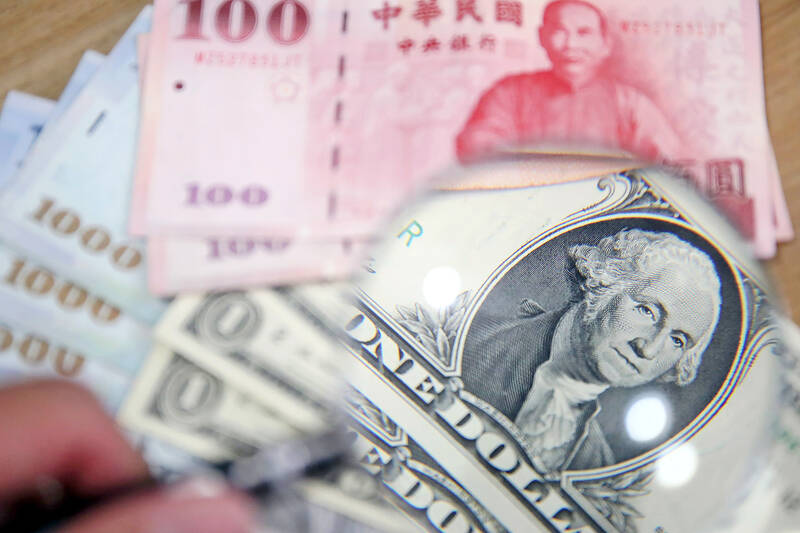
Photo: CNA
“Taiwan’s economic outlook remains weak and while it has seen equity inflows recently, the tech cycle is yet to turn and geopolitics will continue to weigh,” Credit Agricole CIB senior emerging markets strategist Eddie Cheung (張敬勤) said.
The currency is likely to weaken past NT$30 per US dollar in the coming weeks as traders pare optimistic bets on China’s reopening, he said.
The NT dollar traded 0.28 percent lower at NT$29.984 per US dollar yesterday in Taipei trading.
The headwinds for the NT dollar are mirrored by challenges facing other regional peers, boosting chances for the greenback to mount a comeback in Asia.
South Korea’s won could also be affected by falling demand from semiconductors, while pressure on current-account deficits look set to weigh on India’s rupee and the Philippine peso, analysts said.
The rally has already taken Taiwan’s currency into overbought territory versus the greenback, according to slow stochastics, a technical momentum indicator, suggesting it could struggle to make near-term gains.
Technical resistance around NT$29.02 per US dollar, the high of May 31 last year, is also poised to cap any advance.
Chipmakers including Taiwan Semiconductor Manufacturing Co (TSMC, 台積電) are major contributors to the economy, and the nation benefited from the COVID-19 pandemic-fueled surge in demand for electronics.
However, orders for the country’s cutting-edge technology have since waned, and TSMC rival Samsung Electronics Co recently warned that a recovery for the chip sector could be delayed until the second half of this year.
Investors can get their latest reading on the health of the nation’s economy when Taiwan releases trade data today, with economists expecting last month’s exports to slump 20.3 percent from a year earlier, estimates compiled by Bloomberg showed.
The NT dollar benefited from “a catch-up rally amid favorable circumstances to overall emerging currencies,” said Kiyong Seong, lead Asia macro strategist at Societe Generale SA in Hong Kong.
Seong expects a pullback in emerging-market currencies in the second quarter as slowing global growth replaces China’s reopening as the dominant theme.
“Taiwan macro continues to trend weaker in this semiconductor downcycle, and destocking may not be over in the first half,” keeping the currency under pressure, Bloomberg Intelligence Asia currency and rates strategist Stephen Chiu (趙志軒) said.
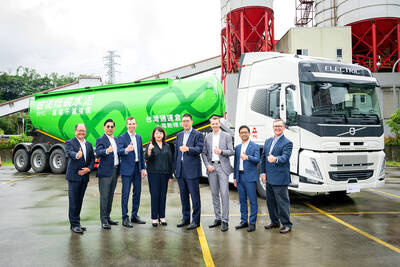
Taiwan Transport and Storage Corp (TTS, 台灣通運倉儲) yesterday unveiled its first electric tractor unit — manufactured by Volvo Trucks — in a ceremony in Taipei, and said the unit would soon be used to transport cement produced by Taiwan Cement Corp (TCC, 台灣水泥). Both TTS and TCC belong to TCC International Holdings Ltd (台泥國際集團). With the electric tractor unit, the Taipei-based cement firm would become the first in Taiwan to use electric vehicles to transport construction materials. TTS chairman Koo Kung-yi (辜公怡), Volvo Trucks vice president of sales and marketing Johan Selven, TCC president Roman Cheng (程耀輝) and Taikoo Motors Group

Among the rows of vibrators, rubber torsos and leather harnesses at a Chinese sex toys exhibition in Shanghai this weekend, the beginnings of an artificial intelligence (AI)-driven shift in the industry quietly pulsed. China manufactures about 70 percent of the world’s sex toys, most of it the “hardware” on display at the fair — whether that be technicolor tentacled dildos or hyper-realistic personalized silicone dolls. Yet smart toys have been rising in popularity for some time. Many major European and US brands already offer tech-enhanced products that can enable long-distance love, monitor well-being and even bring people one step closer to

RECORD-BREAKING: TSMC’s net profit last quarter beat market expectations by expanding 8.9% and it was the best first-quarter profit in the chipmaker’s history Taiwan Semiconductor Manufacturing Co (TSMC, 台積電), which counts Nvidia Corp as a key customer, yesterday said that artificial intelligence (AI) server chip revenue is set to more than double this year from last year amid rising demand. The chipmaker expects the growth momentum to continue in the next five years with an annual compound growth rate of 50 percent, TSMC chief executive officer C.C. Wei (魏哲家) told investors yesterday. By 2028, AI chips’ contribution to revenue would climb to about 20 percent from a percentage in the low teens, Wei said. “Almost all the AI innovators are working with TSMC to address the

Malaysia’s leader yesterday announced plans to build a massive semiconductor design park, aiming to boost the Southeast Asian nation’s role in the global chip industry. A prominent player in the semiconductor industry for decades, Malaysia accounts for an estimated 13 percent of global back-end manufacturing, according to German tech giant Bosch. Now it wants to go beyond production and emerge as a chip design powerhouse too, Malaysian Prime Minister Anwar Ibrahim said. “I am pleased to announce the largest IC (integrated circuit) Design Park in Southeast Asia, that will house world-class anchor tenants and collaborate with global companies such as Arm [Holdings PLC],”


 RSS
RSS