


Japan and the Netherlands are poised to join the US in limiting China’s access to advanced semiconductor machinery, forging a powerful alliance that could undercut Beijing’s ambitions to build its own domestic chip capabilities, people familiar with the negotiations said.
US, Dutch and Japanese officials are set to conclude talks on a new set of limits to what can be supplied to Chinese companies, the people said on condition of anonymity.
Negotiations were ongoing as of Thursday in Washington, and there is no plan for a public announcement of restrictions to be implemented, the people said.
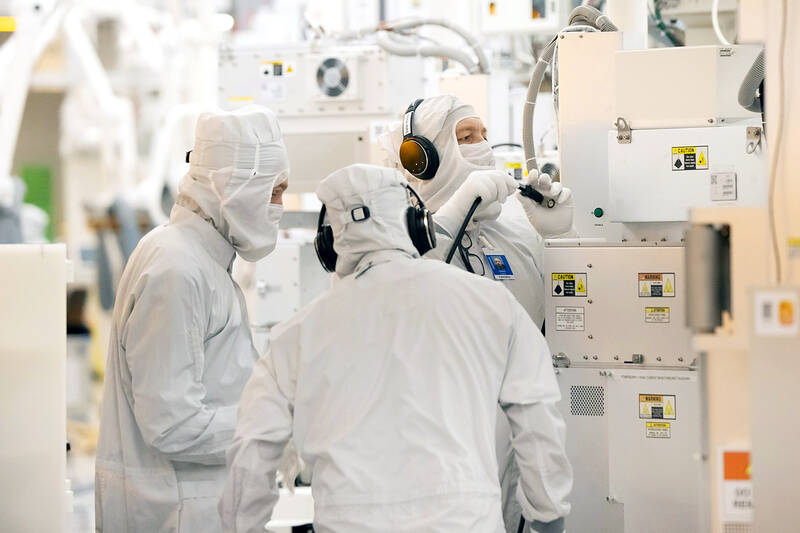
Photo: Bloomberg
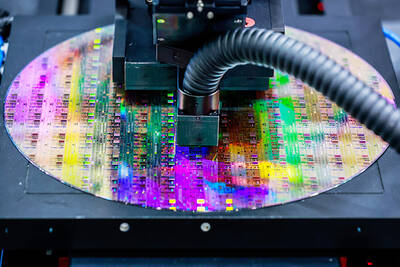
The Netherlands plans to expand restrictions on ASML Holding NV, which would prevent the company from selling to China some of its so-called deep ultraviolet lithography machines, crucial to making some types of advanced chips, and without which attempts to set up production lines are likely impossible.
Japan is to set similar limits on Nikon Corp.
A spokeswoman for the US National Security Council declined to comment.
The joint effort expands on restrictions Washington imposed in October last year to curtail China’s ability to manufacture its own advanced semiconductors or buy cutting-edge chips from abroad that would aid military and artificial intelligence capabilities.
The three countries are home to the companies most important to producing equipment for manufacturing chips, including ASML, Japan’s Tokyo Electron Ltd and the US’ Applied Materials Inc.
US equipment makers have said that the unilateral action by Washington has allowed overseas competitors to continue to operate in one of the biggest markets for their products, and undermined the aim of restricting China’s military advancements.
Tokyo Electron, which has sold chipmaking equipment to China, reversed gains and fell about 1 percent after Bloomberg’s report.
China’s chipmakers dropped too. Shanghai’s Semiconductor Manufacturing International Corp (中芯國際) extended declines to as much as 2.1 percent, while Hua Hong Semiconductor Ltd (華虹半導體) slid as much as 1.5 percent.
“This sets the next escalating move in the US-China tech war a bit more meaningfully and could weaken yuan sentiment a tad in the near term,” Malayan Banking Berhard foreign-exchange strategist Fiona Lim said in Singapore.
China has fought back against the US effort. Beijing filed a dispute with the WTO last month aimed at overturning the US-imposed export controls.
ASML CEO Peter Wennik on Wednesday said that the US-led export control measures against China could push Beijing to successfully develop its own technology in advanced chipmaking gear, in what would be an unintended consequence of the US campaign.
“If they cannot get those machines, they will develop them themselves,” he said in an interview with Bloomberg News.
“That will take time, but ultimately they will get there,” he added.

SECOND-RATE: Models distilled from US products do not perform the same as the original and undo measures that ensure the systems are neutral, the US’ cable said The US Department of State has ordered a global push to bring attention to what it said are widespread efforts by Chinese companies, including artificial intelligence (AI) start-up DeepSeek (深度求索), to steal intellectual property from US AI labs, according to a diplomatic cable. The cable, dated Friday and sent to diplomatic and consular posts around the world, instructs diplomatic staff to speak to their foreign counterparts about “concerns over adversaries’ extraction and distillation of US AI models.” Distillation is the process of training smaller AI models using output from larger, more expensive ones to lower the costs of training a powerful new
Shares of Taiwan Semiconductor Manufacturing Co (TSMC, 台積電) have repeatedly hit new highs, but an equity analyst said the stock’s valuation remains within a reasonable range and any pullback would likely be technical. The contract chipmaker’s historical price-to-earnings (P/E) ratio has ranged between 20 and 30, Cathay Futures Consultant Co (國泰證期) analyst Tsai Ming-han (蔡明翰) told Central News Agency. With market consensus projecting that TSMC would post earnings per share of about NT$100 (US$3.17) this year, supported by strong global demand for artificial intelligence (AI) applications, and the stock currently trading at a P/E ratio of below 25, Tsai said the valuation
The artificial intelligence (AI) boom has triggered a seismic reshuffling of global equity markets, with Taiwan and South Korea muscling past European nations one by one. With its stock market now valued at nearly US$4.3 trillion, Taiwan surpassed the UK, Europe’s biggest market, earlier this month, data compiled by Bloomberg showed. South Korea is about US$140 billion away from doing the same. The tech-heavy Asian markets have shot past Germany and France in the past seven months. The shift is largely down to massive gains in shares of three companies that provide essential hardware for AI: Taiwan Semiconductor Manufacturing Co (TSMC, 台積電),
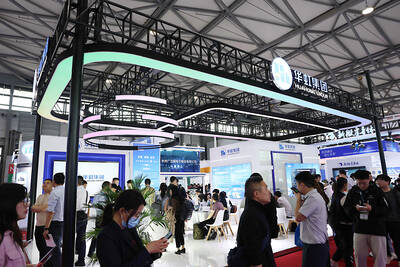
The US Department of Commerce last week ordered multiple chip equipment companies to halt shipments of certain tools to China’s second-largest chipmaker, Hua Hong Semiconductor Ltd (華虹半導體), its latest action to slow the country’s development of advanced chips, two people familiar with the matter said. The department sent letters to at least a handful of companies informing them of restrictions on tools and other materials destined for two Hua Hong facilities US officials believe make China’s most sophisticated chips, the people said. Top US chip equipment companies Lam Research Corp, Applied Materials Inc and KLA Corp, each of which has significant


 RSS
RSS