


The target to boost renewable energy to 20 percent of Taiwan’s consumption has been extended by one year to 2026, as the deployment of offshore wind turbines has been slowed by the COVID-19 pandemic and a large number of typhoons this year, the Ministry of Economic Affairs said.
“Our renewable energy program might take seven to eight years to implement, also considering that most green energy systems begin to generate electricity one year after they are installed. So, we expect progress to be delayed by about one year,” Deputy Minister of Economic Affairs Tseng Wen-sheng (曾文生) told reporters on Thursday.
Contracts with offshore wind energy developers carry a one year grace period to 2026, Tseng said, adding that construction and installation of the projects is progressing smoothly.
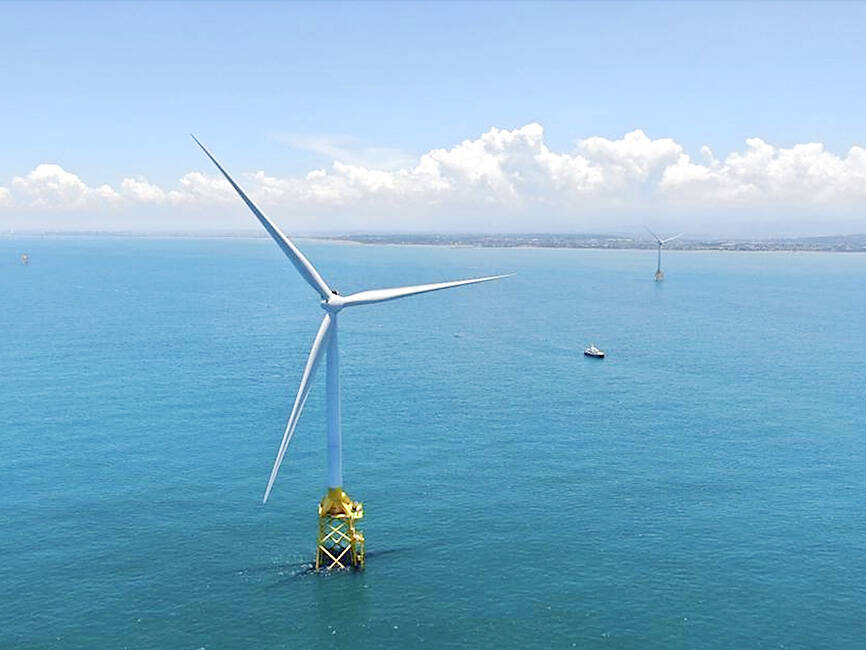
Photo courtesy of Formosa II Wind Power Co
About 188 offshore wind turbines have been installed so far this year, although 200 units were planned.
Solar energy developers achieved this year’s target to install a capacity of 2.5 gigawatts (GW), the ministry said.
However, given delays in previous years, total solar capacity installed has fallen short of the ministry’s expectation of 11.25GW by the end of this year.
Asked whether the ministry plans to expand the multi-year green energy budget of NT$900 billion (US$29.31 billion) to 2030, Tseng said the government is seeking private funding for renewable energy deployments.
Taipei’s budget is to be spent mainly on boosting grid resilience, he added.
State-run Taiwan Power Co (Taipower, 台電) plans to spend more than NT$500 billion to improve its electricity grids over the next 10 years, Tseng said.
The ministry yesterday issued an updated list of offshore wind energy developer’s and their capacity allocations as part of the Offshore Wind Power Zonal Development 2022 project.
Six offshore wind power developers, including Copenhagen Infrastructure Partners K/S and Corio Generation, have won bids to develop 3GW of wind energy that is to enter the power grid in 2026 or 2027, the ministry said.
Four other successful bidders are Northland Power Inc (北陸能源), Synera Renewable Energy Co (風睿能源), Taiya Renewable Energy Co (台亞風能) and Skyborn Renewable Taiwan Co (天豐新能源).
Taiya, the only Taiwanese-owned offshore wind energy developer awarded the capacity allocation, said it also plans to join the government’s “floating wind” and zonal development projects next year.
Taiya has been allocated to generate 4GW, it said.
The ministry plans to auction another 3GW of capacity for new offshore wind farms, and another 3GW are to be developed in 2024.


Taiwanese firms have increased investment in the Philippines in recent years as Manila’s ties with Washington deepen and global supply chains continue to shift away from China, an expert at the Chung-Hua Institution for Economic Research (CIER, 中華經濟研究院) said yesterday. The Philippines had not been among Taiwanese investors’ top choices in Southeast Asia, CIER Taiwan ASEAN Studies Center director Kristy Hsu (徐遵慈) said at a seminar in Taipei. However, Taiwan’s investment in the country has grown significantly since the COVID-19 pandemic, reaching US $257 million last year, a high in recent years, she said. Although Taiwan’s total investment in the Philippines still lags

Intel Corp regards Taiwan Semiconductor Manufacturing Co (TSMC, 台積電) as a longstanding partner, as the US chipmaker would continue outsourcing production of advanced chips to TSMC, Intel chief executive officer Lip-Bu Tan (陳立武) said yesterday. “I don’t look at people as competitors. I look at the collaboration... Nvidia is also, you know, a good friend,” Tan told a news conference following his keynote speech at the Computex trade show in Taipei. “It’s a very trusted partnership for us... We are a big, top customer for them, and we’re going to continue doing that,” he said, referring to TSMC, the world’s largest foundry

Hon Hai Precision Industry Co (鴻海精密) yesterday said it would work with US chipmaker Intel Corp to jointly develop and deploy next-generation artificial intelligence (AI) infrastructure and intelligent computing platforms in a move to capture booming demand for AI computing systems. Hon Hai, also known as Foxconn Technology Group (富士康), said in a statement that the partnership would combine its global manufacturing scale, system integration expertise and AI data center deployment capabilities with Intel’s strengths in processor architecture, silicon technologies and software ecosystem. The companies said they plan to work on equipment used in AI data centers, including server racks powered by

Artificial intelligence (AI) agents would supplant smartphones as the center of people’s digital lives, fundamentally reshaping personal devices and driving a major computing upgrade cycle, Qualcomm Inc CEO Cristiano Amon said yesterday. In his keynote speech for this year’s Computex trade show in Taipei, Amon said that the rise of "agentic AI" — AI systems capable of reasoning, planning and carrying out tasks autonomously — would transform how people interact with technology across phones, PCs, vehicles and wearable devices. Describing the technology as the next major evolution in computing, Amon said that "2026 is the year of agents.” For decades, smartphones have sat


 RSS
RSS