


The S&P 500 on Friday closed higher, in a light trading day ahead of a long weekend, as investors assessed inflation data against rate hike and recession fears.
A US Department of Commerce report showed that US consumer spending barely rose last month, while inflation cooled further, but not enough to discourage the US Federal Reserve from driving interest rates to higher levels next year.
The personal consumption expenditures price index, the Fed’s preferred inflation gauge, rose 0.1 percent last month after climbing 0.4 percent in October.

Photo: AP
A benchmark survey showed that US consumers expect price pressures to moderate notably in the next year, with the one-year inflation outlook dropping to the lowest in 18 months this month.
Wall Street indices on Thursday sold off sharply after revised data indicated a resilient US economy, fueling worries that the Fed could keep hiking rates for longer and end up pushing the economy into a recession.
However, Friday’s data and that it came roughly in line with expectations, eased some of those concerns for now, said Shawn Cruz, head trading strategist at TD Ameritrade in Chicago, Illinois.
“This is a clear indication that this is a bad news is good news kind of market. The market wants the Fed to feel what they’re doing has been enough,” Cruz said.
“It is on edge over what the path for Fed policy is going to be for next year as that’s going to drive the economy and corporate earnings,” he said.
Investors have been jittery since last week as the Fed indicated that it remains stubbornly committed to achieving the 2 percent inflation goal and projected rate hikes to higher than 5 percent next year, a level not seen since 2007.
Joe Quinlan, head of CIO market strategy at Merrill and Bank of America Private Bank also called the Fed hawkishness “the big cloud on the horizon.”
“Today is more of a muted response to good data, but still it’s not all clear, mission accomplished,” he said, adding that analyst earnings estimates for next year are likely too high.
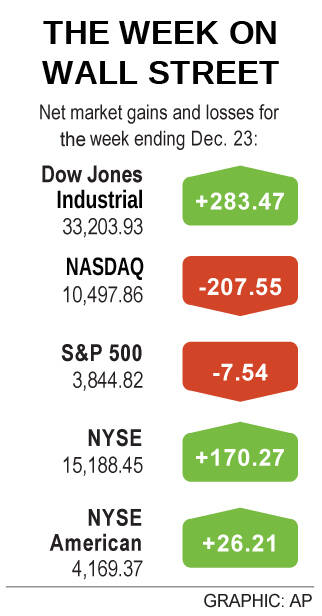
The Dow Jones Industrial Average rose 176.44 points, or 0.53 percent, to 33,203.93, while the S&P 500 gained 22.43 points, or 0.59 percent, to 3,844.82. The NASDAQ Composite added 21.74 points, or 0.21 percent, to 10,497.86.
The S&P and NASDAQ lost ground for the third week in a row, with the benchmark index falling 0.2 percent compared with a weekly decline of 1.94 percent for NASDAQ. The Dow gained 0.86 percent for its first weekly increase out of three.
Cruz said that thin trading volume might have created more exaggerated moves on Thursday and Friday, with volume dropping sharply on Friday as participants likely took time off ahead of the long weekend.
US markets are to be closed tomorrow, the day after the Christmas holiday.


The domestic unit of the Chinese-owned, Dutch-headquartered chipmaker Nexperia BV will soon be able to produce semiconductors locally within China, according to two company sources. Nexperia is at the center of a global tug-of-war over critical semiconductor technology, with a Dutch court in February ordering a probe into alleged mismanagement at the company. The geopolitical tussle has disrupted supply chains, with some carmakers reportedly forced to cut production due to chip shortages. Local production would allow Nexperia’s domestic arm, Nexperia Semiconductors (China) Ltd (安世半導體中國), to bypass restrictions in place since October on the supply of silicon wafers — etched with tiny components to

Taiwan is open to joining a global liquefied natural gas (LNG) program if one is created, but on the condition that countries provide delivery even in a scenario where there is a conflict with China, an energy department official said yesterday. While Taiwan’s priority is to have enough LNG at home, the nation is open to exploring potential strategic reserves in other countries such as Japan or South Korea, Energy Administration Deputy Director-General Chen Chung-hsien (陳崇憲) said. While the LNG market does not have a global reserve for emergencies like that of oil, the concept has been raised a few times —

Taiwan Semiconductor Manufacturing Co (TSMC, 台積電) yesterday received government approval to deploy its advanced 3-nanometer (3nm) process at its second fab currently under construction in Japan, the Ministry of Economic Affairs said in a news release. The ministry green-lit the plan for the facility in Kumamoto, which is scheduled to start installing equipment and come online in 2028 with a monthly production capacity of 15,000 12-inch wafers, the ministry said. The Department of Investment Review in June 2024 authorized a US$5.26 billion investment for the facility, slated to manufacture 6- to 12nm chips, significantly less advanced than 3nm process. At a meeting with

Standard Chartered Taiwan on March 26 announced that it has partnered with international fintech firm FinIQ to build an “Automated Structured Products Pricing Platform.” The bank is also introducing products from global issuers including Goldman Sachs Group Inc, Barclays PLC and BNP Paribas SA. The new platform enables an end-to-end process whereby it finds the most competitive pricing across multiple issuers in a matter of minutes, followed by automated documentation and transaction execution, which significantly shortens time-to-market and delivers a superior wealth management experience. Standard Chartered Bank Taiwan CEO Anthony Yu (游天立) said: “Standard Chartered is increasingly leveraging its wealth management


 RSS
RSS