


In November 2019, Indian Kapil Sharma would not have known that he would share a bond with Taiwan because of its guavas.
Laid off from his job as a bank teller during the COVID-19 pandemic, Sharma returned to his home village of Shahijadpur, near Sonipat City north of New Delhi, where he turned his life around by growing Taiwanese guavas.
Unlike most local farmers who planted water-consuming crops like wheat or rice, Sharma visited a biotech company before deciding what to grow. There he saw Taiwanese guava tree saplings, which appealed to him because they consume less water, and a lack of stable water supply can be a problem during the long summer months in India, where the temperature often rises above 40°C.
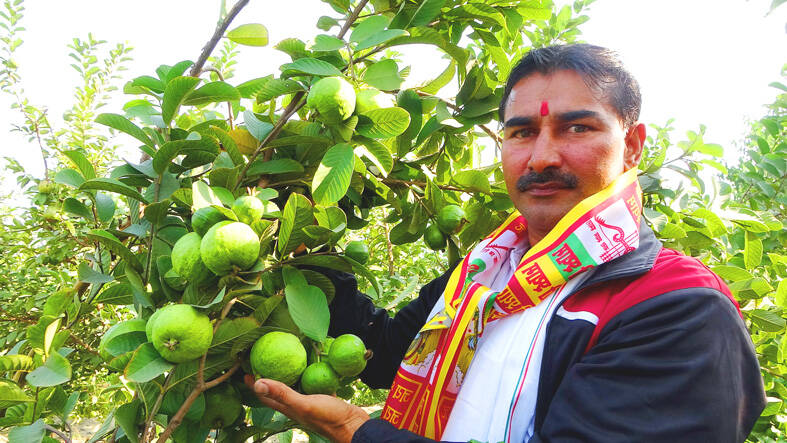
Photo: CNA
Sharma bought 550 saplings at 160 rupees (US$1.94) each and the company provided on-site training. He planted different types of guava trees in his 0.4 hectare orchard, including guavas with white flesh and another variety with pink flesh.
About eight months later, Sharma had his first harvest of guavas that earned him about 55,000 rupees.
The pink guavas sold particularly well, Sharma told the Central News Agency (CNA).
They were so popular that demand soon outstripped supply, he said.
This was just the beginning, he added.
With the second harvest, Sharma earned more than 100,000 rupees and decided he was not going back to working as a bank teller.
“Taiwanese guavas changed my life,” he said, adding that the story might have been different if he had chosen another crop.
Taiwanese guavas stand out from other varieties because ripened fruits do not fall from the branches easily, and even when they do, they can be used to make vinegar, which fetches a good price, Sharma said.
Everyone in his village has heard about Taiwanese guavas, he added.
In addition to the rich soil, organic fertilizer was one of the secrets of Sharma’s success.
“I didn’t want my customers to take in the toxic stuff,” said Sharma, who used marigold flowers and plastic bottles to keep fruit flies at bay.
Following the success of Taiwanese guavas, Sharma expanded his business by planting sugarcane and lemons, and started keeping bees. His methods of organic farming has made him a role model in the local community.
In addition to appearing on local media as a model entrepreneur, Sharma also attracted the attention of Rakesh Kumar, a local official at the Indian Ministry of Agriculture and Farmers Welfare.
Kumar told CNA that he welcomed Taiwanese experts instructing local farmers on crop cultivation.
Sharma’s story became more widely known after Manoj Kumar Panigrahi, an Indian assistant professor who studied in Taiwan, wrote an article in Chinese and English detailing the farmer’s experience with Taiwanese guavas.
Panigrahi said Sharma asked him “to humbly share with the people of Taiwan that he is thankful for what Taiwan has given him indirectly and it changed his life.”
When asked whether he would like to visit Taiwan and learn more about the country’s farming techniques, Sharma did not hesitate.
“I want to go to Taiwan so much. A huge part of my success can be attributed to Taiwan. I want to go there and kiss the land,” Sharma said.

Cairo’s new monorail slices across the city skyline, running above the familiar chaos of blaring horns and aging buses’ exhaust fumes that mark rush hour below. The US$4.5 billion monorail, opened this month, is among Egypt’s most prominent new transport projects, part of a debt-funded infrastructure drive criticized for sapping state finances while bringing limited benefits to most of the country’s 109 million people. “It feels like you’re in a different country,” said Ramy Sayed, a restaurant manager, aboard a driverless Innovia 300 train. “No noise, no traffic, we’re not used to this.” The eastern line runs 56km from the bustling middle-class

Taiwanese firms have increased investment in the Philippines in recent years as Manila’s ties with Washington deepen and global supply chains continue to shift away from China, an expert at the Chung-Hua Institution for Economic Research (CIER, 中華經濟研究院) said yesterday. The Philippines had not been among Taiwanese investors’ top choices in Southeast Asia, CIER Taiwan ASEAN Studies Center director Kristy Hsu (徐遵慈) said at a seminar in Taipei. However, Taiwan’s investment in the country has grown significantly since the COVID-19 pandemic, reaching US $257 million last year, a high in recent years, she said. Although Taiwan’s total investment in the Philippines still lags
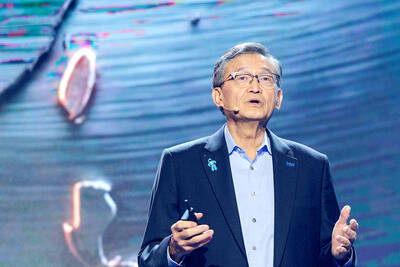
Intel Corp regards Taiwan Semiconductor Manufacturing Co (TSMC, 台積電) as a longstanding partner, as the US chipmaker would continue outsourcing production of advanced chips to TSMC, Intel chief executive officer Lip-Bu Tan (陳立武) said yesterday. “I don’t look at people as competitors. I look at the collaboration... Nvidia is also, you know, a good friend,” Tan told a news conference following his keynote speech at the Computex trade show in Taipei. “It’s a very trusted partnership for us... We are a big, top customer for them, and we’re going to continue doing that,” he said, referring to TSMC, the world’s largest foundry

Artificial intelligence (AI) agents would supplant smartphones as the center of people’s digital lives, fundamentally reshaping personal devices and driving a major computing upgrade cycle, Qualcomm Inc CEO Cristiano Amon said yesterday. In his keynote speech for this year’s Computex trade show in Taipei, Amon said that the rise of "agentic AI" — AI systems capable of reasoning, planning and carrying out tasks autonomously — would transform how people interact with technology across phones, PCs, vehicles and wearable devices. Describing the technology as the next major evolution in computing, Amon said that "2026 is the year of agents.” For decades, smartphones have sat


 RSS
RSS