


China’s imports and exports last month plunged to levels not seen since early 2020, official figures showed yesterday, as stringent COVID-19 restrictions hit the economy hard.
The last major economy still wedded to a zero-tolerance virus policy, China’s snap lockdowns, travel curbs and mass testing have stifled business activity, disrupted supply chains and dampened consumption.
Imports fell 10.6 percent year-on-year, the biggest drop since May 2020, Chinese General Administration of Customs data showed.
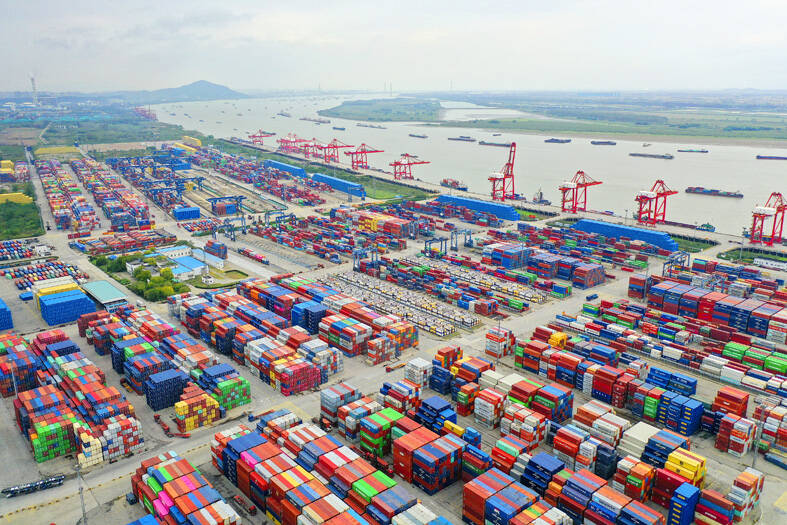
Photo: AP
Exports fell 8.7 percent — the steepest decline since February 2020, when the country was mired in the early stages of the COVID-19 pandemic.
“Weakening domestic and foreign demand, COVID disruptions and a rising comparison base lead to a perfect, but well-expected storm to China’s exports and imports,” Jones Lang Lasalle Inc chief economist Bruce Pang (龐溟) told Bloomberg News.
The figures are the latest in a string of gloomy economic indicators as the world’s second-largest economy charts a faltering path out of its “zero COVID-19” policy.
The Chinese Communist Party (CCP) has indicated a shift in its COVID-19 messaging since the country’s largest protests in decades last week took aim at lockdowns and other virus curbs.
Local authorities have begun easing testing requirements and other restrictions, but travel between provinces remains complicated and health measures continue to vary from place to place.
“The zero COVID policy has been loosened, but mobility has not recovered much on the national level,” Pinpoint Asset Management Ltd (保銀私募基金管理) chief economist Zhang Zhiwei (張智威) said.
“I expect exports will stay weak in the next few months as China goes through a bumpy reopening process,” he said. “As global demand weakens in 2023, China will have to rely more on domestic demand.”
As Beijing shifts gears toward bolstering economic recovery, senior Chinese officials are debating an economic growth target for next year of about 5 percent, people familiar with the discussion said.
Some officials say that setting a goal at a relatively high level would help local governments shift the focus of their work away from COVID-19 controls to boosting the economy, the people said.
Other officials are concerned a target of about 5 percent could be too ambitious, they said.
The CCP’s Politburo, its top decisionmaking body, yesterday said in a statement that it would next year seek a turnaround in the economy and significantly boost market confidence.
“Growth is clearly more important for the leaders now,” Zhang said.
A growth target of about 5 percent “would be a signal to send this message to the public and local officials,” he added.
The GDP target would likely be discussed at the CCP’s Central Economic Work Conference, which usually takes place within a week of the Politburo’s meeting this month.
The GDP goal itself is only disclosed at the annual legislative meeting in March.
Additional reporting by Bloomberg


The domestic unit of the Chinese-owned, Dutch-headquartered chipmaker Nexperia BV will soon be able to produce semiconductors locally within China, according to two company sources. Nexperia is at the center of a global tug-of-war over critical semiconductor technology, with a Dutch court in February ordering a probe into alleged mismanagement at the company. The geopolitical tussle has disrupted supply chains, with some carmakers reportedly forced to cut production due to chip shortages. Local production would allow Nexperia’s domestic arm, Nexperia Semiconductors (China) Ltd (安世半導體中國), to bypass restrictions in place since October on the supply of silicon wafers — etched with tiny components to

Taiwan is open to joining a global liquefied natural gas (LNG) program if one is created, but on the condition that countries provide delivery even in a scenario where there is a conflict with China, an energy department official said yesterday. While Taiwan’s priority is to have enough LNG at home, the nation is open to exploring potential strategic reserves in other countries such as Japan or South Korea, Energy Administration Deputy Director-General Chen Chung-hsien (陳崇憲) said. While the LNG market does not have a global reserve for emergencies like that of oil, the concept has been raised a few times —
AI-FUELED DEMAND: The company has been benefiting from the skyrocketing prices for DRAM chips amid the AI frenzy, especially its core product — DDR4 DRAM chips DRAM chipmaker Nanya Technology Corp (南亞科技) yesterday reported that its revenue for the first quarter surged 582.91 percent to NT$49.09 billion (US$1.54 billion) from NT$7.19 billion a year earlier, as the supply crunch caused chip price spikes. Last quarter’s figure is the highest on record. On a quarterly basis, revenue jumped 63.14 percent from NT$30.09 billion, the company said. In January, Nanya Technology expected global DRAM supply scarcity to continue through the first half of 2028, thanks to strong demand for artificial intelligence (AI) applications. Market researcher TrendForce Corp (集邦科技) forecast prices of standard DRAM chips would rise between 58 percent and 63

HIGHER PRICES: Given rising energy costs, CPC raised natural gas prices for generators by 41.58%, which Taipower said would raise its power generation costs by NT$10 billion State-run CPC Corp, Taiwan (CPC, 台灣中油) has activated its fourth naphtha cracker to boost ethylene supply, aiming to ease concerns over plastic material shortages amid tensions in the Middle East, the Ministry of Economic Affairs said yesterday. The move is expected to add 19,000 tonnes of supply this month and 30,000 tonnes next month, Deputy Minister of Economic Affairs Ho Chin-tsang (何晉滄) said at a meeting of the legislature’s Economics Committee in Taipei. CPC on Tuesday held talks with major polyethylene producers, including Formosa Plastics Corp (台塑), Asia Polymer Corp (亞聚) and USI Corp (台聚), and pledged to supply ethylene feedstock


 RSS
RSS