


HSBC is cutting as many as 15 percent of its 2,000 senior operations managers worldwide, as it attempts to streamline its management ranks and reduce costs, two sources with knowledge of the matter said.
The global job cuts at the London-headquartered bank would fall across several business units and locations, and result in the loss of at least 200 positions, mostly with the title of chief operating officer (COO), the sources said.
HSBC, which used to position itself as the world’s local bank, employs many COOs because country and business lines have their own separate COO, the sources said.
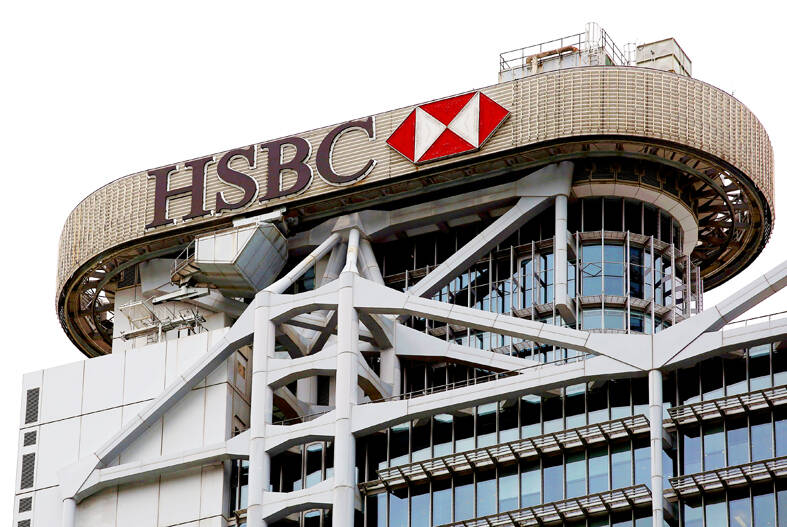
Photo: REUTERS
HSBC declined to comment.
The lender has been shrinking its sprawling global business for several years, downsizing in many regions and exiting some countries entirely as it tries to improve shareholder returns.
The latest cuts are already underway, one of the sources said.
HSBC chief executive officer Noel Quinn said on Thursday that HSBC has identified US$1.7 billion of extra cost cuts it would make next year as it battles to meet an overall goal of costs rising by no more than 2 percent despite inflationary pressures.
Incoming chief financial officer Georges Elhedery has been involved in the project to trim management headcount, the sources said.
The initiative, codenamed “project banyan,” follows HSBC’s last major redundancy plan in 2020, which targeted about 35,000 job cuts globally across all staffing levels.
Three separate sources confirmed job cuts were underway, as HSBC joins a chorus of other Western banks axing staff as a bleak global economic outlook weighs on business, consumer and investment banking revenues.
All the sources declined to be named due to sensitivity of the matter.
HSBC slightly increased its full-time staff this year, its third-quarter earnings showed, with headcount rising by 378 to 220,075 by Sept. 30 compared with Dec. 31 last year.
The UK-based bank, which makes the bulk of its revenue and profit in Asia, is under pressure from its biggest shareholder, Chinese financial conglomerate Ping An Insurance Group Co (平安保險集團), to explore options to boost returns, including listing its Asian business.
Last month, Ping An Asset Management, a wholly-owned unit of Ping An Insurance urged HSBC to aggressively reduce costs by cutting jobs and divesting peripheral non-Asian businesses, its first such public call.
Besides considering layoffs, the bank should also look at reducing the cost of its global headquarters, Ping An Asset Management had said at that time.
HSBC’s management plans to tell staff that the latest round of job cuts is part of its broader strategy to rein in expenses and improve earnings in tougher market conditions, one source said.
On Wednesday, HSBC announced a possible sale of its business in New Zealand and its plans to close 114 branches in the UK.
On Tuesday it said it had agreed to sell its much larger Canadian business to Royal Bank of Canada, further shrinking its global footprint after earlier sales of its US and French retail banks in the past two years.


The domestic unit of the Chinese-owned, Dutch-headquartered chipmaker Nexperia BV will soon be able to produce semiconductors locally within China, according to two company sources. Nexperia is at the center of a global tug-of-war over critical semiconductor technology, with a Dutch court in February ordering a probe into alleged mismanagement at the company. The geopolitical tussle has disrupted supply chains, with some carmakers reportedly forced to cut production due to chip shortages. Local production would allow Nexperia’s domestic arm, Nexperia Semiconductors (China) Ltd (安世半導體中國), to bypass restrictions in place since October on the supply of silicon wafers — etched with tiny components to

Taiwan’s foreign exchange reserves fell below the US$600 billion mark at the end of last month, with the central bank reporting a total of US$596.89 billion — a decline of US$8.6 billion from February — ending a three-month streak of increases. The central bank attributed the drop to a combination of factors such as outflows by foreign institutional investors, currency fluctuations and its own market interventions. “The large-scale outflows disrupted the balance of supply and demand in the foreign exchange market, prompting the central bank to intervene repeatedly by selling US dollars to stabilize the local currency,” Department of Foreign

Taiwan is open to joining a global liquefied natural gas (LNG) program if one is created, but on the condition that countries provide delivery even in a scenario where there is a conflict with China, an energy department official said yesterday. While Taiwan’s priority is to have enough LNG at home, the nation is open to exploring potential strategic reserves in other countries such as Japan or South Korea, Energy Administration Deputy Director-General Chen Chung-hsien (陳崇憲) said. While the LNG market does not have a global reserve for emergencies like that of oil, the concept has been raised a few times —
AI-FUELED DEMAND: The company has been benefiting from the skyrocketing prices for DRAM chips amid the AI frenzy, especially its core product — DDR4 DRAM chips DRAM chipmaker Nanya Technology Corp (南亞科技) yesterday reported that its revenue for the first quarter surged 582.91 percent to NT$49.09 billion (US$1.54 billion) from NT$7.19 billion a year earlier, as the supply crunch caused chip price spikes. Last quarter’s figure is the highest on record. On a quarterly basis, revenue jumped 63.14 percent from NT$30.09 billion, the company said. In January, Nanya Technology expected global DRAM supply scarcity to continue through the first half of 2028, thanks to strong demand for artificial intelligence (AI) applications. Market researcher TrendForce Corp (集邦科技) forecast prices of standard DRAM chips would rise between 58 percent and 63


 RSS
RSS