


Tesla Inc chief executive officer Elon Musk delivered the company’s first heavy-duty Semi on Thursday to PepsiCo without offering updated forecasts for the vehicle’s pricing, production plans or how much cargo it could haul.
Musk, who appeared onstage at an event at Tesla’s Nevada plant, said the battery-powered, long-haul truck would reduce highway emissions, outperform existing diesel models on power and safety, and spin-off a fast-charging technology Tesla would use in its upcoming Cybertruck pickup.
“If you’re a trucker and you want the most badass rig on the road, this is it,” Musk said, noting that it was five years since Tesla had announced it was developing the all-electric truck.
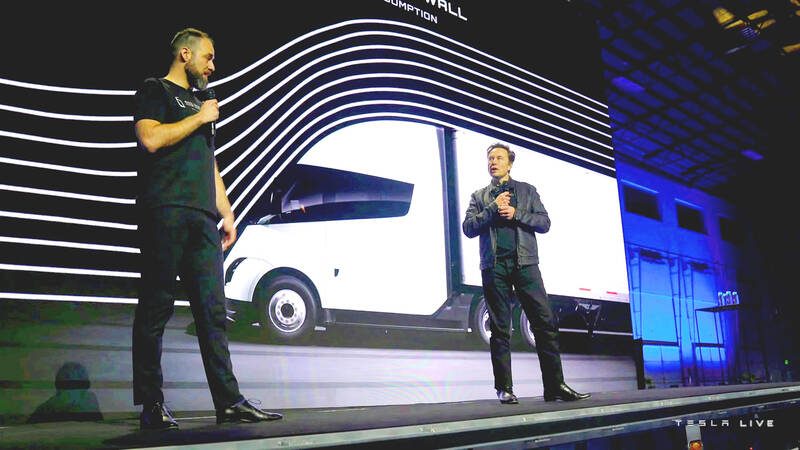
Photo: REUTERS
However, industry experts remain skeptical that battery electric trucks can economically take the strain of hauling hefty loads for hundreds of miles.
The company did not announce pricing for the vehicle, provide details on variants of the truck it had initially projected, or supply a forecast for deliveries to PepsiCo or other customers.
Tesla said it would begin using the vehicle to ship parts to its plant in Fremont, California.
In 2017, Tesla had said the 483km-range version of the semi-truck would cost US$150,000, and the 805km version US$180,000, but Tesla’s passenger electric vehicle prices have increased sharply since then.
Tesla chair Robyn Denholm recently said the automaker might produce 100 Semis this year. Musk has said Tesla would aim to produce 50,000 of the trucks in 2024.
PepsiCo, which completed its first cargo run with the Tesla truck to deliver snacks for those attending the Nevada launch event, had ordered 100 trucks in 2017.
Brewer Anheuser-Busch, United Parcel Service Inc and Walmart Inc were among other companies that had reserved the Semi.
Tesla did not provide details on orders or deliveries to customers, nor an estimate on what the total cost of ownership for buyers would be compared with diesel alternatives.
Musk said the semi-truck has been doing test runs from Tesla’s Nevada factory to its plant in Fremont, California.
Tesla said it had completed a 805km drive on a single charge, with the Semi and cargo weighing 36,741kg in total.
Tesla did not disclose the weight of an unloaded semi-truck, one key specification analysts had hoped to learn and an important consideration for the efficiency of electric trucks.
The vehicle’s delivery presentation ended without Musk taking questions, as he often does at Tesla events.
“Not very impressive — moving a cargo of chips [average weight per pack 52 grams] cannot in any way be said to be definitive proof of concept,” Guidehouse senior analyst Oliver Dixon said.
Tesla had initially set a production target for 2019 for the semi-truck, which was first unveiled in 2017. Since then, rivals have begun to sell battery-powered trucks.
Daimler’s Freightliner, Volvo, startup Nikola and Renault are among Tesla’s competitors in developing alternatives to combustion-engine trucks.
Walmart has said it has been testing Freightliner’s eCascadia and Nikola’s Tre BEV trucks in California.
Tesla’s semi-truck is capable of charging at 1 megawatt and has liquid-cooling technology in the charging cable in an updated version of Tesla’s Supercharger that would be made available to the Cybertruck, Musk said.
The Cybertruck is scheduled to go into production next year.
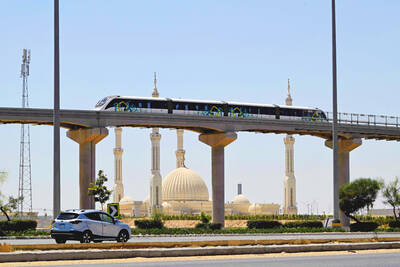
Cairo’s new monorail slices across the city skyline, running above the familiar chaos of blaring horns and aging buses’ exhaust fumes that mark rush hour below. The US$4.5 billion monorail, opened this month, is among Egypt’s most prominent new transport projects, part of a debt-funded infrastructure drive criticized for sapping state finances while bringing limited benefits to most of the country’s 109 million people. “It feels like you’re in a different country,” said Ramy Sayed, a restaurant manager, aboard a driverless Innovia 300 train. “No noise, no traffic, we’re not used to this.” The eastern line runs 56km from the bustling middle-class
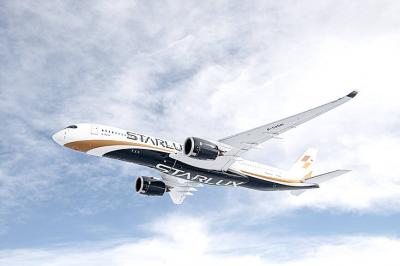
Starlux Airlines Co (星宇航空) today unveiled a long-haul network expansion plan at a shareholders’ meeting in Taipei, including direct flights to Barcelona, Spain, and Zurich, Switzerland, as well as a service connecting Taipei, Sydney and New Zealand. Starlux is to become the first Taiwanese carrier to offer non-stop services to the two European cities, while the inaugural oceanic route is expected to expand transit opportunities within the Australia-New Zealand market, Starlux said. Flight services to Chicago, Dallas, Washington and New York are under evaluation, the airline added. Prior to the shareholders’ meeting, the airline earlier this year announced that it would be

Taiwanese firms have increased investment in the Philippines in recent years as Manila’s ties with Washington deepen and global supply chains continue to shift away from China, an expert at the Chung-Hua Institution for Economic Research (CIER, 中華經濟研究院) said yesterday. The Philippines had not been among Taiwanese investors’ top choices in Southeast Asia, CIER Taiwan ASEAN Studies Center director Kristy Hsu (徐遵慈) said at a seminar in Taipei. However, Taiwan’s investment in the country has grown significantly since the COVID-19 pandemic, reaching US $257 million last year, a high in recent years, she said. Although Taiwan’s total investment in the Philippines still lags

Taiwanese prosecutors suspect that three people successfully smuggled at least one shipment of Nvidia Corp artificial intelligence (AI) chips to China after first exporting them to Japan, people familiar with the matter said. The trio was detained last week by the Keelung District Prosecutors’ Office for allegedly falsifying documents related to exports of Super Micro Computer Inc servers containing advanced Nvidia chips, which the US has barred from sale to China without a license from Washington. The move marked Taiwan’s first public crackdown on AI chip diversion after years of pressure from the US to take a more active role in curtailing


 RSS
RSS