


US shoppers have spent US$6.3 billion so far on Cyber Monday, according to Adobe Inc, a robust showing that suggests steep discounts attracted inflation-stung shoppers.
Cyber Monday spending would reach as much as US$11.6 billion, making it the biggest online spending day ever, Adobe said.
“There is a ton of momentum coming into Cyber Monday, after a surprising Sunday where consumers latched onto early deals and spent nearly US$5 billion online, shattering previous records,” said Vivek Pandya, a lead analyst at Adobe Digital Insights. “With discounts set to reach new heights today, Adobe expects Cyber Monday will be a major bright spot this season.”
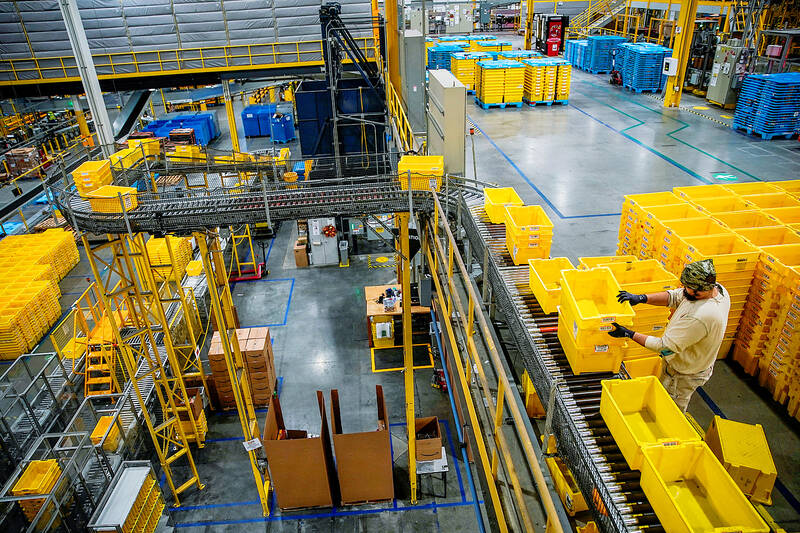
Photo: Reuters
The promotional period from Thanksgiving through Monday — now known as the Cyber Five — was nothing like last year, when supply chain snarls prompted people to shop earlier and retailers to skimp on discounts. This year stores were saddled with a glut of unsold merchandise, forcing them to offer sharply reduced prices to lure bargain hunters looking to offset higher food and fuel costs.
Hot sellers included Legos, drones and digital cameras. Discounts were steeper compared with a year earlier. For instance, electronics had average discounts of about 20 percent and toys 22 percent, said Adobe, which tracks 1 trillion visits to retail Web sites and monitors sales of more than 100 million products.
Adobe does not adjust its forecast for inflation, but said the slow rate of growth is not entirely inflation-driven, because prices for many consumer goods, particularly electronics, have dropped from a year ago.
Big sale days like Black Friday and Cyber Monday have been gradually losing their cachet as shoppers spread their spending over longer periods.
Black Friday online spending rose 2.3 percent to US$9.12 billion and was better than anticipated, Adobe said.
The total for this month and next month combined is set to reach US$209.7 billion, up 2.5 percent from last year, the firm said.
Shoppers less concerned about COVID-19 returned to stores for more of their shopping, which blunted online sales growth, Adobe said.
Overall Black Friday spending — both online and in-store — was up 12 percent from a year earlier, MasterCard Inc data showed.
Cyber Monday “isn’t worth waiting for anymore,” since most retailers just rebrand their Black Friday deals as Cyber Monday deals, said Kristin McGrath, a shopping expert at the deal-monitoring Web site BlackFriday.com.
Retailers offered bargains on countertop kitchen appliances and electronics, which would likely be discounted even further after Christmas for those not in a rush, she said.
“Anything they don’t sell will be marked down again,” she said. “So you only have to buy it now if you want to give it to someone as a gift.”
Separately, the volume of payments made in Britain on so-called Cyber Monday was up 5 percent compared with the same point last year, Barclaycard Payments data showed.
“Despite a challenging economic backdrop, shoppers have made the most of the discounts on offer, with today’s data following an encouraging Black Friday, and strong weekend both online and in-store,” its head, Marc Pettican, said.
Barclaycard Payments, which says it processes nearly £1 (US$1.20) in every £3 spent on credit and debit cards in the UK, said Black Friday payment transactions were up 3.59 percent year-on-year.
Additional reporting by Reuters

The domestic unit of the Chinese-owned, Dutch-headquartered chipmaker Nexperia BV will soon be able to produce semiconductors locally within China, according to two company sources. Nexperia is at the center of a global tug-of-war over critical semiconductor technology, with a Dutch court in February ordering a probe into alleged mismanagement at the company. The geopolitical tussle has disrupted supply chains, with some carmakers reportedly forced to cut production due to chip shortages. Local production would allow Nexperia’s domestic arm, Nexperia Semiconductors (China) Ltd (安世半導體中國), to bypass restrictions in place since October on the supply of silicon wafers — etched with tiny components to

Singapore-based ride-hailing and delivery giant Grab Holdings Ltd has applied for regulatory approval to acquire the Taiwan operations of Germany-based Delivery Hero SE's Foodpanda in a deal valued at about US$600 million. Grab submitted the filing to the Fair Trade Commission on Friday last week, with the transaction subject to regulatory review and approval, the company said in a statement yesterday. Its independent governance structure would help foster a healthy and competitive market in Taiwan if the deal is approved, Grab said. Grab, which is listed on the NASDAQ, said in the filing that US-based Uber Technologies Inc holds about 13 percent of

Taiwan Semiconductor Manufacturing Co (TSMC, 台積電) yesterday received government approval to deploy its advanced 3-nanometer (3nm) process at its second fab currently under construction in Japan, the Ministry of Economic Affairs said in a news release. The ministry green-lit the plan for the facility in Kumamoto, which is scheduled to start installing equipment and come online in 2028 with a monthly production capacity of 15,000 12-inch wafers, the ministry said. The Department of Investment Review in June 2024 authorized a US$5.26 billion investment for the facility, slated to manufacture 6- to 12nm chips, significantly less advanced than 3nm process. At a meeting with

Taiwan is open to joining a global liquefied natural gas (LNG) program if one is created, but on the condition that countries provide delivery even in a scenario where there is a conflict with China, an energy department official said yesterday. While Taiwan’s priority is to have enough LNG at home, the nation is open to exploring potential strategic reserves in other countries such as Japan or South Korea, Energy Administration Deputy Director-General Chen Chung-hsien (陳崇憲) said. While the LNG market does not have a global reserve for emergencies like that of oil, the concept has been raised a few times —


 RSS
RSS