


US Federal Reserve Chairman Jerome Powell left little doubt that he is prepared to push rates as high as needed to stamp out inflation, even as the central bank eyes a downshift to a slower pace of increases.
Addressing reporters on Wednesday after the Fed raised rates by 75 basis points for the fourth time in a row, Powell said: “Incoming data since our last meeting suggests that the ultimate level of interest rates will be higher than previously expected.”
The move lifts the Fed’s benchmark to a range of 3.75 percent to 4 percent, from nearly zero in March. Even so, the US economy has shown remarkable resilience, as rising borrowing costs have slowed the housing market, and the inflation rate is stubbornly stuck near 40-year highs.
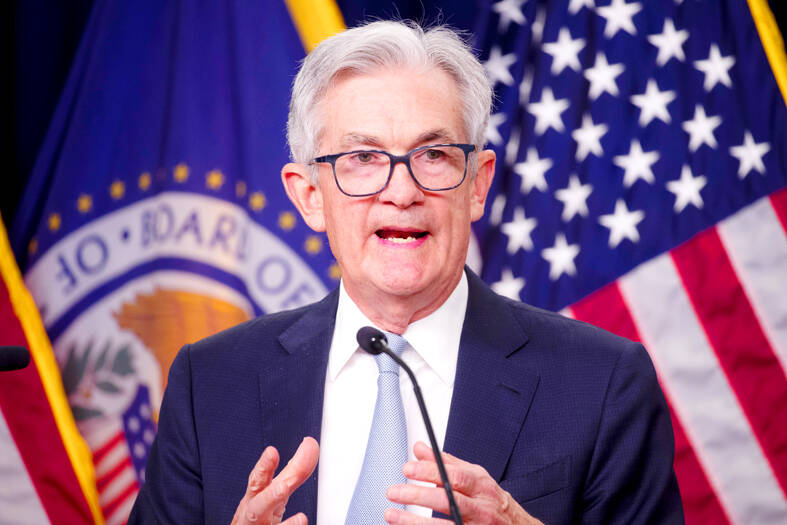
Photo: EPA-EFE
“We think that we have a ways to go, we have some ground to cover with interest rates before we get to that level of interest rates that we think is sufficiently restrictive,” Powell said, an indication to investors that the tightening campaign is not over.
“It is very premature to be thinking about pausing,” he said, while also adding that it could be appropriate to slow the pace of increases “as soon as the next meeting or the one after that.”
US stocks on Wednesday reversed initial gains, with the S&P 500 experiencing its worst rout on a Fed decision day since January last year as investors digested the message.
Asian markets sank yesterday, with Hong Kong leading the losses as its central bank hiked rates in line with the Fed. Taipei, Shanghai, Sydney, Seoul, Wellington, Mumbai, Bangkok and Manila were also well in the red. Tokyo was closed for a holiday.
Powell’s challenge was to signal a shift to a slower pace of hikes without communicating that the Fed was close to done with the tightening campaign. He accomplished that by declaring rates would peak higher than officials expected in September, even as they slow the pace of their increases as they get closer to that destination.
His remarks shift the focus from the size of the next rate hike to where they might peak and how long they should stay at those levels.
“That was the single most important thing that came out of this entire meeting,” said Erik Weisman, chief economist and portfolio manager at MFS Investment Management in Boston. “I don’t need to know anything else.”
The term “sufficiently restrictive” was new language in the US Federal Open Market Committee’s statement. It was balanced by saying the pace of future increases “will take into account the cumulative tightening of monetary policy, the lags with which monetary policy affects economic activity and inflation, and economic and financial developments.”
The committee’s vote was unanimous, and some economists said the statement read like a compromise to prevent dissent.
However, Powell was careful to spell out that this did not represent any retreat in the war on inflation, adding that the risks of doing too little are higher than too much.
“I would want people to understand our commitment to getting this done and to not making the mistake of not doing enough or the mistake of withdrawing our strong policy and doing that too soon,” he told reporters.
Unemployment at 3.5 percent is matching a five-decade low. Job openings, which Powell watches closely, unexpectedly rebounded in September, with the ratio of available positions for every unemployed person now at 1.9.
He called the labor market out of balance, and expressed disappointment at the persistence of high inflation even though some prices have begun to decelerate.
The Fed’s latest rate hike comes just days before the US midterm congressional elections on Tuesday, and amid rising criticism from Democrats who are worried that higher borrowing costs could push up unemployment.
Powell said that low inflation was better in the long run for all Americans, even if the short-term cost was high.
However, he said that the path to a soft economic landing is getting narrower, because robust demand and stubbornly high inflation have not moved much in response to higher rates.
“There is a lot of pressure on Powell to stop and pause, and wait for the lags,” said Veronique de Rugy, an economist at the Mercatus Center at George Mason University in Arlington, Virginia.
“I don’t think there was ever going to be another option other than creating a recession. There is no way to get out of this high inflation without extreme pain,” she said.

In Italy’s storied gold-making hubs, jewelers are reworking their designs to trim gold content as they race to blunt the effect of record prices and appeal to shoppers watching their budgets. Gold prices hit a record high on Thursday, surging near US$5,600 an ounce, more than double a year ago as geopolitical concerns and jitters over trade pushed investors toward the safe-haven asset. The rally is putting undue pressure on small artisans as they face mounting demands from customers, including international brands, to produce cheaper items, from signature pieces to wedding rings, according to interviews with four independent jewelers in Italy’s main

Japanese Prime Minister Sanae Takaichi has talked up the benefits of a weaker yen in a campaign speech, adopting a tone at odds with her finance ministry, which has refused to rule out any options to counter excessive foreign exchange volatility. Takaichi later softened her stance, saying she did not have a preference for the yen’s direction. “People say the weak yen is bad right now, but for export industries, it’s a major opportunity,” Takaichi said on Saturday at a rally for Liberal Democratic Party candidate Daishiro Yamagiwa in Kanagawa Prefecture ahead of a snap election on Sunday. “Whether it’s selling food or

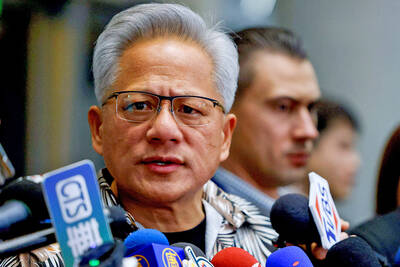
CONCERNS: Tech companies investing in AI businesses that purchase their products have raised questions among investors that they are artificially propping up demand Nvidia Corp chief executive officer Jensen Huang (黃仁勳) on Saturday said that the company would be participating in OpenAI’s latest funding round, describing it as potentially “the largest investment we’ve ever made.” “We will invest a great deal of money,” Huang told reporters while visiting Taipei. “I believe in OpenAI. The work that they do is incredible. They’re one of the most consequential companies of our time.” Huang did not say exactly how much Nvidia might contribute, but described the investment as “huge.” “Let Sam announce how much he’s going to raise — it’s for him to decide,” Huang said, referring to OpenAI
Nvidia Corp’s negotiations to invest as much as US$100 billion in OpenAI have broken down, the Wall Street Journal (WSJ) reported, exposing a potential rift between two of the most powerful companies in the artificial intelligence (AI) industry. The discussions stalled after some inside Nvidia expressed concerns about the transaction, the WSJ reported, citing unidentified people familiar with the deliberations. OpenAI makes the popular chatbot ChatGPT, while Nvidia dominates the market for AI processors that help develop such software. The companies announced the agreement in September last year, saying at the time that they had signed a letter of intent for a strategic


 RSS
RSS