


Japan and Australia are standouts among major economies, with relatively healthy consumption on the back of more mild inflation that is keeping a floor under spending power, according to Goldman Sachs Group Inc research.
A metric of consumer health used by Goldman analysts led by Jan Hatzius shows the two Asia-Pacific giants stand at about the 60th percentile, compared with about 40th percentile for the US and 35th for the eurozone.
The percentile refers to data comparing each country to itself, going back to 2000.
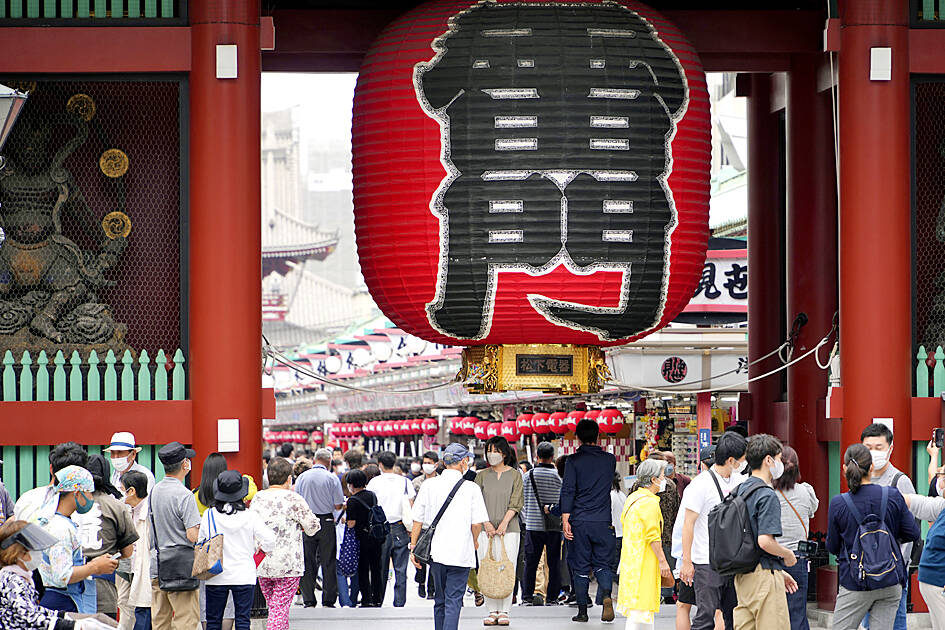
Photo: EPA-EFE
“Real spending growth has slowed substantially in North America and Europe, but remains solid in Japan and Australia given later reopening and less elevated inflation,” the analysts wrote in a report on Sunday, measuring the UK and Canada in addition to the four others.
The overall consumer health standings show a rare distinction for Japan and Australia, whereas much of the data show all six economies bearing similar characteristics.
On the upside, all are still seeing low unemployment, with rates having only edged up recently in the US and Canada. Household net worth as a share of income ranks in percentile 90 or higher in all of them, with debt service ratios broadly mild.
More troublingly, elevated inflation has crushed real income growth across those economies, where it has fallen to the 30th percentile or less. That has sent consumer confidence to a similar percentile in all economies except the US.
The Goldman analysts focused on seven gauges of consumer health: real spending growth, unemployment rate, real income growth, consumer confidence, debt service ratio, net worth-to-income ratio and real net worth growth.
Separately, soaring consumer price growth is the greatest threat for German output, German Minister of Finance Christian Lindner said.
“Prices are soaring, that’s the biggest danger for economic growth — it undermines the substance of our economy,” Lindner told German public broadcaster ARD in an interview on Sunday. “But we cannot fight inflation with borrowed money as we did with the corona pandemic.”
Germany’s inflation rate hit 8.8 percent last month — the highest level since the euro was introduced — fanned by soaring power prices.
Bundesbank AG president Joachim Nagel has repeatedly said that consumer price growth could hit double digits later this year and on Saturday warned that Germany faced a “tough winter.”
Lindner’s pro-market Free Democrats are part of German Chancellor Olaf Scholz’s ruling coalition, which has pledged about 100 billion euros (US$99.74 billion) in assistance measures to protect households and companies from soaring prices.
Still, the finance minister has repeatedly said that Germany must return to constitutional rules limiting borrowing known as the “debt brake” next year.
“Fighting inflation is always associated with a temporary economic slowdown, but that’s the price of stopping this inflation,” Lindner said.
“What we can do is protect healthy companies, healthy livelihoods” and “we must cushion people’s social hardships: No one will freeze in winter or go hungry for financial reasons,” he said. “But we cannot work with borrowed money like we did during the coronavirus pandemic.”

Taichung reported the steepest fall in completed home prices among the six special municipalities in the first quarter of this year, data compiled by Taiwan Realty Co (台灣房屋) showed yesterday. From January through last month, the average transaction price for completed homes in Taichung fell 8 percent from a year earlier to NT$299,000 (US$9,483) per ping (3.3m²), said Taiwan Realty, which compiled the data based on the government’s price registration platform. The decline could be attributed to many home buyers choosing relatively affordable used homes to live in themselves, instead of newly built homes in the city’s prime property market, Taiwan Realty
The government yesterday approved applications by Alphabet Inc’s Google to invest NT$27.08 billion (US$859.98 million) in Taiwan, the Ministry of Economic Affairs said in a statement. The Department of Investment Review approved two investments proposed by Google, with much of the funds to be used for data processing and electronic information supply services, as well as inventory procurement businesses in the semiconductor field, the ministry said. It marks the second consecutive year that Google has applied to increase its investment in Taiwan. Google plans to infuse NT$25.34 billion into Charter Investments Ltd (特許投資顧問) through its Singapore-based subsidiary Fructan Holdings Singapore Pte Ltd, and

JET JUICE: The war on Iran’s secondary effects have seen fuel prices skyrocket, knocking flight schedules down to earth in return as airlines struggle with costs Airline passengers should brace for more irritation in the next few months as carriers worldwide cancel flights and ground planes to cope with stratospheric increases in jet-fuel prices. Dutch flag carrier KLM is the latest company to cut its schedule, saying on Thursday that it would scrap 80 return flights at Amsterdam’s Schiphol Airport in the coming month. That puts it in the same league as United Airlines Holdings Inc, Deutsche Lufthansa AG and Cathay Pacific Airways Ltd, which have all pruned itineraries to mitigate costs. Global capacity for next month has been reduced by about 3 percentage points, with all

The US said it plans to help build a first-of-its-kind industrial hub in the Philippines to boost production of inputs crucial to US supply chains. The 4,000-acre hub is intended to be “a purpose-built platform for allied manufacturing” and “an investment acceleration hub where the specific industrial activities are shaped by market demand,” the US Department of State said on Thursday. The project — touted as an “economic security zone” — would be within the Luzon Economic Corridor, a flagship economic project backed by the US and Japan on the main Philippine island. The project was also described as “the first artificial intelligence


 RSS
RSS