


China’s factory activity last month shrank for the second month in a row, official data showed yesterday, as the sector was hit by strict “zero COVID-19” restrictions and extreme heat.
The purchasing managers’ index (PMI), a key gauge of manufacturing in the world’s second-biggest economy, came in at 49.4, up from July’s 49, but still below the 50-point mark separating growth from contraction, Chinese National Bureau of Statistics data showed.
Sporadic COVID-19 lockdowns around China have dampened consumer enthusiasm and business confidence, while searing temperatures across large parts of the country this summer prompted power rationing for factories.
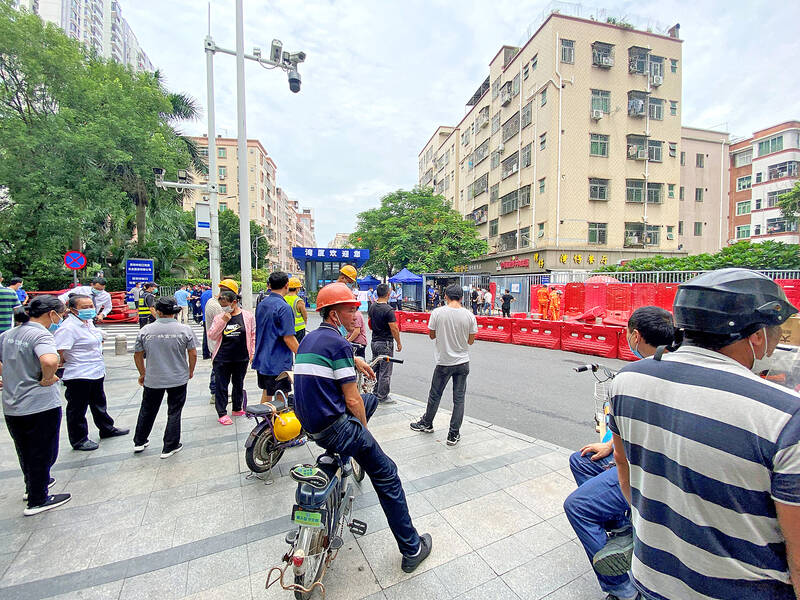
Photo: Reuters
Bureau senior statistician Zhao Qinghe (趙清河) said in a statement that the data showed “the recovery of manufacturing production and demand still needs to be strengthened,” although he added that there was an uptick in activity in agricultural product processing and food producers ahead of the Mid-Autumn Festival on Sept. 10.
China’s manufacturing PMI has been in contraction territory for five out of the past six months, in the wake of a disruptive months-long lockdown in Shanghai and COVID-19-related restrictions elsewhere.
Officials show few signs of relaxing strict pandemic curbs, with the southern tech hub of Shenzhen sealing off the world’s largest electronics market this week despite just dozens of daily cases in the city of more than 18 million, while Guangzhou yesterday imposed COVID-19 curbs in parts of the city, even though the city of nearly 19 million reported just five locally transmitted infections for Tuesday.
Capital Economics said that 41 cities, responsible for 32 percent of China’s GDP, are in the midst of outbreaks — the highest number since April.
“For now, the resulting disruption appears modest, but the threat of damaging lockdowns is growing,” Capital Economics senior China economist Julian Evans-Pritchard said. “And even if they are avoided, we expect growth to remain subdued going forward.”
Zhao said that while larger businesses saw an expansion in activity last month, small and medium-sized enterprises reported contractions, dragging the overall PMI down.
“China’s economic weakness is increasingly becoming demand-driven,” Australia & New Zealand Banking Group Ltd chief economist for Greater China Raymond Yeung (楊宇霆) said. “Consumption and investment sentiment among households and enterprises are weak, increasing the risk of a deflationary spiral.”
China’s nonmanufacturing PMI came in at 52.6 points last month, down from 53.8 in July, bureau data showed.
Zhao said that the accommodation, food and beverage, and telecommunications industries saw “sustained rapid growth” in the month.
Yeung said that weak expansion in the service sector “bodes ill for China’s overall growth outlook.”
He said authorities were likely to continue their tough COVID-19 approach in the lead-up to a key political meeting next month — the 20th Chinese Communist Party Congress.
Additional reporting by Reuters
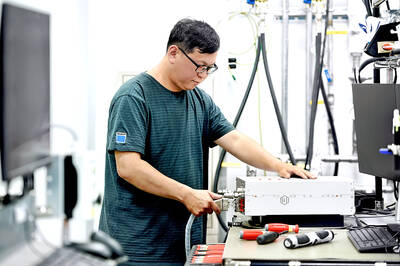
SEMICONDUCTORS: The German laser and plasma generator company will expand its local services as its specialized offerings support Taiwan’s semiconductor industries Trumpf SE + Co KG, a global leader in supplying laser technology and plasma generators used in chip production, is expanding its investments in Taiwan in an effort to deeply integrate into the global semiconductor supply chain in the pursuit of growth. The company, headquartered in Ditzingen, Germany, has invested significantly in a newly inaugurated regional technical center for plasma generators in Taoyuan, its latest expansion in Taiwan after being engaged in various industries for more than 25 years. The center, the first of its kind Trumpf built outside Germany, aims to serve customers from Taiwan, Japan, Southeast Asia and South Korea,

POWERING UP: PSUs for AI servers made up about 50% of Delta’s total server PSU revenue during the first three quarters of last year, the company said Power supply and electronic components maker Delta Electronics Inc (台達電) reported record-high revenue of NT$161.61 billion (US$5.11 billion) for last quarter and said it remains positive about this quarter. Last quarter’s figure was up 7.6 percent from the previous quarter and 41.51 percent higher than a year earlier, and largely in line with Yuanta Securities Investment Consulting Co’s (元大投顧) forecast of NT$160 billion. Delta’s annual revenue last year rose 31.76 percent year-on-year to NT$554.89 billion, also a record high for the company. Its strong performance reflected continued demand for high-performance power solutions and advanced liquid-cooling products used in artificial intelligence (AI) data centers,

Gasoline and diesel prices at domestic fuel stations are to fall NT$0.2 per liter this week, down for a second consecutive week, CPC Corp, Taiwan (台灣中油) and Formosa Petrochemical Corp (台塑石化) announced yesterday. Effective today, gasoline prices at CPC and Formosa stations are to drop to NT$26.4, NT$27.9 and NT$29.9 per liter for 92, 95 and 98-octane unleaded gasoline respectively, the companies said in separate statements. The price of premium diesel is to fall to NT$24.8 per liter at CPC stations and NT$24.6 at Formosa pumps, they said. The price adjustments came even as international crude oil prices rose last week, as traders

SIZE MATTERS: TSMC started phasing out 8-inch wafer production last year, while Samsung is more aggressively retiring 8-inch capacity, TrendForce said Chipmakers are expected to raise prices of 8-inch wafers by up to 20 percent this year on concern over supply constraints as major contract chipmakers Taiwan Semiconductor Manufacturing Co (TSMC, 台積電) and Samsung Electronics Co gradually retire less advanced wafer capacity, TrendForce Corp (集邦科技) said yesterday. It is the first significant across-the-board price hike since a global semiconductor correction in 2023, the Taipei-based market researcher said in a report. Global 8-inch wafer capacity slid 0.3 percent year-on-year last year, although 8-inch wafer prices still hovered at relatively stable levels throughout the year, TrendForce said. The downward trend is expected to continue this year,


 RSS
RSS