


Few outside of India had heard of Gautam Adani just a few years ago. Now the Indian businessman, a college dropout who first tried his luck as a diamond trader before turning to coal, has become the world’s third-richest person.
It is the first time an Asian person has broken into the top three of the Bloomberg Billionaires Index — fellow citizen Mukesh Ambani and China’s Jack Ma (馬雲) never made it that far.
With a US$137.4 billion fortune, Adani has overtaken France’s Bernard Arnault and now trails just Elon Musk and Jeff Bezos of the US in the ranking.
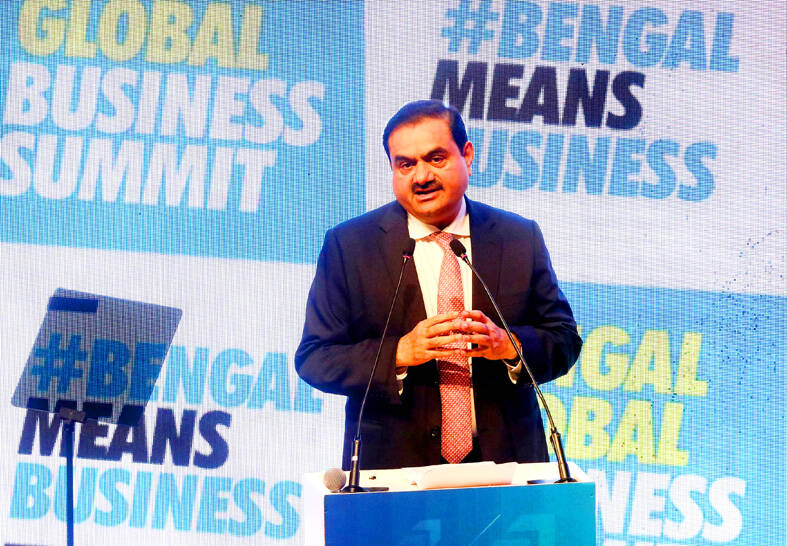
Adani, 60, has spent the past few years expanding his coal-to-ports conglomerate, venturing into everything from data centers to cement, media and alumina. The group now owns India’s largest private-sector port and airport operator, city-gas distributor and coal miner.
While its Carmichael mine in Australia has been criticized by environmentalists, it pledged in November last year to invest US$70 billion in green energy to become the world’s largest renewable-energy producer.
As his empire has expanded to one of the world’s largest conglomerates fueling the remarkable wealth gains, concerns have grown over the rapid growth.
Adani’s deals spree has been predominantly funded with debt and his empire is “deeply overleveraged,” CreditSights said in a report this month.
Some lawmakers and market watchers have also raised concerns over opaque shareholder structures and a lack of analyst coverage at Adani Group companies. Yet the shares have soared — some of them more than 1,000 percent since 2020, with valuations hitting 750 times earnings — as the tycoon focused on areas that Indian Prime Minister Narendra Modi deems crucial to meeting the nation’s long-term goals.
The pivot to green energy and infrastructure has won investments from firms including Warburg Pincus and TotalEnergies SE, helping Adani enter the echelons previously dominated by US tech moguls.
The surge in coal in recent months has further turbocharged his ascent.
All told, Adani has added US$60.9 billion to his fortune this year alone, five times more than anyone else. He first overtook Ambani as the richest Asian in February, became a centibillionaire in April and surpassed Microsoft Corp’s Bill Gates as the world’s fourth-richest person last month.
Adani was able to move past some of the world’s richest US billionaires partly because they have recently boosted their philanthropy.
Gates last month said he was transferring US$20 billion to the Bill & Melinda Gates Foundation, while Warren Buffett has already donated more than US$35 billion to the charity.
The two, along with Gates’ ex-wife Melinda French Gates, started the Giving Pledge initiative in 2010, vowing to give away most of their fortunes in their lifetimes. The billions of dollars spent on philanthropy have pushed them lower on the Bloomberg wealth ranking. Gates is now fifth and Buffett is sixth.
Adani, too, has increased his charitable giving. He pledged in June to donate US$7.7 billion for social causes to mark his 60th birthday.

Taiwanese firms have increased investment in the Philippines in recent years as Manila’s ties with Washington deepen and global supply chains continue to shift away from China, an expert at the Chung-Hua Institution for Economic Research (CIER, 中華經濟研究院) said yesterday. The Philippines had not been among Taiwanese investors’ top choices in Southeast Asia, CIER Taiwan ASEAN Studies Center director Kristy Hsu (徐遵慈) said at a seminar in Taipei. However, Taiwan’s investment in the country has grown significantly since the COVID-19 pandemic, reaching US $257 million last year, a high in recent years, she said. Although Taiwan’s total investment in the Philippines still lags
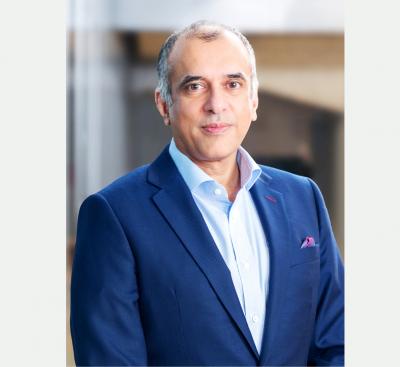
HSBC Holdings PLC is deepening its commitment to Taiwan as the economy emerges as one of the bank’s fastest-growing markets globally, driven by an artificial intelligence (AI) investment boom, expanding cross-border trade, and rising wealth creation. “The advantage that Taiwan has is a growth story linked to the semiconductor and broader AI industries, strong underlying corporate performance, and wealth creation,” said Surendra Rosha, HSBC’s co-chief executive for Asia and the Middle East, in an exclusive interview with the Taipei Times on June 2, during this year’s HSBC Taiwan Conference. That combination has helped HSBC cement its position as the most profitable international

Intel Corp regards Taiwan Semiconductor Manufacturing Co (TSMC, 台積電) as a longstanding partner, as the US chipmaker would continue outsourcing production of advanced chips to TSMC, Intel chief executive officer Lip-Bu Tan (陳立武) said yesterday. “I don’t look at people as competitors. I look at the collaboration... Nvidia is also, you know, a good friend,” Tan told a news conference following his keynote speech at the Computex trade show in Taipei. “It’s a very trusted partnership for us... We are a big, top customer for them, and we’re going to continue doing that,” he said, referring to TSMC, the world’s largest foundry
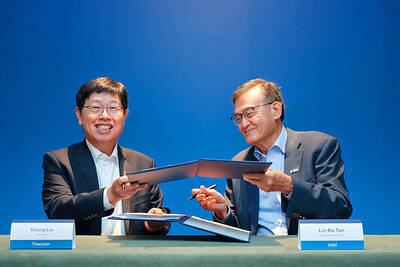
Hon Hai Precision Industry Co (鴻海精密) yesterday said it would work with US chipmaker Intel Corp to jointly develop and deploy next-generation artificial intelligence (AI) infrastructure and intelligent computing platforms in a move to capture booming demand for AI computing systems. Hon Hai, also known as Foxconn Technology Group (富士康), said in a statement that the partnership would combine its global manufacturing scale, system integration expertise and AI data center deployment capabilities with Intel’s strengths in processor architecture, silicon technologies and software ecosystem. The companies said they plan to work on equipment used in AI data centers, including server racks powered by


 RSS
RSS