


Academia Sinica yesterday called on the central bank to adjust its longstanding policy of keeping interest rates low and local currency exchange rates weak, which has contributed to national economic stagnation and excessive liquidity.
The Taipei-based research body made the appeal at a news conference after releasing recommendations on how the monetary policymaker can enhance stabilization of Taiwan’s currency market and banking institutions.
“Taiwan’s economic and financial development shows stagnation and suggests significant need for reform,” the report said.
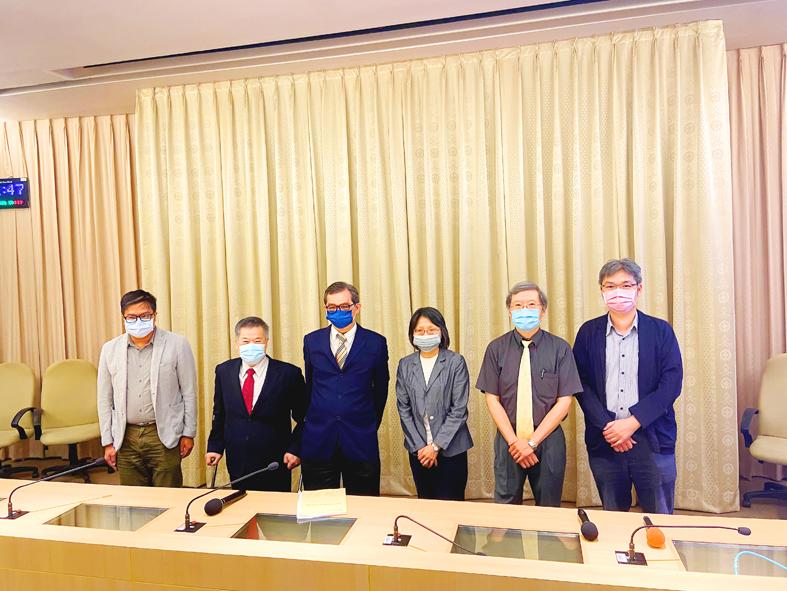
Photo: Huang Tzu-hsun, Taipei Times
The central bank in the past year has met its goal of stabilizing the local currency and financial system, but has ignored enhancing liquidity and the economy, it said.
The central bank has favored policies focusing on low interest rates and a weak New Taiwan dollar, which has been responsible for excessive liquidity, property price hikes, stagnant wages and weak banking institutions, it said.
Low capital utilization hinders the development of the financial industry, which leads to slow industrial transformation, soft economic growth and stagnant wages, it added.
The bank’s policy stance also misses opportunities for wealth creation through better use of foreign exchange reserves, the report said.
The central bank should be more transparent in its interventions in the foreign exchange market, and lend support to the creation of a sovereign wealth fund using foreign exchange reserves, it said.
The monetary policymaker should also cease profiting from the currency market, leaving currency profit activities to wealth management experts, as is the case in other countries, the report said.
The central bank should follow the US Federal Reserve in offering forward-looking guidance on inflation and interest rates to help people and corporations prepare for their impacts, it said.
“The government should rethink the status of the central bank and not treat it like a state-run enterprise,” said Li Yi-ting (李怡庭), an academician at Academia Sinica and a member of the central bank’s policy board.
“This would reduce pressure to supplement the national treasury from its operational earnings. It would require collaboration on fiscal, governmental and legislative levels to increase the central bank’s independence,” she said.
Academia Sinica’s non-binding recommendations carry weight with the government given the institution’s influence, and the report marks the first time it has weighed in so publicly on central bank reform.
The central bank issued a response later in the day, saying it has guided its policy decisions in line with the nation’s needs, which differ from those in large economies.
A stable local currency is better for a small and open economy such as Taiwan’s, whereas other economies have different needs, the bank said.
The bank denied that a lack of independence in its operations or the need to profit from the currency market, saying that supply and demand decides the value of the New Taiwan dollar.
The bank said it is not against the creation of a sovereign wealth fund, but there should be a legal foundation first and then the government can plan its budget and funding sources.
Additional reporting by Bloomberg

Taiwanese firms have increased investment in the Philippines in recent years as Manila’s ties with Washington deepen and global supply chains continue to shift away from China, an expert at the Chung-Hua Institution for Economic Research (CIER, 中華經濟研究院) said yesterday. The Philippines had not been among Taiwanese investors’ top choices in Southeast Asia, CIER Taiwan ASEAN Studies Center director Kristy Hsu (徐遵慈) said at a seminar in Taipei. However, Taiwan’s investment in the country has grown significantly since the COVID-19 pandemic, reaching US $257 million last year, a high in recent years, she said. Although Taiwan’s total investment in the Philippines still lags

Intel Corp regards Taiwan Semiconductor Manufacturing Co (TSMC, 台積電) as a longstanding partner, as the US chipmaker would continue outsourcing production of advanced chips to TSMC, Intel chief executive officer Lip-Bu Tan (陳立武) said yesterday. “I don’t look at people as competitors. I look at the collaboration... Nvidia is also, you know, a good friend,” Tan told a news conference following his keynote speech at the Computex trade show in Taipei. “It’s a very trusted partnership for us... We are a big, top customer for them, and we’re going to continue doing that,” he said, referring to TSMC, the world’s largest foundry

Hon Hai Precision Industry Co (鴻海精密) yesterday said it would work with US chipmaker Intel Corp to jointly develop and deploy next-generation artificial intelligence (AI) infrastructure and intelligent computing platforms in a move to capture booming demand for AI computing systems. Hon Hai, also known as Foxconn Technology Group (富士康), said in a statement that the partnership would combine its global manufacturing scale, system integration expertise and AI data center deployment capabilities with Intel’s strengths in processor architecture, silicon technologies and software ecosystem. The companies said they plan to work on equipment used in AI data centers, including server racks powered by

Artificial intelligence (AI) agents would supplant smartphones as the center of people’s digital lives, fundamentally reshaping personal devices and driving a major computing upgrade cycle, Qualcomm Inc CEO Cristiano Amon said yesterday. In his keynote speech for this year’s Computex trade show in Taipei, Amon said that the rise of "agentic AI" — AI systems capable of reasoning, planning and carrying out tasks autonomously — would transform how people interact with technology across phones, PCs, vehicles and wearable devices. Describing the technology as the next major evolution in computing, Amon said that "2026 is the year of agents.” For decades, smartphones have sat


 RSS
RSS