


The Ministry of Finance on Friday welcomed any opportunity to negotiate an income tax agreement with the US involving the reduction of double taxation.
However, the ministry said negotiations would not commence until both sides shared “similar ideas” on the matter.
The ministry’s remarks came one week after two US senators presented a draft resolution urging the administration of US President Joe Biden to begin negotiating such an accord with Taiwan.
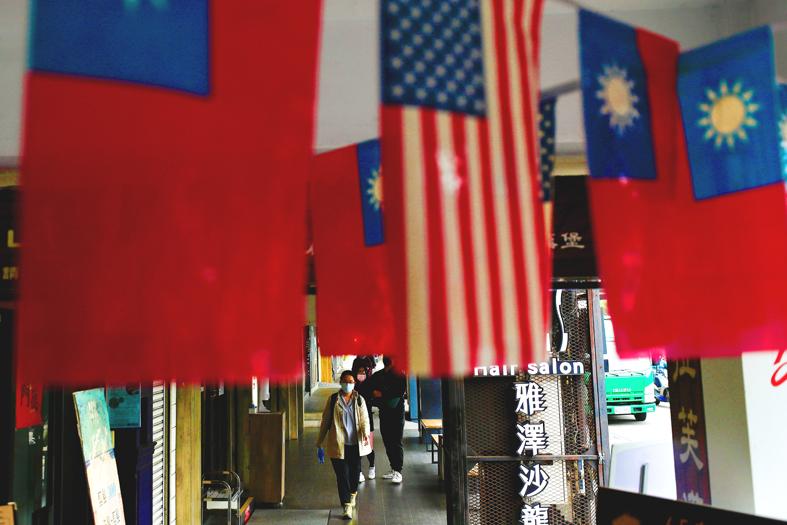
Photo: Ritchie B. Tongo, EPA-EFE
According to the proposed resolution, an income tax agreement between Taiwan and the US “could boost bilateral trade and investment by reducing double taxation, and increasing economic efficiency and integration.”
A ministry official said that Taiwan and the US previously signed taxation-related deals, including a transportation income tax agreement in 1988.
However, the two countries have not entered into a comprehensive reciprocal tax treaty that includes the reduction or elimination of double taxation on individuals and businesses with operations in each other’s countries, the official said, speaking on condition of anonymity.
Taiwan has income tax agreements with 34 countries, including Canada, France, India, Japan and Canada.
On July 21, US senators Chris Van Hollen and Ben Sasse introduced a resolution in the US Congress, urging the Biden administration to begin negotiating an income tax agreement with Taiwan.
“For decades, Taiwan has been a key economic partner of the United States. Yet, right now Taiwanese and US businesses are double-taxed due to the lack of a formal joint tax agreement,” Van Hollen said in a news statement on July 22.
“It’s common sense we’d negotiate a tax agreement that can benefit both US and Taiwanese companies doing business in each other’s country,” Sasse said.

The domestic unit of the Chinese-owned, Dutch-headquartered chipmaker Nexperia BV will soon be able to produce semiconductors locally within China, according to two company sources. Nexperia is at the center of a global tug-of-war over critical semiconductor technology, with a Dutch court in February ordering a probe into alleged mismanagement at the company. The geopolitical tussle has disrupted supply chains, with some carmakers reportedly forced to cut production due to chip shortages. Local production would allow Nexperia’s domestic arm, Nexperia Semiconductors (China) Ltd (安世半導體中國), to bypass restrictions in place since October on the supply of silicon wafers — etched with tiny components to

Singapore-based ride-hailing and delivery giant Grab Holdings Ltd has applied for regulatory approval to acquire the Taiwan operations of Germany-based Delivery Hero SE's Foodpanda in a deal valued at about US$600 million. Grab submitted the filing to the Fair Trade Commission on Friday last week, with the transaction subject to regulatory review and approval, the company said in a statement yesterday. Its independent governance structure would help foster a healthy and competitive market in Taiwan if the deal is approved, Grab said. Grab, which is listed on the NASDAQ, said in the filing that US-based Uber Technologies Inc holds about 13 percent of

Taiwan Semiconductor Manufacturing Co (TSMC, 台積電) yesterday received government approval to deploy its advanced 3-nanometer (3nm) process at its second fab currently under construction in Japan, the Ministry of Economic Affairs said in a news release. The ministry green-lit the plan for the facility in Kumamoto, which is scheduled to start installing equipment and come online in 2028 with a monthly production capacity of 15,000 12-inch wafers, the ministry said. The Department of Investment Review in June 2024 authorized a US$5.26 billion investment for the facility, slated to manufacture 6- to 12nm chips, significantly less advanced than 3nm process. At a meeting with

Taiwan’s food delivery market could undergo a major shift if Singapore-based Grab Holdings Ltd completes its planned acquisition of Delivery Hero SE’s Foodpanda business in Taiwan, industry experts said. Grab on Monday last week announced it would acquire Foodpanda’s Taiwan operations for US$600 million. The deal is expected to be finalized in the second half of this year, with Grab aiming to complete user migration to its platform by the first half of next year. A duopoly between Uber Eats and Foodpanda dominates Taiwan’s delivery market, a structure that has remained intact since the Fair Trade Commission (FTC) blocked Uber Technologies Inc’s


 RSS
RSS