


Charles McCormick is the CEO of City Bikes Inc, a couple of bike shops in Washington, one in Adams Morgan and one in Tenleytown, both of which do a healthy trade in e-bikes. He is also a digital nomad who has spent most of his time since 2009 on the road.
“You are sitting in front of your computer to get your administration done,” he says. “So why not do it somewhere nice.”
McCormick’s desire to be “somewhere nice” has driven him to ride his motorbike across Europe, South America, Africa and Central Asia (“it’s a progressive tour that is ongoing”), and involved him in some hair-raising moments, including being expelled from Mali during the 2011 coup. He has now decided to swap his motorcycle for a camper van re-engineered to accommodate e-bikes.
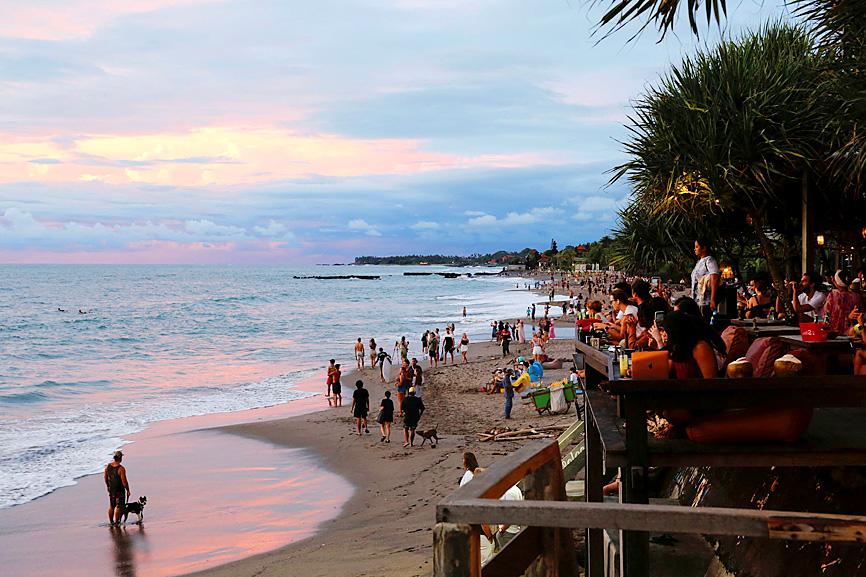
Photo: Reuters
The grizzled veteran notes three phases in the nomad movement. The housing crash in 2007-2008 forced some people to abandon their houses for the itinerant life. The idea of “going untethered” caught fire with younger people in 2015-2017. Then the COVID-19 pandemic took the nomad life mainstream, demonstrating that regular people can work from anywhere.
However, one force has been constant: the relentless improvement in enabling technology.
When McCormick first started on his odyssey, he wasted a lot of time looking for a signal; today, thanks to satellite Internet services such as SpaceX’s Starlink and Internet telephone systems such as Google Fi, life on the road is a lot easier.
Working-from-home is so well-established that it has its own acronym, WFH, and, presumably, its own syndrome.
However, what happens if you cannot abide the idea of even two days a week in the office?
Nobody knows how many digital nomads there are — the oft-repeated claim of 35 million owes more to evangelism than sober accounting — but a new breed of people is undoubtedly emerging and exploiting modern technology in ways that defy our most basic assumptions about the relationship between work and physical place.
The most conservative members of the new nomadic tribe are digital executives who want to combine high-level jobs with soaking up the sun. Many of them own their own businesses and so can decide where they want to be. Others have “gone plural” — they sit on several boards or offer advice to multiple companies and so can work over Zoom.
The most popular option for digital executives is to buy a permanent place in the sun and live there for several months a year.
Ever sensitive to movements in the luxury property market, Savills PLC has recently constructed an executive nomad index based on climate, connectivity — both physical and virtual — and general quality of life. The top five destinations are Lisbon, Miami, Dubai, the Algarve (also in Portugal), and Barbados.
Another method is the “workation” of “bleisure” break. Some executives have taken to extending business trips to include some leisure; some return to work virtually while staying on in their holiday resorts; still others work full-time on vacation while their families frolic. Elite resorts are responding to this blurring of boundaries between work and leisure by providing on-call IT support, improving their conference facilities, installing Zoom rooms and throwing in massages.
Digital nomads proper contain lots of different tribes, from road warriors like McCormack to migratory birds who like to spend half the year in warmer places. “Crypto bros” want to build communities outside the jurisdiction of the state; hippies want to do much the same thing, but with lots of tofu and yoga thrown in; trust-fund nomads pretend to work while spending daddy’s money; Californians want to cash in on the state’s exorbitant house prices or escape from its onerous taxes; and some middle-class refugees from rich countries can only afford to live the same comfortable lifestyle as their parents if they move to emerging markets.
Zach Boyette is an acute observer of the nomad scene partly because he is a nomad himself and partly because he recruits the employees of his company, Galactic Fed, from the nomadic community, which he regards as a deep and expanding pool of talent.
He says that the average digital nomad is in their early 30s — the mean age is perhaps 33 — rather than backpackers in their early 20s. It takes a certain level of discipline and experience to preserve the lifestyle, and most people who think that they can go on the road after college, and make a living in a cloud of marijuana smoke and beer belches are soon disappointed.
He also points to an emerging paradox: the growth of permanent digital nomad communities in Asia, and eastern and southern Europe.
Companies are cropping up to take the lifestyle mainstream: Remote Year puts professionals together into groups to live, work and travel together, organizing everything from coworking spaces to white-water rafting expeditions; Outpost rents out temporary living-working spaces in Indonesia and Sri Lanka. There are nomad-specific insurance schemes, how-to Web sites galore, and coworkspace arrangements that will unlock office doors from Madrid to Kuala Lumpur.
Still, serious problems persist. The world is still built around nation-states, particularly for tax and welfare. Too many nomads think they can get away with “forgetting” to file their taxes while relying on local hospitals if they break their leg.
Visa rules in one of the most popular destinations, Indonesia, are still unclear. Particularly at the level of local officials and police, even countries that claim to be nomad-friendly can harbor significant hostility to Westerners.
Working while traveling can mean that you do not do either properly: When nomads arrive in a new place, all too many are more interested in catching a Wi-Fi signal than contemplating the scenery. As for the beach, it is impossible to imagine a worse place to work: Sand gets everywhere, the sun prevents you from being able to see your screen and, if you are unlucky, the sea destroys your laptop.
Digital nomads can flame out, fall sick or get into trouble. Those who start out working for big companies can find themselves downgraded to part-time contractors and then freelancers, making it ever harder to earn enough money to live on.
Ukraine was a popular destination for nomads before Russian President Vladimir Putin invaded. Now another popular destination, Sri Lanka, is going through agonies of its own.
McCormick says that the lifestyle is “not for everyone.”
Boyette says that it is likely to combine phases of life — a spell in your 30s then perhaps another spell when you are approaching retirement — rather than a permanent state of affairs.
The popularity of the nomadic lifestyle raises problems of its own. What is the difference between a digital nomad and a digital expat? Digital nomads can bring rising prices and cultural imperialism in their wake. Bali’s Seminyak district feels more and more like California, with its Starbucks and Mexican restaurants, than an authentic part of Indonesia, sparking local resentment that sometimes flames into theft or violence.
Can companies really operate if their workers are completely detached from their headquarters?
Boyette says that Galactic Fed devotes an enormous amount of effort to “on-boarding” its employees and keeping them engaged.
However, for most companies managing employees on the other side of the world might prove a challenge too far. If they can indeed cope with the challenge, why not dispense with all those expensive Westerners and simply outsource jobs to educated Thais and Indonesians who will do the same work for one-10th of the pay?
Knowledge workers have gained a lot of freedom thanks to the remote-working revolution. That deserves to be celebrated, but going one step further and untethering ourselves completely from the mothership might prove to be too good to be true.
Adrian Wooldridge is the global business columnist for Bloomberg Opinion. A former writer at The Economist, he is author, most recently, of The Aristocracy of Talent: How Meritocracy Made the Modern World.
This column does not necessarily reflect the opinion of the editorial board or Bloomberg LP and its owners.

DAMAGE REPORT: Global central banks are assessing war-driven inflation risks as the law of unintended consequences careens around the world, spiking oil prices Central banks from Washington to London and from Jakarta to Taipei are about to make their first assessments of economic damage after more than two weeks of conflict between the US and Iran. Decisions this week encompassing every member of the G7 and eight of the world’s 10 most-traded currency jurisdictions are likely to confirm to investors that the specter of a new inflation shock is already worrying enough to prompt heightened caution. The US Federal Reserve is widely expected to do exactly what everyone anticipated weeks ahead of its March 17-18 policy gathering: hold rates steady. The narrative surrounding that

Taiwan Semiconductor Manufacturing Co’s (TSMC, 台積電) share of the global foundry market rose to almost 70 percent last year amid booming demand for artificial intelligence (AI), market information advisory firm TrendForce Corp (集邦科技) said on Thursday. The contract chipmaker posted US$122.54 billion in revenue, up 36.1 percent from a year earlier, accounting for 69.9 percent of the global market, TrendForce said. Its share was up from 64.4 percent in 2024, it said. TSMC’s closest rival, Samsung Electronics, was a distant second, posting US$12.63 billion in sales, down 3.9 percent from a year earlier, for a 7.2 percent share of the global market. In the

At a massive shipyard in North Vancouver, Canadian workers grind metal beams for a powerful new icebreaker crucial to cementing the country’s presence in the increasingly contested arctic. Icebreakers are specialized, expensive vessels able to navigate in the frozen far north. And “this is the crown jewel,” said Eddie Schehr, vice president of production at the Seaspan shipyard. For Canadian Prime Minister Mark Carney, who heads to Norway next Friday to observe arctic defense drills involving troops from 14 NATO states, Canada’s extreme north has emerged as a strategic priority. “Canada is and forever will be an Arctic nation,” he said ahead of

Chinese entrepreneur Frank Gao used to spend long hours running his social media accounts but now outsources the chore to artificial intelligence (AI) agent tool OpenClaw, which is taking China by storm despite official warnings over cybersecurity. OpenClaw, created in November by an Austrian coder, differs from bots such as ChatGPT because it can execute real-life tasks such as sending e-mails, organizing files or even booking flight tickets. “Since January, I’ve spent hours on the lobster every day,” Gao said in an interview, referring to OpenClaw’s red crustacean mascot. “We’re family.” After downloading OpenClaw, users connect it to artificial intelligence models of their


 RSS
RSS