


Tesla Inc reported solid quarterly earnings on Wednesday despite a hit from Shanghai’s COVID-19 lockdowns, which CEO Elon Musk said prompted the company to liquidate most of its bitcoin holdings.
Musk, who has generated headlines over his controversial withdrawal from a US$44 billion acquisition of Twitter Inc, said the company has navigated a tricky environment with the Shanghai closure and lingering supply chain problems that have raised costs.
The electric vehicle maker reported second-quarter profits of US$2.3 billion, about twice the same period last year, as the automaker lifted its prices to “embarrassing” levels, as Musk put it.
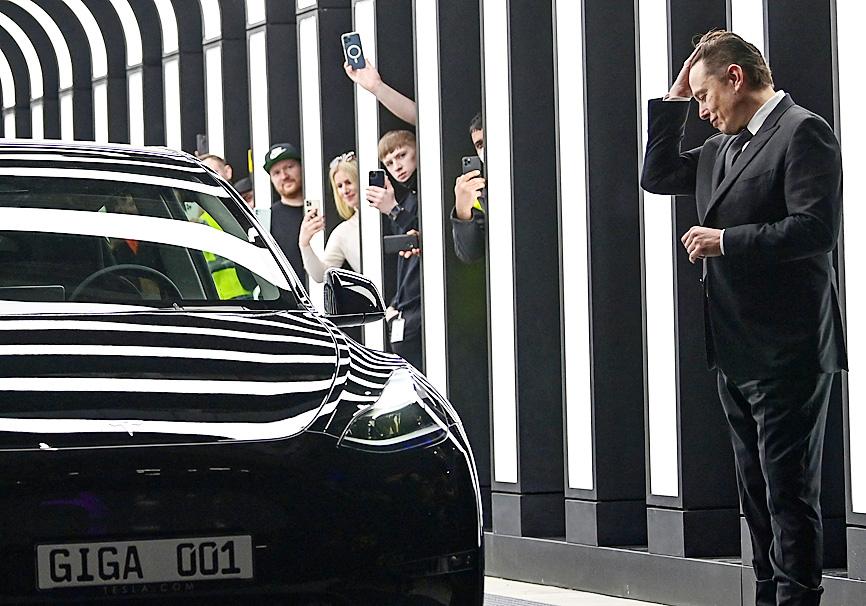
Photo: Reuters
Although Tesla’s profits topped estimates, they lagged behind first-quarter results, the first sequential profit drop since late 2020, which coincided with a fall in automotive profit margins due to rising costs.
While revenues jumped 42 percent to US$16.9 billion, they came in below the US$17.1 billion projected by analysts.
Musk described the period as a “unique quarter,” but told investors and analysts on a conference call that the restart of the Shanghai plant and the ramp-up of new factories in Germany and Texas create “the potential for a record-breaking second half of the year.”
The company cited the drag from Shanghai, where its factory was shuttered for part of the quarter, but Tesla said it finished the three-month period with “a record monthly production level” after the China restart.
Tesla said supply chain challenges remain an ongoing headache, as factory shutdowns, labor shortages, logistics and other issues “limited our ability to consistently run our factories at full capacity.”
During the quarter, Tesla liquidated about 75 percent of its holdings in bitcoin, the value of which declined sharply this year.
The moves on bitcoin resulted in one-time costs of US$106 million, Tesla chief financial officer Zachary Kirkhorn said.
Musk attributed the move to the need to raise cash because of the uncertainty of when Shanghai operations would return.
The sale “should not be taken as some verdict on bitcoin,” Musk said at the outset of the call.
However, the cryptocurrency is a “side show to the side show” compared with the goal of accelerating the transition to green energy, Musk said, adding that the scorching heat now plaguing many countries underscores the need for change.
Torrid demand for Musk’s electric vehicles has allowed Tesla to pass on higher prices to consumers. In the US, Tesla’s cheapest vehicle, the Model 3, starts at nearly US$50,000.
“We’ve raised our prices quite a few times. They’re frankly at embarrassing levels,” Musk said. “We’ve also had a lot of supply chain and production shocks, and we’ve got crazy inflation.”
“This is not a promise or anything, but I’m hopeful that at some point we can reduce the prices a little bit,” he said.
Many Tesla watchers are bullish on the second half of this year in light of the company’s growing production profile.
The second quarter was “especially impressive” given the headwinds of the Shanghai closure and the costs of upping production at new plants, CFRA Research analyst Garrett Nelson said.
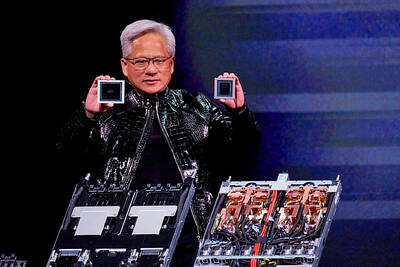
Nvidia Corp chief executive officer Jensen Huang (黃仁勳) on Monday introduced the company’s latest supercomputer platform, featuring six new chips made by Taiwan Semiconductor Manufacturing Co (TSMC, 台積電), saying that it is now “in full production.” “If Vera Rubin is going to be in time for this year, it must be in production by now, and so, today I can tell you that Vera Rubin is in full production,” Huang said during his keynote speech at CES in Las Vegas. The rollout of six concurrent chips for Vera Rubin — the company’s next-generation artificial intelligence (AI) computing platform — marks a strategic
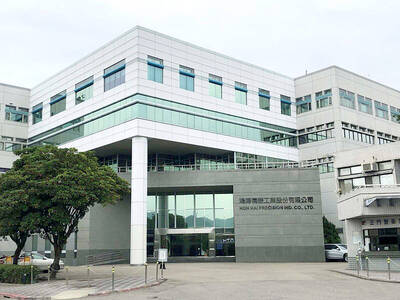
REVENUE PERFORMANCE: Cloud and network products, and electronic components saw strong increases, while smart consumer electronics and computing products fell Hon Hai Precision Industry Co (鴻海精密) yesterday posted 26.51 percent quarterly growth in revenue for last quarter to NT$2.6 trillion (US$82.44 billion), the strongest on record for the period and above expectations, but the company forecast a slight revenue dip this quarter due to seasonal factors. On an annual basis, revenue last quarter grew 22.07 percent, the company said. Analysts on average estimated about NT$2.4 trillion increase. Hon Hai, which assembles servers for Nvidia Corp and iPhones for Apple Inc, is expanding its capacity in the US, adding artificial intelligence (AI) server production in Wisconsin and Texas, where it operates established campuses. This
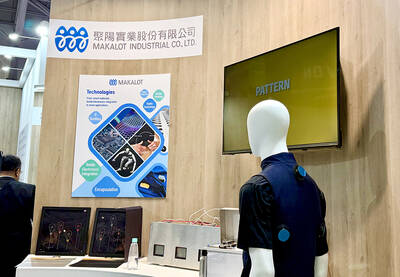
Garment maker Makalot Industrial Co (聚陽) yesterday reported lower-than-expected fourth-quarter revenue of NT$7.93 billion (US$251.44 million), down 9.48 percent from NT$8.76 billion a year earlier. On a quarterly basis, revenue fell 10.83 percent from NT$8.89 billion, company data showed. The figure was also lower than market expectations of NT$8.05 billion, according to data compiled by Yuanta Securities Investment and Consulting Co (元大投顧), which had projected NT$8.22 billion. Makalot’s revenue this quarter would likely increase by a mid-teens percentage as the industry is entering its high season, Yuanta said. Overall, Makalot’s revenue last year totaled NT$34.43 billion, down 3.08 percent from its record NT$35.52
PRECEDENTED TIMES: In news that surely does not shock, AI and tech exports drove a banner for exports last year as Taiwan’s economic growth experienced a flood tide Taiwan’s exports delivered a blockbuster finish to last year with last month’s shipments rising at the second-highest pace on record as demand for artificial intelligence (AI) hardware and advanced computing remained strong, the Ministry of Finance said yesterday. Exports surged 43.4 percent from a year earlier to US$62.48 billion last month, extending growth to 26 consecutive months. Imports climbed 14.9 percent to US$43.04 billion, the second-highest monthly level historically, resulting in a trade surplus of US$19.43 billion — more than double that of the year before. Department of Statistics Director-General Beatrice Tsai (蔡美娜) described the performance as “surprisingly outstanding,” forecasting export growth


 RSS
RSS