


Starbucks Corp has asked its adviser, Houlihan Lokey, to assess interest for its UK operations, the Times reported on Saturday.
The coffee chain has not initiated a formal sale process, but continues to “evaluate strategic options” for its international operations, the newspaper said.
The UK is Starbucks’ largest market of all in Europe, the Middle East and Africa.
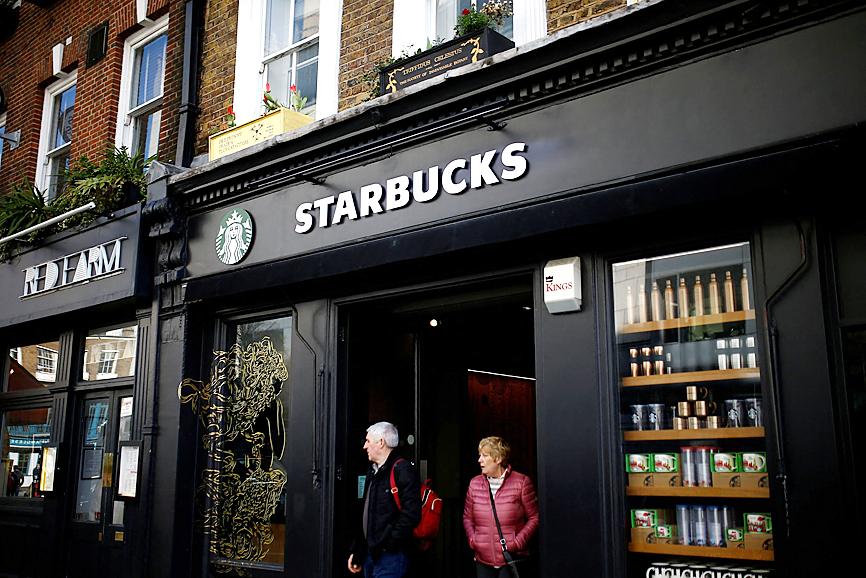
Photo: Reuters
As of last year, it had 1,000 stores in the UK, with 297 company-owned and 703 run by licensees, Starbucks said in a financial report for the fiscal year ending in October last year.
Total revenue was £328 million (US$388.83 million) for the fiscal year, and Starbucks UK Coffee had repaid in full a £25 million loan from its parent company to offset losses from reduced sales during the first months of the COVID-19 pandemic, it said.
While the coffee chain experienced a rebound in revenue after pandemic-related lockdowns eased in the UK, it said the financial performance of company-owned stores had not recovered to pre-pandemic levels.
Starbucks opened 14 new stores during the last fiscal year and closed five, it said.
Coffee chains in the UK might need four years to recover from the COVID-19 slump, market researcher Allegra Group said earlier this year.
Separately, Amazon.com Inc said it would this year create more than 4,000 new permanent jobs in the UK, the smallest number it has announced in at least three years, despite planning to open two more fulfillment centers in the north of England.
The new roles are to span corporate, technology and delivery positions, some of which are to be based at warehouses opening in Wakefield and Knowsley later this year, the Seattle-based firm said in a statement on Friday.
It marks a deceleration in Amazon’s publicized recruitment efforts in the UK. In 2020, it said it would create 7,000 new local positions; a year later, it announced the addition of 10,000 more.
A spokesman for the company said that last year it exceeded that figure by more than double.
However, Amazon in April told investors that pandemic-fueled hiring and warehouse-building was taking a toll, as e-commerce sales growth inevitably slowed from the torrid pace of the COVID-19 outbreak. Fuel and labor costs were already biting, and soaring inflation has only continued since.
Still, the company said that by the end of the year it would have 75,000 permanent employees in the UK, making it one of the nation’s largest private-sector employers.

SECOND-RATE: Models distilled from US products do not perform the same as the original and undo measures that ensure the systems are neutral, the US’ cable said The US Department of State has ordered a global push to bring attention to what it said are widespread efforts by Chinese companies, including artificial intelligence (AI) start-up DeepSeek (深度求索), to steal intellectual property from US AI labs, according to a diplomatic cable. The cable, dated Friday and sent to diplomatic and consular posts around the world, instructs diplomatic staff to speak to their foreign counterparts about “concerns over adversaries’ extraction and distillation of US AI models.” Distillation is the process of training smaller AI models using output from larger, more expensive ones to lower the costs of training a powerful new

Micron Technology Inc is a driving force pushing the US Congress to pass legislation that would put new export restrictions on equipment its Chinese competitors use to make their chips, according to people familiar with the matter. A US House of Representatives panel yesterday was to vote on the “MATCH Act,” a bill designed to close gaps in restrictions on chipmaking equipment. It would also pressure foreign companies that sell equipment to Chinese chipmaking facilities to align with export curbs on US companies like Lam Research Corp and Applied Materials Inc. The bill targets facilities operated by China’s ChangXin Memory Technologies Inc

Singapore-based ride-hailing and delivery giant Grab Holdings’ planned acquisition of Foodpanda’s Taiwan operations has yet to enter the formal review stage, as regulators await supplementary documents, the Fair Trade Commission (FTC) said yesterday. Acting FTC Chairman Chen Chih-min (陳志民) told the legislature’s Economics Committee that although Grab submitted its application on March 27, the case has not been officially accepted because required materials remain incomplete. Once the filing is finalized, the FTC would launch a formal probe into the deal, focusing on issues such as cross-shareholding and potential restrictions on market competition, Chen told lawmakers. Grab last month announced that it would acquire

The artificial intelligence (AI) boom has triggered a seismic reshuffling of global equity markets, with Taiwan and South Korea muscling past European nations one by one. With its stock market now valued at nearly US$4.3 trillion, Taiwan surpassed the UK, Europe’s biggest market, earlier this month, data compiled by Bloomberg showed. South Korea is about US$140 billion away from doing the same. The tech-heavy Asian markets have shot past Germany and France in the past seven months. The shift is largely down to massive gains in shares of three companies that provide essential hardware for AI: Taiwan Semiconductor Manufacturing Co (TSMC, 台積電),


 RSS
RSS