


Grilled on skewers, dried or used in hair oil: Farmers in Bafoussam in western Cameroon are seeking to take the lowly mushroom, grown on agricultural waste, beyond the kitchen.
Fungiculture, or the cultivation of edible mushrooms, is long-developed in the West, while China has become by far the world’s largest producer.
However, it remains rare in Africa, despite the advantages of being almost free and supplying “clean” food by recycling waste.
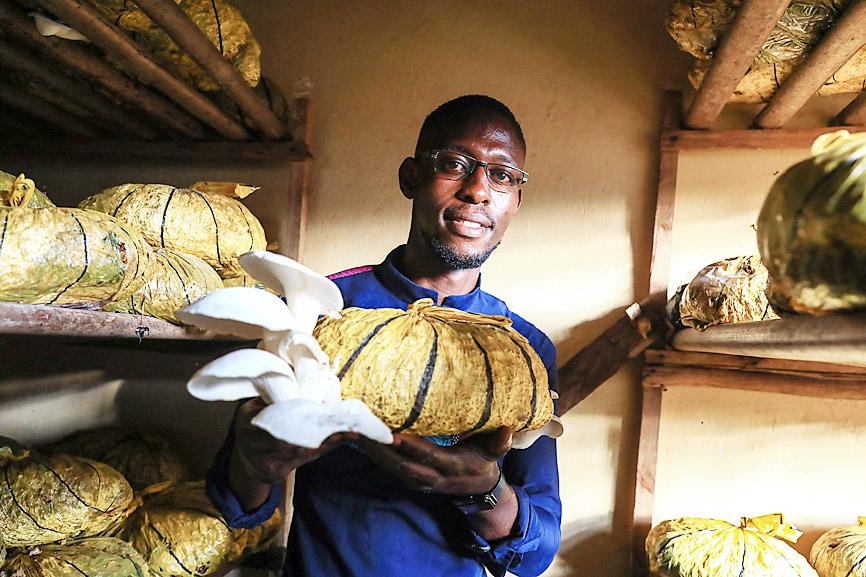
Photo: AFP
Cameroonians are particularly fond of mushrooms, but have to wait for the rainy season to identify and gather the edible fungi in the wilds of the west-central African country.
In Bafoussam, capital of the Western region and fifth-largest city, Jean-Claude Youbi saw an opportunity to exploit, like other small farmers across the nation of 28 million inhabitants.
Youbi grows thousands of oyster mushrooms in a darkened room of the Common Initiatives Group — GIC Champignon — which he launched with associates in Maetur, a district of Bafoussam, four years ago.
MUSHROOM HOUSE
“We are in the mushroom house of our GIC,” Youbi says proudly amid the rows on rows of fungi growing on shelves on agricultural waste packaged in plastic bags.
“Some, like these, have passed the harvest period,” says one of his associates, Patrick Yaptieu, pushing aside a pile of mushrooms which have turned from the desired white color to a yellowish hue.
He then puts the good harvest of the day in bags headed for the GIC shop, near the city center.
A kilogram of oyster mushrooms sells in Bafoussam for 2,000 CFA francs (US$3.11), while it costs up to 3,500 CFA in Yaounde, the capital, or Douala, the main port and economic capital.
The lack of official national data on the production and consumption of mushrooms makes it hard to gain an idea of the market value and extent of the sector.
Activity in the GIC Champignon premises is punctuated by constant comings and goings, while two young trainees in a little side room are shoveling a pile of agricultural residue.
To obtain the soil-free culture, “we mixed corn cobs with nutrients such as bran flour, wheat and ox blood,” production manager Brice Nono Djomo says.
“We added a fungicide to it to avoid the bad mushrooms,” he says, adding that the effects of this precautionary treatment fade away after two weeks, well before the good crop grows.
Once the substrate mixture is ready, it is sterilized, placed in barrels and heated over a wood fire, then cooled down and placed in the plastic bags. Once the spores are introduced, the bags are placed in the mushroom house, where it takes 30 days to see the first stems appear.
“I was amazed to discover this way of cultivating mushrooms,” says Junior Leogip, a boy of 12 who is devoting his school holidays to do an internship at GIC Champignon.
“I learned to prepare the substrate... I want to know everything,” Leogip adds, his heart set on winning a place in an agricultural college after his baccalaureate.
‘MY OWN PRODUCTION’
“My ambition is to launch my own production and be independent,” says Lea Tona, another trainee who comes from Yaounde.
Every three months, the time it takes for a full growth cycle, the business in Bafoussam produces from 300kg to 400kg of mushrooms, 80 percent of which are sold directly to customers to be eaten.
The remainder is transformed into body and hair oils, soap, juice and even a liqueur that Youbi presents as “mushroom whiskey.”
In a small laboratory at the GIC, Youbi grinds part of the harvest in a blender to obtain a juice that would be combined with other elements for the range of by-products.
“For beauty oils, we can add snail slime and a perfume to give a pleasant smell,” he says, guarding his secrets close to his chest. “We’re in a promotional phase. For the hair oil, we give boxes to some hairstylists to experiment with.”
“It softens the hair and makes it grow back, it treats dandruff, breakage,” Josiane Sogo says in her hairdressing salon.
Some people prefer simply to taste the fungi.
“I am a very big consumer of mushrooms, especially for their virtues. It is a vegetable meat that helps me steer clear of several risks,” Barthelemy Tchoumtchoua says, adding that his skewer is rich in protein and vitamins B2, B3, B5 and D.
Thanks to fungiculture, “we can eat them all year round,” he adds.
In Italy’s storied gold-making hubs, jewelers are reworking their designs to trim gold content as they race to blunt the effect of record prices and appeal to shoppers watching their budgets. Gold prices hit a record high on Thursday, surging near US$5,600 an ounce, more than double a year ago as geopolitical concerns and jitters over trade pushed investors toward the safe-haven asset. The rally is putting undue pressure on small artisans as they face mounting demands from customers, including international brands, to produce cheaper items, from signature pieces to wedding rings, according to interviews with four independent jewelers in Italy’s main

Macronix International Co (旺宏), the world’s biggest NOR flash memory supplier, yesterday said it would spend NT$22 billion (US$699.1 million) on capacity expansion this year to increase its production of mid-to-low-density memory chips as the world’s major memorychip suppliers are phasing out the market. The company said its planned capital expenditures are about 11 times higher than the NT$1.8 billion it spent on new facilities and equipment last year. A majority of this year’s outlay would be allocated to step up capacity of multi-level cell (MLC) NAND flash memory chips, which are used in embedded multimedia cards (eMMC), a managed

Japanese Prime Minister Sanae Takaichi has talked up the benefits of a weaker yen in a campaign speech, adopting a tone at odds with her finance ministry, which has refused to rule out any options to counter excessive foreign exchange volatility. Takaichi later softened her stance, saying she did not have a preference for the yen’s direction. “People say the weak yen is bad right now, but for export industries, it’s a major opportunity,” Takaichi said on Saturday at a rally for Liberal Democratic Party candidate Daishiro Yamagiwa in Kanagawa Prefecture ahead of a snap election on Sunday. “Whether it’s selling food or

In the wake of strong global demand for AI applications, Taiwan’s export-oriented economy accelerated with the composite index of economic indicators flashing the first “red” light in December for one year, indicating the economy is in booming mode, the National Development Council (NDC) said yesterday. Moreover, the index of leading indicators, which gauges the potential state of the economy over the next six months, also moved higher in December amid growing optimism over the outlook, the NDC said. In December, the index of economic indicators rose one point from a month earlier to 38, at the lower end of the “red” light.


 RSS
RSS