


China’s factory output and retail sales remained weak last month, official data showed yesterday, with tepid demand and lingering COVID-19 restrictions putting a damper on growth in the world’s second-largest economy.
The government is persisting with a “zero COVID” strategy to stamp out clusters as they emerge, but this has placed companies and consumers at the mercy of snap, economically damaging lockdowns.
The American Chamber of Commerce (AmCham) yesterday said that Shanghai’s lengthy COVID-19 lockdown pushed one-quarter of US firms in the city to cut investment plans and nearly all to drop revenue forecasts.
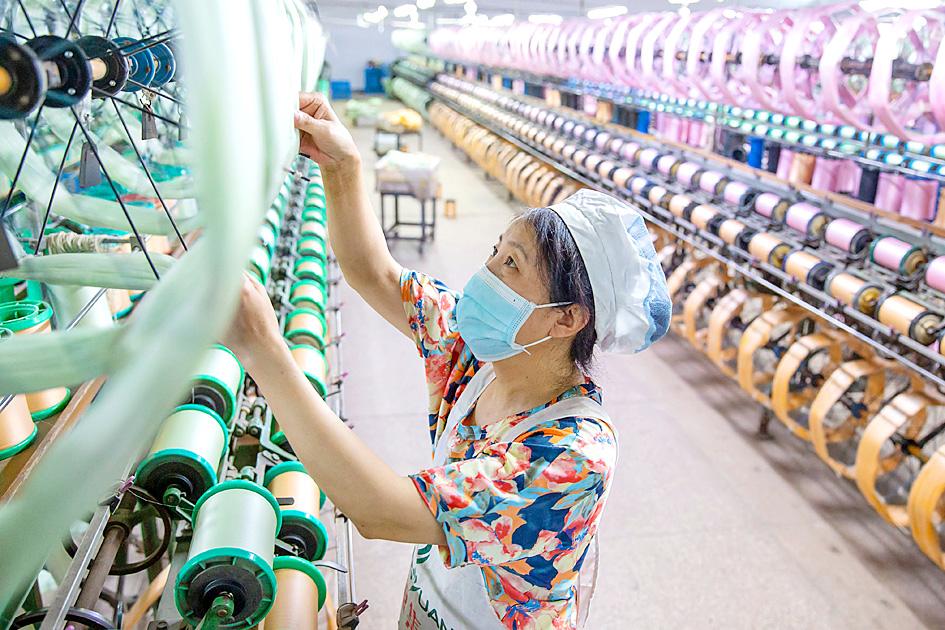
Photo: AFP
Retail sales sank 6.7 percent year-on-year, the Chinese National Bureau of Statistics said, although that was an improvement from April’s 11.1 percent drop.
The figure was also slightly better than forecasts from analysts polled by Bloomberg.
“In May, our economy gradually overcame the adverse impact of the pandemic,” National Bureau of Statistics spokesman Fu Linghui (傅令輝) told reporters. “But we also have to see that the international environment has become more complex and severe, and the domestic economic recovery still faces many difficulties and challenges.”
It was the third consecutive month of contraction in retail sales, suggesting that nervous consumers are tightening their purse strings with the persistent threat of COVID-19 lockdowns.
However, industrial production was up 0.7 percent after falling 2.9 percent in April, while the urban unemployment rate ticked down to 5.9 percent.
Shanghai, China’s most populous city, this month started emerging from a grueling two-month lockdown, providing a boost to economic sentiment.
Tommy Wu (胡東安), lead China economist at Oxford Economics, speculated that the “worst of lockdowns is probably behind us.”
However, he added that it will be “difficult for household consumption to recover strongly” as long as China’s “zero COVID” strategy remains in place.
Concerns are mounting over the trend in unemployment, as millions of students graduate in the summer, Pinpoint Asset Management Ltd (保銀私募基金管理) chief economist Zhang Zhiwei (張智威) said.
Unemployment among rural migrant workers remained elevated, while home sales in the first five months dropped 34.5 percent, data showed.
Observers remain cautious about the government’s reluctance to transition away from the “zero COVID” strategy, despite fine-tuning.
More than 90 percent of US companies in the metropolis surveyed by AmCham Shanghai have cut their revenue projections for the year, the group said in a report yesterday.
The survey of 133 companies also found that one-quarter were expecting revenue to be more than 20 percent lower than projected.
Nearly 25 percent of companies surveyed have cut investment plans, AmCham Shanghai said.
AmCham said that about one-quarter of manufacturers surveyed were speeding the localization of their China supply chains, while moving production of global goods out of the country.
As of early this month, only 35 percent of the manufacturers polled were operating at full capacity and close to three-quarters of all firms surveyed had yet to enjoy economic support measures since Shanghai’s lockdown.
AmCham Shanghai president Eric Zheng (鄭藝) said the lockdown’s impact on businesses has been “profound.”
“The Shanghai government must act quickly to ensure unhindered supply chains, logistics and worker mobility, and to accelerate the provision of financial support to businesses,” Zheng said.
This week, analysts at Fitch Ratings downgraded China’s growth predictions for the year to 3.7 percent based on the “cautious pace at which pandemic-related restrictions have been eased.”
That would be far below China’s target of about 5.5 percent full-year growth.

The domestic unit of the Chinese-owned, Dutch-headquartered chipmaker Nexperia BV will soon be able to produce semiconductors locally within China, according to two company sources. Nexperia is at the center of a global tug-of-war over critical semiconductor technology, with a Dutch court in February ordering a probe into alleged mismanagement at the company. The geopolitical tussle has disrupted supply chains, with some carmakers reportedly forced to cut production due to chip shortages. Local production would allow Nexperia’s domestic arm, Nexperia Semiconductors (China) Ltd (安世半導體中國), to bypass restrictions in place since October on the supply of silicon wafers — etched with tiny components to

Singapore-based ride-hailing and delivery giant Grab Holdings Ltd has applied for regulatory approval to acquire the Taiwan operations of Germany-based Delivery Hero SE's Foodpanda in a deal valued at about US$600 million. Grab submitted the filing to the Fair Trade Commission on Friday last week, with the transaction subject to regulatory review and approval, the company said in a statement yesterday. Its independent governance structure would help foster a healthy and competitive market in Taiwan if the deal is approved, Grab said. Grab, which is listed on the NASDAQ, said in the filing that US-based Uber Technologies Inc holds about 13 percent of

Taiwan Semiconductor Manufacturing Co (TSMC, 台積電) yesterday received government approval to deploy its advanced 3-nanometer (3nm) process at its second fab currently under construction in Japan, the Ministry of Economic Affairs said in a news release. The ministry green-lit the plan for the facility in Kumamoto, which is scheduled to start installing equipment and come online in 2028 with a monthly production capacity of 15,000 12-inch wafers, the ministry said. The Department of Investment Review in June 2024 authorized a US$5.26 billion investment for the facility, slated to manufacture 6- to 12nm chips, significantly less advanced than 3nm process. At a meeting with

Taiwan’s food delivery market could undergo a major shift if Singapore-based Grab Holdings Ltd completes its planned acquisition of Delivery Hero SE’s Foodpanda business in Taiwan, industry experts said. Grab on Monday last week announced it would acquire Foodpanda’s Taiwan operations for US$600 million. The deal is expected to be finalized in the second half of this year, with Grab aiming to complete user migration to its platform by the first half of next year. A duopoly between Uber Eats and Foodpanda dominates Taiwan’s delivery market, a structure that has remained intact since the Fair Trade Commission (FTC) blocked Uber Technologies Inc’s


 RSS
RSS