


Taiwan’s major developers remain positive about their business prospects this year, even though an ongoing COVID-19 outbreak and unfavorable policy measures are dampening buying interest.
Continental Development Corp (CDC, 大陸建設), the property development arm of Continental Holdings Corp (欣陸投控), on Wednesday said that it is planning to go ahead with development projects and land hunting, as it is seeking to support earnings in the next few years.
“The ongoing virus outbreak will be another temporary damper on the housing market,” CDC chief executive officer Liao Tsung-sen (廖淳森) told a news conference in Taipei.
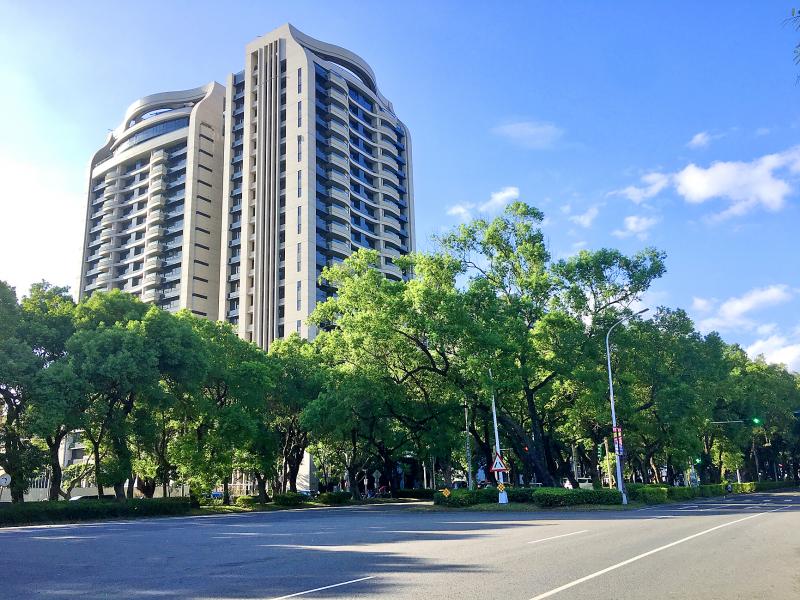
Photo: Hsu Yi-ping, Taipei Times
However, the situation would improve once the COVID-19 situation stabilizes, Liao added.
CDC would this year launch presale projects totaling NT$21 billion (US$714.58 million) and begin offering newly completed housing projects in central locations of Taipei and Taichung, Liao said, adding that the firm is seeking to expand in Taoyuan, Kaohsiung and other markets.
Unfavorable factors such as interest rate hikes and economic uncertainty would not trigger real-estate price corrections, even though investors might have to wait longer to realize gains, he said, citing soaring building material and labor costs.
Huang Hsiang Construction Corp (皇翔建設) said it would continue to thrive on the back of real demand and urban renewal projects.
While building companies generally feel the pinch of inflation, the Taipei-based firm said it is less susceptible because it can hire migrant workers to construct its urban renewal projects.
Urban renewal projects are also not subject to selective credit controls, giving the company more flexibility for financial planning, it said.
Projects available for sale in Taipei, New Taipei City and Taoyuan could generate NT$30 billion in revenue this year, Huang Hsiang said.
Huaku Development Co (華固建設) told its shareholders on Tuesday that the housing market could regain momentum next quarter, even though it is this quarter affected by the virus outbreak and tighter credit controls.
The central bank is expected to raise interest rates for the second time this year at its quarterly board meeting on June 16 to curb inflation.
A considerable number of prospective buyers have retreated to the sidelines, but remain keen to invest in relatively inflation-proof real estate, Huaku said.
Overall transactions might this year shrink slightly compared with last year, but housing prices would hold firm with an upside bias, it said.
Taichung-based Shining Building Business Co (鄉林建設) called on the central bank to pause interest rate increases and credit controls, saying that Taiwan’s economy has showed signs of slowing down and further credit tightening could hurt all sectors.

Singapore-based ride-hailing and delivery giant Grab Holdings Ltd has applied for regulatory approval to acquire the Taiwan operations of Germany-based Delivery Hero SE's Foodpanda in a deal valued at about US$600 million. Grab submitted the filing to the Fair Trade Commission on Friday last week, with the transaction subject to regulatory review and approval, the company said in a statement yesterday. Its independent governance structure would help foster a healthy and competitive market in Taiwan if the deal is approved, Grab said. Grab, which is listed on the NASDAQ, said in the filing that US-based Uber Technologies Inc holds about 13 percent of

The domestic unit of the Chinese-owned, Dutch-headquartered chipmaker Nexperia BV will soon be able to produce semiconductors locally within China, according to two company sources. Nexperia is at the center of a global tug-of-war over critical semiconductor technology, with a Dutch court in February ordering a probe into alleged mismanagement at the company. The geopolitical tussle has disrupted supply chains, with some carmakers reportedly forced to cut production due to chip shortages. Local production would allow Nexperia’s domestic arm, Nexperia Semiconductors (China) Ltd (安世半導體中國), to bypass restrictions in place since October on the supply of silicon wafers — etched with tiny components to

Taiwan Semiconductor Manufacturing Co (TSMC, 台積電) yesterday received government approval to deploy its advanced 3-nanometer (3nm) process at its second fab currently under construction in Japan, the Ministry of Economic Affairs said in a news release. The ministry green-lit the plan for the facility in Kumamoto, which is scheduled to start installing equipment and come online in 2028 with a monthly production capacity of 15,000 12-inch wafers, the ministry said. The Department of Investment Review in June 2024 authorized a US$5.26 billion investment for the facility, slated to manufacture 6- to 12nm chips, significantly less advanced than 3nm process. At a meeting with

Taiwan’s food delivery market could undergo a major shift if Singapore-based Grab Holdings Ltd completes its planned acquisition of Delivery Hero SE’s Foodpanda business in Taiwan, industry experts said. Grab on Monday last week announced it would acquire Foodpanda’s Taiwan operations for US$600 million. The deal is expected to be finalized in the second half of this year, with Grab aiming to complete user migration to its platform by the first half of next year. A duopoly between Uber Eats and Foodpanda dominates Taiwan’s delivery market, a structure that has remained intact since the Fair Trade Commission (FTC) blocked Uber Technologies Inc’s


 RSS
RSS